Showing posts with label model-vs-model. Show all posts

Monday, August 3, 2026

Review: Pillage- Victrix


I was buying a lot of miniatures, so I figured I might as well pick-up this set of rules to go with them.  I all ready have a large Viking, Anglo-saxon, and Dark Age Irish army so I had more than enough miniatures for a dozen or so figure, model-vs-model skirmish game.  I also have cattle and loot markers.  Therefore, this one seemed like a low-cost investment for me to pick up! 

This would not be my first raid into the Viking Age.  I myself have a few rulesets related to Vikings; Fury of the Northman and Odin's Ravens.  Therefore, I know my way around a Viking based game.  I was curious what this brought that could be new to my table.  

This one has a very nice forward where the author is very clear that this game is about "forging the narrative".  I.e. the focus is on telling stories on the tabletop and revolves around scenarios and scenario play.  This is not intended to be a competitive, tournament ready ruleset.  

So, don your hauberk, heft your shield, and hoist your spear arm for now is the time to loot this rulebook of ideas!  

Things I Liked

This is a gorgeous looking book.  It has very high production values, great photos, great miniature pictures, and really nice terrain lay-outs.  This reminded me of what separated early GW books from the competition.  Rules are detailed with images and diagrams over laid on the photos.  This is a sumptuous looking book with great, hard cover, artwork.  Just really top-drawer production values all around. 

This book is pitched at beginner wargamers.  It is written like the reader is unfamiliar with the hobby of wargaming.  In addition it has a short history section, timeline, historical sidebars, etc.  There is also a Hobby section about collecting miniatures, making terrain, and painting.  There are some fun little tutorials about painting miniatures and making nice looking terrain.    Again, it reminds me of early GW rules as an introduction to wargaming.  I do not need this section, but I unironically LOVE this section.  

There are a few charge reactions a model can make when they are the target of a charge.  If you have a missile weapon you can shoot, you can run away, or you can stand and accept the charge.  Nothing super hard to do, but gives some options for melee early on.  

Armor is similarly simple with unarmored, some armor, and fully armored.  Of note, armor dictates how fast you can move as well.  That is a good idea, and everyone basically moves the same.    

This game is called Pillage, and there are several chapters on looting and another on setting things on fire.  That matches the theme of the game and ties into several scenarios.  Interesting, there is also rules for ship-to-ship combat!  Nice!


Things I Did Not Like

The game does not use frontage or combat arcs.  Weapons and line-of-sight is 360 degrees.  This reduces some of the tactical gameplay. There is some detail about shooting from windows or other constricted spaces, but that is a niche rather than the standard.   

Charging into combat is an extra 1d3 of movement leading to contact.  I am not a huge fan of random charging typically.  No real reason, but for such a critical action I like a bit more certainty in the action.  Melee is pretty quick and brutal by design but still is a bit of Melee Yahtzee coming down mostly to dice rolls based on a table with different weapons hitting better or worse based on armor type. Pretty basic.  Thankfully, the advanced weapon rules add some more nuance to the weapons and melee about supporting allies.  

There are 5 scenarios.  Nothing that you have not seen before.  The game explicitly recommends you to design and make your own scenarios.  However, I think the game could have provided a few more guidelines on alternate deployment zones, objectives, and perhaps some complications.  


Meh and Other Uncertainties

Of note, this game does not allow pre-measuring.  If you grab a tape measure, it is assumed that you are committed to the action.  I.e. you do not measure until you are all ready going to shoot at that target, move to that place, or charge that model, etc.  

Of note, this game only uses d6 to resolve all actions.  It uses simple modifiers and rules for rolling above a 6.    

It also uses WYSIWYG for simply determining who is armed with what.  

The game itself is for 4x4 tables or even 3x3 tables.  This makes it just a bit too large for a Kitchen Table game.  However, it is a good size for a convention or club game.     

The game turn is broken down into the usual of Initiative, Move, Shoot, Melee, and End.  This gives you all the basic 4Ms.  Of note, games use alternating Phases, so it is not IGOUGO but not alternate activation either.       

Army lists include Vikings, Anglo-saxons, Normans, Irish/Scots/Picts, Carolingian Franks, Bretons, Welsh, and Generic.   

Final Thoughts

This is a solid, well-produced product.  It is a basic wargame, but comes into its own with the Advanced Rules.  Here is where it shines allowing some period specific and unique activities to add some tactical depths.  However, it is still relatively straight forward and easy to teach.  That is its strength.  

This is not for Competitive play because there is a fair amount of randomness in the rules.  It is not intended for that.  It is intended for a beer-and-pretzels experience focusing on story-telling, social interactions, and narrative fun.  This is explicit in the foreword and in the rules themselves.

For a first rulebook product from Victrix, this is a slick product!  It is intentionally designed to get people into playing the period and folks that are new to wargaming.  I applaud this approach BUT I am not sure that it is a good strategy.  I think they are simply following the GW template of a rulebook, but I am not convinced that people get into Dark Age Wargaming cold by buying a rulebook.  However, I really do not know how people get into Historical Wargaming anymore.  

Anyway, a great introductory product but not a great wargame.  It is very serviceable but old hands to the period will find it wanting.  To veterans the big adds are the pillaging and ship-to-ship combat ideas.  

Until next time! 


Become a Patron and get access to all the cool stuff, a peak behind the curtain of Blood and Spectacles, and early-access to playtest games!  


You can follow Blood and Spectacles Facebook page or Instagram for more fun! 

Check out the latest publications and contact me at our Blood and Spectacles website

Or purchase all out games at the Blood and Spectacles Publishing Wargames Vault Page!                   

Monday, June 2, 2025

Wargame Design: Odin's Ravens: Viking Age Bad Boys


You know what really speeds up the wargame design process?  Two things: 

1. Having an existing set of rules to build off

2. Having the miniatures for photos in your collection

Both of those details can be the difference between finishing a game in 1-3 years, versus finishing in 5 years.  For me, post-production is the longest part.  That is where those two points really help out.  Post-production involves making sure the game works as intended and getting all the parts to publish together.  Those parts take the longest amount of time in the whole process.  

If you all ready have a set of rules to work off of, then you know the game mostly works.  It really speeds up the process if you don't have to test the 4Ms, just the chrome.  You probably recall the Play-testing process, well building off an existing game cuts the first couple layers of play-testing off.  

The second point is self-explanatory.  Most miniature wargamers have a pile of shame they are painting through.  Buying, building, and painting models takes times and money.  If you all ready have the models in your collection then you can go straight to the photography stage, that alone can save a year in the production pipeline!  

So, that brings us to today's game: 


Odin's Ravens is a model-vs-model skirmish game with a narrative campaign element added to it. As the sub-title implies the game is focused on Norse warbands with a Hero, a Second, and up to 8 other soldiers.  The game can be played as a straight historical game, or with mythological elements added into it.  

Like all my games, Odin's Ravens is scale and model agnostic.  I did this by using generic measurement units with no fixed scale.  This way it works with 15mm, 28mm, 54mm, or other scales.  All models are individually based because this is a model-vs-model game.  There is no fixed time or ground scale, as is my design preference.  The game can be played on just about any playing surface thanks to the adjustable size of an MU, but typically plays on a 36-48MU square.     

This game can be played as a Versus game, Solo, or Co-op.  There is a simple Narrative Campaign added so warbands can evolve and grow based on your Heroes Legend.  There is myth magic, mythological monsters you can fight, mythical gear to find, and several special solo/co-op only scenarios.  

Taking on a troll

The game is trying to answer the problem of Melee Yahtzee and how to add Tactical Gameplay to a melee heavy game.  In addition, it is trying to capture the idea of Heroes being heroic and special, but not game breakers.  These are all tough needles to thread.  So, how does this game do it?  

Here are a couple key features of gameplay to keep in mind: 

  1. It uses facing as a tactical component to gameplay
  2. Outnumbering plays a critical roll in combat
  3. Winning a combat can do more than just causing damage, sometimes causing damage is not the best option so you have to decide what to do
  4. Melee does not lock you, as there are several ways to escape melee
  5. Heroes have more dice and activations than soldiers    
In addition, there are about 6 Versus scenarios, and 6 different methods for deployment and 3 special Solo/Co-op scenarios.  This gives the game a lot of replayability with different tactical set-ups.  In addition, Heroes, Seconds, and Soldiers can also have a variety of set load-outs.  Each hero also has a special ability granted by his god to make him a worthy hero to follow.    

A hero and his loyal warband of followers

The astute observer will notice something right away.  This is not a new game!  It is a reskin of my popular Greek Mythology game; Homer's Heroes: Bronze Age Bad Boys.  The core gameplay is the same and uses the same core mechanics.  The Chrome has been modified to fit a Norse setting.  For example, chariots have been removed from the game.  Instead, I have replaced it with the chance to have a mounted soldier, Hero, or Second and updated the Mounted rules accordingly.  I have also changed some of the weapons and load-outs to better match Viking warfare compared to Greek Homeric combat.  

Most of the miniatures in the book came from my existing collection.  Thanks to my Viking Age rules Fury of the Northman; I have a decent sized selection of Vikings and Dark Age warriors to choose my Odin's Ravens from.  My monsters came from my rather larger selection of HeroQuest and Reaper models.  That made post-production on these rules a snap!  

When I started the year, this game was not even on my radar.  I had toyed around with some expansions of the Homer's Heroes concepts, but it wasn't until early this year when I started working on this particular version of the game.  Maybe I will expand the core game further into new periods and eras?  Got any suggestions?  

Final Thoughts

The first step to being a game designer is to create your game and get it out there for others.  From there, they get easier and easier.  The first one is the hardest because you are building it all from scratch.  Once you have the first, you have a set of templates to build your next one.  

To get more games to market, it is easiest if you: 

1. Build off of your existing designs

2. Use miniatures and art you all ready have in your collection

The more games you make, the easier it gets to make more of them!      

If you like Vikings, you like Skirmish games, or you like Homer's Heroes: Bronze Age Bad Boys then you will probably enjoy recreating the Norse epics and sagas with this game.  You can find Odin's Ravens now on Bloodandspectacles.com.  


Become a Patron and get access to all the cool stuff, a peak behind the curtain of Blood and Spectacles, and early-access to playtest games!  


You can follow Blood and Spectacles Facebook page or Instagram for more fun! 

Check out the latest publications and contact me at our Blood and Spectacles website

Or purchase all out games at the Blood and Spectacles Publishing Wargames Vault Page!    


Monday, January 27, 2025

Review: One-Hour Ancient and Medieval Skirmish Wargames- Pen and Sword


Well, the title tells you exactly what this is.  That is a bit of a lost art in today's modern world.  It is no surprise that seeing this made me interested in buying it.  There is not a lot of content out there for Ancient skirmish.  I can think of only a few titles, but it always seems to be an area of perpetual interest, but can never quite grab the market share.  Ancient players seem to want to play the "big battles" of history.  This is a true "Skirmish" game in that the operational unit is one model is one combatant.  I tend to call these Model-vs-Model games.  

The author, John Lambshead; also wrote One-Hour Skirmish Wargames a few years back that has been proven to be a popular ruleset.  That one is focused on gunpowder weapons from the Napoleonic to modern battles.  In the Introduction, Mr. Lambshead is kind enough to provide some "Designer's Notes" details about the differences between these rules and his previous work, and why he made some the decisions he did in the design.  I think the most interesting statement was:

"The key to improving any work is not what you put in but what you strip out"   

With that, I knew I was going to be in for a treat.  Indeed, the focus on the game is to keep the game moving quickly and swiftly.  In the Introduction, he wanted his game to accomplish three key objectives: 

  1. Excitement
  2. Streamlining
  3. Chaos
So, let's take a closer look and see if we can get the review done in less than an hour too! 

One of the rare Diagram's in the book

Things I Liked
The game uses a very clear and simple Unified Game Mechanic.  To determine the results of an action, both players flip the top card of their own deck of standard playing cards, and see who got a higher number.  The more cards a model can flip at once, the better there chance of winning.  There is also a Bridge based system of suits to break ties as needed.  When in doubt you flip a card and compare the results!  

Modifiers are based on the number of extra cards drawn for benefits, while drawbacks often force you to only be able to use 1 card in an opposed draw.  You only ever use the highest card drawn.  

If a Joker is revealed, all play instantly stops and the turn ends.  This leads immediately to the End Phase for the turn.  That is where shocked models have their injury determined, objectives are reviewed, and morale tested.  This means that length of a turn is variable.  

All Models have a 1 inch Zone of Control.  You can not have a model pass through it without intending to attack.  This makes maneuver and order of activation important, especially in dense terrain.  You can also carefully use ZoCs to block access in and out of key points.  This is a great way to add subtle tactics to a game with few rules.  Models who are "Shocked" i.e. failed when hit lose their ZoC and are unable to do anything but fight back in combat.    

This game uses Arcs!  A simple front or rear arc.  There are benefits for attacking models in the rear arc, and you can only shoot at stuff in your front arc!  More skirmish games need this simple approach as it adds a lot of tactical depth to a game, for very simple rules. 

Models that are hit by a missile or melee attack are shocked.  When shocked they lose their ZoC and can only draw 1 card.  In the End Phase, you determine if they are removed as a casualty or re-engage in the fight.  This represents morale and injury in one card flip.  


Things I Do Not Like
When a player begins their Phase of a Turn, they flip a card over.  Th result is the number of Action Points they have in their Phase.  A single model can move up to 3 times for escalating Points costs.  They can then also shoot or fight.  A model can only shoot after moving, so no moving and scooting, which I think is a bit of a missed trick; but in play-testing it must have made shooting too powerful in a melee based Ancients game.  I am also not a huge fan of Action Point systems like the one listed above due to tracking and prefer 1 activation = 1 Action systems as it forces more tactical decision making.  In practice, this system makes this an alternate activation system, with some pile-on abilities.  

There are no pictures of models on the table.  I am not a fan of this for a couple reasons: 
  • Wargames are inherently about spectacle and visual appeal, otherwise we would use paper counters and 2D terrain. 
  • Gives new players an idea of what a "normal" game should look like
  • Provides aspiration to newer players to wargaming of the genre
  • Generates excitement to recreate what you see in the rulebook
  • There is a lot of work in getting good pictures, and if I do it; everyone should! <Stamps foot petulantly>
Of note, Zones of Control will lock models into combat.  I am generally not a fan of this approach as it reduces maneuver and tactical movement within a game.  However, there are some exceptions such as chariots/cavalry can move away from infantry freely.  Elephants can move away from anyone, except other elephants.  Again, more subtle rules to influence your tactics. 
 
There are a few If This/Than That rules hidden in the game in the appropriate section.  Generally, I am not a fan of those as they can easily get lost.  I don't think any are game breaking, but an example is determining if you are charging into the REAR arc of an enemy before any movement is done.  Therefore, no using multiple actions to run around a model and attack from the rear.  Having this special rule maybe an example of how the multiple movement rules may not be the best final iteration of the rules? 

There is no mention about pre-measuring or not in this game.  The way it is written, I am not sure of what the author's intent would be.  There are clear nods to subtle tactics where Pre-measuring would be useful, but those same nods lead me to believe the author may want clever players to be able to use maneuver to get around some of those tactics or non-measured mistakes?  Not sure either way really, so you as the player get to decide! 

I think there may have been a missed trick to use card flips to accomplish non-combat related tasks like move through terrain, perform non-combat actions, etc.  Basically, an unopposed check to do certain tasks like help a comrade, cross difficult terrain freely, etc. at the cost of Action Points.  This would have expanded the scope of the game and added more RPG-Lite elements.  

The game has 6 scenarios listed in the back.  This includes: 
  • Mountain Assault
  • Punishment Raid
  • On The Rhine
  • The Adventures of Robin Hood
  • Longbow
  • High Medieval Tournament
These all are for a specific set of forces, place, and time.  They are not generic and are intended to give a flavor of what a "skirmish" may look like at various times and places.  This is one of the few sections of the book with diagrams to show you force deployments and board lay-outs. 
 

Meh and Other Uncertainties

Mr. Lambshead deliberately reduces the effectiveness of range-weapons to focus on up-close and personal combat.  I did something similar in my Roman and Greek based games, but the opposite in my Chariot based games.  That is one of the down-sides of a "generic" ruleset like this covering such a vast period.  Thankfully, he encourages tweaks to better fit any specific period or type of game you want to play.  

The terrain rules are basic and easy to use.  Very much of the broad categories type designed to not get in the way of quick game play.  They are reminiscent of Daniel Mersey games, like Lion Rampant. 

War Machines and Elephants have slightly more complicated special rules that relate to how they are injured and what happens.  For example, Elephants can go wild, can trample, etc.  

Each warband has a "Motivation" that is used in the End Phase for morale checks.  These can vary based on the scenario.   In addition, a model with the Leader trait can do a great job by doubling or tripling the results of a card flip for Morale.  However, their loss can be a big problem too.  They also cover some command units like standard bearers, religious figures, musicians, etc. 

There are some optional rules about Light Infantry, special results on certain cards, and the like added in after the core rules.  There are even some suggestions to speed up gameplay!  That made me think of some skit I saw where I guy was pitching 8-minute abs, and the other person said, "But what if someone comes out with 7 minute abs!"  

There is a lot of discussion about creating warbands from a variety of time periods.  It is important to note that these are all suggestions.  Mr. Lambshead breaks most groups down into Heavy infantry with armor and shields, medium infantry with shields, and light infantry that are mostly unarmored.  Therefore, something like a Greek Peltast would be Medium, Roman Legionnaires would be Heavy, and an Egyptian Archer would be Light.  Cavalry are similarly divided into Heavy, Battle, and Light using similar breakdowns.  This includes lists of generic values and 20 sample lists to give you an idea of how it all works.  The author is very clear that this is intended to be a tool box approach.   

In the introduction, Mr. Lambshead recommends between 6-12 units; which in this case is models per side.  The more complicated the special rules the less models that should be used.  He does not really mention this in the scenario or Warband list section, so you will have to go back and look at the section in the Introduction to get an idea of game size.  He also does not recommend a board size, saying 3-4 feet in a square or rectangle in his intro.    

Finally, there are a couple of Appendixes that cover:
  1. QRS
  2. Mini Makers by scale


Final Thoughts
A pretty good little set of rules that has some tactical depth thanks to the Zones of Control, Facings, and simple Unifying Mechanic.  There is a bit of If This/Then That but when you are covering such a vast period as Bronze-Age to High Medieval that is bound to happen.  Since this uses a tool box approach, it gives you a solid, streamlined starting point to work from.  As the author alludes to, less is more in these rules.  I find the core of the rules and the optional rules to be solid.  

I think the biggest disappointment is some of the vagueness around Scenarios.  A handy generator of some basic, generic scenarios with some complications and the like would have been helpful for people new to the period, genre, or wargaming.  I was also somewhat disappointed by warband creation section, but it does what it needs to do for a quick game.  It is always a decision point to think about how "newbie friendly" a game needs to be.  However, I get the feeling that Mr. Lambshead's target audience are not new to wargaming or the periods per se, but those new to Skirmish gaming in the periods mentioned. 

Anyway, s good core set of rules for a fast game with more tactical depth that many other skirmish games I have read.... just what it says on the cover. 


Become a Patron and get access to all the cool stuff, a peak behind the curtain of Blood and Spectacles, and early-access to playtest games!  


You can follow Blood and Spectacles Facebook page or Instagram for more fun! 

Check out the latest publications and contact me at our Blood and Spectacles website

Or purchase all out games at the Blood and Spectacles Publishing Wargames Vault Page!                         


Monday, June 26, 2023

Battle Report: Restless Sun - Raid on Drill Rig Oscar 678-H


Restless Sun is my model vs model skirmish using the general rules of the "Restless" series of games.  They are designed so each each model is an individual combatant.  Therefore, results are determined on a model-by-model basis.  

Submarine insertions were exactly what they had been trained for.  Lt. Meyers watched with a diligent eye as his North Ammoriss Naval PDF Commandoes prepared.  Unlike most of the North Ammoriss PDF, his men weren't a bunch of conscripts.  They had been recruited and chosen from some of the best soldier in the PDF and were considered to be the best native troops on Ammoriss.  A raid on a drill rig from a submarine deployment was exactly the type of mission his troops had been trained for.

Taskforce: Thorn under Vice-Admiral Travers had done their job and mostly wiped the Ork forces from the sea lanes, and put in a over-the-horizon blockade of the Deff Islands.  However, despite the set back in the Approaches, they didn't know how to quit.  They counter-attacked with a series of air assaults that managed to re-take several of the Drill Rigs in the Approaches.  Using these stations as staging points they had successfully managed to harass the supply lines the Imperial forces were sending from North Ammoriss to the Warzone.  That put the entire campaign in jeopardy.  

It was up to Lt. Meyers, and similar troops across the Approaches to put an end to these staging points.  Their mission was to re-take the Drill Rig Oscar678-H.  It was a simple mission to sweep the target, kill any greenskin that gets in the way, and re-take the control room of the drill rig.  From there the commandoes could de-activate the power plant running the Ork defenses and allow follow-on troops to take the rig.  Simple, but not easy. 

Forces:

North Ammoriss Naval Commando    

Lt. Meyers - Trained Infantry
- Combat Weapons, Commander, Enhanced Senses

1 Specialist - Trained Infantry
-  Indirect Fire, Blast, Enhanced Senses

1 Specialist- Trained Infantry
- Squad Support Weapon, Blast, Enhanced Senses

5 Commandoes- Trained Infantry
- Enhanced Senses

Ork Mob

1 Nob- Regular Infantry
-- Combat Weapon, Fierce, Armored, Commander

4 Boyz-- Irregular Infantry
-- Fierce, Combat Weapons

2 Boyz- Irregular Infantry
-- Fierce, 

5 Grotz- Irregular Infantry      

Mission: 
We are using the Forced Entry scenario from the main rulebook.  The objective is a control room for the drill rig.  The Commandoes have 8 turns to get a single unshaken model into the control room for the Rig. 

As a complication, this battle is taking place at night.  However, the North Ammoriss Naval Commandoes came prepared with some Enhanced Senses.  They are immune to the darkness, but the Orks are not.  

Set-up: 
This battle is being played  out on a 36x36 MU board to represent the drill rig's main command platform. 1MU with equal 1 inch.   The terrain is being placed by the defender, but the attacker gets to choose the board edge to deploy from.  Therefore, it is in the defenders best interest to make it work.  Once the terrain and sides are picked, the objective is placed and the terrain adjusted as needed.  

The Orks are placed within 6 MU of their board edge.  The Commandoes are placed anywhere, but must be at least 12 MU away from any defender. 


You can see the Orks using their Gretchin to pushback the attackers by deploying as far away from the objective as they can.  They are then using the Combat oriented Boyz and Nob as a reserve force behind the objective.  Meanwhile, the Imperial Attackers seem like they are stacking up to go down the center, with the Flamer leading the way, and the Grenade Launcher as support on the North edge of the board. 

For this battle, I won't be going over it turn-by-turn.  I have found this method to be too time consuming and difficult to play and record.  Instead, I will break it down into three sections; the Maneuvers, the Battle, and the End Game.  The Maneuver section is the opening parts of the battle, the Battle phase is when the main engagement is taking place, the End Game is the final key parts of the game.  I will wrap up the game with a conclusion and some thoughts on how the game went.  Let me know what you think of this approach.  I know it is easier on me!  :) 

Maneuver Phase:
The battle opens with a volley of aimed fire coming from the darkness and blasting the Gretchin in front of the main building in the head.  This catches the Orks off guard, and they mostly fail to respond to the attack!  Lt. Meyers makes for the objective in the confusion.

An Ork and a Gretchin round a corner and come face-to-face with a Commando, but they are all too stunned to act. The Ork Nob comes running out from his position bellowing orders, but aimed fire from Lt. Meyers sends him scurrying back into cover. 

The Orks are starting to shake off their surprise and respond.  However, their shooting and the Imperial shooting is largely ineffective this turn.  However, Lt. Meyers assaults and kills a Gretchin up-close and personal.  


Battle Phase:
We are entering Turn 4, and half-way to the end of the battle.  Lt. Meyers is attacked by a Choppa Boy, and barely manages to fend him off.  A nearby trooper than blasts into pushed back Ork and causes him to rout from the battle.  Lt. Meyers than assaults and Ork near the entrance to the control building, and forces him back with close range pistol fire and wildly swinging his chainsword.  This victory is short lived, as a slugga boy pops out from behind the bunker and the shooting forces Lt. Meyers back.  The Ork Nob gets himself in front of the control building.  


Lt. Meyers shakes off being shot at, just in time for the Ork Nob to charge into him swinging his choppa and shooting.  However, the impetuous charge causes the Ork to lodge his Choppa into some machinery, leaving him wide open for the Lt.  This forces the Ork back away from Lt. Meyers.  


A Commando gets the doorway to the Control Center amidst a hail of enemy shooting.  However, he stays in place and ready to go in next turn.  A precise shot from a commando kills another Gretchin. 


A Commando makes it into the control center, but an Ork boy chases him inside and kills him with a choppa swing.  Seeing his trooper go down, Lt. Meyers rushes in and finishes the Ork that killed his friend. Another nearby Ork rushes in, and the Lt. and the Ork come tumbling out in a rolling, spitting fight.  An Ork Shoota boy manages to gun down one of the flanking commandoes.  Finally, the Grenadier gets his gun going, and an indirect shot forces a Gretchin and an Ork Shoota boy into the drink with its blast wave.  


The Commandoes are down 2, and the Orks have lost 4 Gretchin, 2 Slugga boys, and a shoota boy.  

The End Game: 
The Ork Nob picks up a Choppa from a fallen boy, and rushes the shaken Lt. Meyers.  This time, his aim is true and the Commando officer is killed. The death of their leader stuns the Commandoes, and they seem unable to respond.  

A Flamer blast forces back the Ork Nob, and a trooper runs for the Control Room, however he is flying tackled by an Ork Slugga boy and the two bash each others brains out.  The Grenadier forces the Ork Nob off the side of the rig (Forced a retreat off the board edge) with a well placed grenade shot.  


With that, the automated defenses open fire in the approaching Imperial aircraft, and they are forced to abort from their attack runs.  The Commandoes failed to secure the objective in time. 


Conclusion: 
Orks win in a squeaker.  

The Imperials managed to get into the control room but they couldn't stay in it.  Then, after the death of Lt. Meyer, they had a tough time activating on their own.  This was late in the game, so that left that too far away to get there in the end.  Of course, the Orks only had an Ork and 2 Grots left to oppose them. 

Vice Admiral Travers saluted General Kurtz as the Cadian marched into the command center on Admiral Traver's flagship.  He and several aides marched crisply in behind him.  The off-worlder looked comfortable onboard ship, even though he was an Imperial Guardsmen.  General Kurtz returned the salute with the precision that Vice-Admiral Travers had learned to expect.  

"Our Naval Commandoes were unable to secure the defense, so the follow-on attacks were aborted General," Vice-Admiral Travers reported matter-of-factly.  The commander of Taskforce: Thorn was pretty sure that the General was well aware of what had happened. "Perhaps, if your connections in the Panther's Claws Space Marine Chapter would have better luck?" 

The General waved off the suggestion, "No need for that.  The Drill Rigs are just a diversion from the main theatre.  The challenge is the Ork air assets.  Therefore, if Battlegroup Hemlock is going to succeed we will need to put a dent in their air power."

Vice-admiral Travers nodded, "I see.  Well, I am sure Commodore Miles has a plan of action."

"You have read the reports. Taskforce: Chalice is struggling and the air crews are reaching a breaking point.  The pilots are not the issue, but I have doubts that the mainline PDF aircraft are a match for the Ork Fighta, and there are not enough Imperial Navy can't be everywhere. 

Taskforce: Thorn has been successful in sweeping the seas clear of the Ork fleets.  They have been bottled up and pose little threat.  Therefore, if we want to make a dent in the Ork air power we need to leverage the successes you have had Vice-admiral Travers."   

Vice-admiral Travers kept a stern military face on the outside, but on the inside he was reeling, "I will do what is necessary, General Kurtz." 

Before playing this game, My skumgrod and I had a long talk about which game system we wanted to use.  We had been playing a lot of Kill Team and this seemed like a perfect mission for the system.  However, we ultimately dismissed it because we had been playing it a lot at the club so decided to try something different.  We also considered Black Ops but ultimately decided that the board space might not work out for this mission.  We also dismissed Stargrave and Rogue Stars quickly.  The first was ill-suited for what we wanted, and the second took too long to stat up the models. 

We settled on Restless Suns because my Skumgrod was confident that there would be no rules questions, or if their were, we could at least comfortably make them up on the fly.  Overall, I think it worked well enough BUT the arbitrary time limit ended up with a bit of an abrupt ending.  Secondly, Ork ferociousness in hand-to-hand does not translate 1:1 in the system.  The game also introduces a lot of friction for a commander, as troops often do not do what they are supposed to be doing.  It can also be tough to outright kill a foe, and indeed about 4 of the casualties in this game were due to retreat moves. Still, quick fun with plenty of killy-ness and some a lot of surprises during game play! 


Become a Patron and get access to all the cool stuff, a peak behind the curtain of Blood and Spectacles, and early-access to playtest games!  


You can follow Blood and Spectacles Facebook page or Instagram for more fun! 

Check out the latest publications and contact me at our Blood and Spectacles website

Or purchase all out games at the Blood and Spectacles Publishing Wargames Vault Page!          


Monday, October 12, 2020

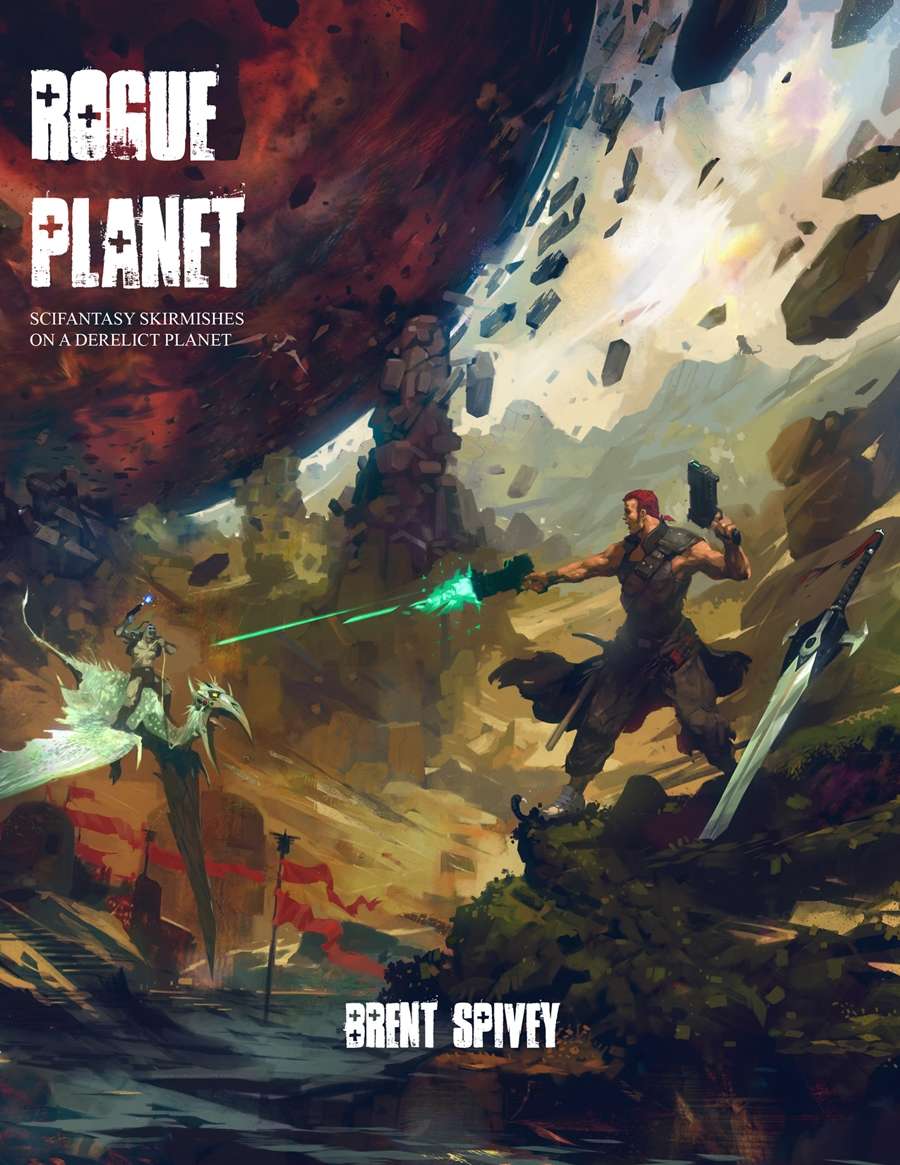
Review: Rogue Planet- Bombshell Games/Brent Spivey


I have been meaning to pick up these rules for about two years now.  I finally got around to it when they went on sale at the Wargame Vault as part of the Summer Offensive.  The price was hard to pass up and I ordered the PDF and a soft cover of the book.  Today, I will be looking at the E-book.  I also received a Desolation Planet edition which is full of really awesome artwork, but I am using the E-book for the rules.

Rogue Planet starts with a nice couple of paragraphs about what it is.  It is Sci-Fantasy.  What is that?  The book spends a lot of time telling you.  I think my favorite description was Sword-and-Planet instead of Sword-and-Sorcery.  The book points out examples of the genre such as Star Wars, Final Fantasy, and Heavy Metal.  I think we can all think of one or two others as well. 

From there, Brent Spivey then spends some time explaining a bit of the flavor and his design philosophy for the game.  I am always a sucker for such designer notes.  Rogue Planet lands squarely in the camp of cinematic action.    To paraphrase the author: "If you find yourself wondering why a mechanic operates in a certain way, chances are the answer is one of the following reasons:
  • It is cool
  • because it is Sci-Fantasy
  • You are on Rogue Planet
  • It leads to interesting tactical decisions"
Well, what isn't to like about that philosophy?  So, now that we are marooned on Rogue Planet, let's see what we discover.....

Things I Liked
I always am a sucker for a Scale and Model agnostic game.  Yeah!

The game starts each turn with a choice.  You can roll a dice to generate 1d6 action points, or you can play it safe and get 3 guaranteed.  The player with the most action points can choose to go first or second.  Now, everyone knows I am not a fan of action points BUT this initial choice is intriguing to me.  It forces a player to make an early decision that will impact the tactical play for the rest of the turn, and may impact initiative.  The player who had fewer action points last turn can roll 2d6 and choose the highest dice, a simple balancing mechanic.  All of this in the first actions of a turn.   

The game uses a simple 2d6 skill check roll.  I like 2d6 as it gives a nice curve of results.  7+ is a partial success, with 10+ being a complete success.  Interesting, if you fail a skill check your opponent gains two free move activation immediately.  A success of 7-9 also allows a single opponent activation for movement.  That means every time you pick up a dice, you are risking allowing your opponent to act.     

Some units or equipment can access and use something called a "Rogue Die"  It is rolled at the same time as the skill check.  If the Rogue Die matches one of the other dice, it could trigger additional benefits.  This is separate from Crits and the like.  

Movement in this game is entirely free-flowing and promotes terrain placement.  Why?  When moving a unit can move as far as they want in a straight line until they interact with terrain or are halted by the opponent making a Counteract action and using Action Points, which are a limited pool.  Therefore, if you pick up the dice and fail, your opponent can potentially really exploit the situation.  In addition, there are no ranges, only engaged in melee or available to shoot at.  There is no measuring in this game.     

In addition to having a random Action Point pool generated at the beginning of the game, players also have a pool of energy.  This can be used to help save models based on their armor.  However, it is a limited pool and once it is out, it is out.  Choose how you use it wisely.   The pool size is based on your forces construction.   


Things I Did Not Like
As we have mentioned, players get 1d6 (or 3) action points a turn to activate and use any of their models anyway they wish.  All actions cost 1 action point.  There are some rules about no more than 2 consecutive actions (Heroes get 3), but it would have been much easier to just give everyone 1 action.  I suppose this forces you to decide who and how you want to use each model, but it could also just lead to your champion getting the bulk of the actions while the others cheer them on. 

Modifiers are capped at +3 and -3.  The caps are a bit confusing as why maneuver for maximum effect?  It is capped anyway.  However, the difference between two opposing units ability scores will also be a modifier.  Ability scores range from 2-7 so if a combat ability of 4 went up against a combat ability of 7, the difference would by +3.  However, the bonus only applies to the active units.  This game has a lot of modifier calculations to apply to that initial 2d6 roll.   

Doubles rolled on the 2d6 can trigger a critical.  Criticals make using energy expenditure to save the target much more expensive or impossible. 

Since the game uses no actual measurements, there are some events or effects that DO need a standardized measure.  The game uses the width of three fingers.  This is a method I have used myself in various dexterity games, but those are different types of games than this wargame.   


Meh and Other Uncertainties
The game also allows the non-initiative player to spend action points to counter-act to things.  You know dodge, counter-charge, return fire, that kind of stuff.  However, the active player can not counter-counter act. 

Of course, as a model and scale agnostic game that means it must have a way to create and stat up models.  There are several pages on creating stat lines, armor values, weaponry, skills, Hero abilities etc.  It is pretty straight forward and easy to use.  

The game outlines 4 different "power levels" to play the game at.  This sets some limits on what can or can not be taken and gives players a way to scale their games and units to be of roughly equal power.  In addition, there are 6 scenarios.  Lastly, there is discussion about multi-player games too.   

There are some extra fun combat actions besides just moving and shooting.  These include throwing objects, destroying terrain, colliding, staggering a foe, etc.  One of these is that when a enemy unit is in Treacherous Terrain, your opponent can choose to spend an Action Point to have the Treacherous Terrain "attack" that unit.  Nice additions to add flavor and chrome.    

The Desolation Planet version of the book has some amazing artwork!  Love it!  Some example models linked to game rules/profiles could be helpful though.  Afterall, the FAQ specifically calls out that these rules could be used to play out a grim, war-torn, gothic future!    


Final Thoughts
Who doesn't love a good scale and model agnostic game for sci-fantasy games!  This will allow you to bring whatever you have to the table and play an interesting and tactically challenging game.  For a 24 page rulebook, this game covers a lot of ground and allows for a wide variety of situations, models, and stuff.  

This game has a lot of interesting and good ideas.  However, I can't help but think that as a whole the game is a bit over-engineered.  In that respect, it reminds me a bit of Pulp Alley where there are a lot of great mechanics and ideas, but perhaps too many in one game system.  I can't shake the feeling that it is trying a bit too hard, and is therefore a bit challenging with all the minutia of when to do what when.  A good quick reference guide seems like it is a must have for this game.  Thankfully, one is provided when you buy the PDF!  

That being said, if I compare it to other scale and model agnostic games in this genre it has a lot of positive things going for it.  Customization and unit creation is pretty simple.  The power scales also allow you to do some sort of "escalating" campaign.  I think the rules give you enough lee-way to do some fun stuff, and the FX and Rogue Dice allow for some "cinematic" moments to be created as well.          
I just need to figure out how I want to use this game for myself so I can get it on the table.  The game feels geared to a hero model and a couple pawns, with a group or two per side.  That fits small scale skirmish, but I could also see it being usable Mode vs. Model too.  Now I am rambling as I think about how to use it myself.....

Anyway, this looks like a solid set of low model count rules that you will want a good FAQ to play the first couple times.  I will probably play it a few times.