Showing posts with label Ancients. Show all posts

Monday, September 28, 2026

Wargame Design: Heirs to Empire - The Late Persian Army


This is a ruleset that has been out for a while now, and the focus is on the wars of the Diadochi after the death of Alexander the Great.  Therefore, all your favorite Greek generals get a shout-out and have their own Lines of Battle.  However, one thing I do not think the rules cover very well is Lines of Battle for the Late Persian Army or rather Lines of Battle for rebel Persian Satraps who mostly drew their forces from the remains of the Late Persian Army.  We know from the sources that Perdiccas and others had to contend with rebel Persians after Alexander's Death.

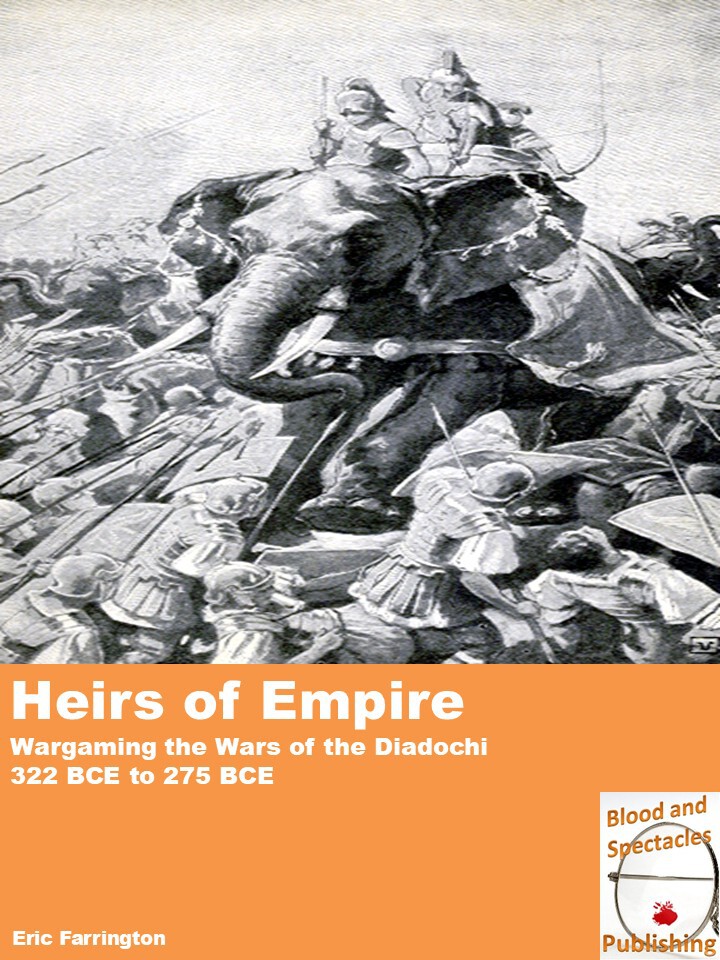
Therefore, this will be a post where I try to rectify that situation and "build a better" Late Persian list to be used in your games.  This is not the first time I have gone back to add a new Line of Battle for this game.  Long-time readers and fans will recall my efforts to add a Mauryan Empire list to potentially face off against Seleceus during his Eastern Anabasis.  You can find that here.  The very sharp-eyed of you will also see that I updated the games cover since those halcyon days too!  

This is also not the first time going to take a closer look at the Late Persian Army for me either.  The Ionian Revolt supplement for Men of Bronze also has an updated Line of Battle for the Late Persian army to update it from the core rulebook.  Therefore, the list you see here will build off this as a source.  That supplement also details many of the foes of the Persian Empire as well and is a great resource for those of you who want to expand your games with Persian armies.  I think it is also important that Heirs of Empire was written before The Ionian Revolt so my thinking and scholarship around these forces has evolved.   


Who Were the Persians?

The Persians were a vassal tribe of the Medes from the Iranian steppe. Their king Cyrus the Great led them to victory over the Medes, and then the Babylonians, and finally the Lydians.  At this point, the Achaemenid Empire was declared.  The empire continued to expand outward under other kings.  At its height, it covered the majority of the known world, stretching from the Indus River Valley to the Balkans to Egypt. 

Cyrus and his descendants brought a new model of control to the region.  The Assyrians had brought a reign of terror for their subject people including royal massacres, forced deportations, destruction of temples, and brutal military tactics designed to cause terror.  The Medes and the Babylonians followed this successful example.  However, when Cyrus took over he did not bring brutality with him.  Instead, he offered stability.  His empire respected local religions, kept local leadership in charge, and showed mercy.  The Persians had a relatively hands off approach to their provinces as long as the taxes were paid, the levied troops provided, and the Kings orders were followed.  This approach allowed the Persian Empire to flourish and grow.    

In addition, the Persians brought an efficient bureaucracy and administration to their holdings.  They built infrastructure like the great Royal Road that crossed the Empire.  This infrastructure allowed a series of message relays and a post-offices that made Royal communications swift.  In addition, the infrastructure allowed the King’s soldiers to get from one end of the Empire to the other rapidly to maintain order.  They also professionalized government officials and created a professional army.  

The Persians were very wealthy from the taxes they collected from their subject people.  They used this wealth shrewdly to expand trade, professionalize their leadership, and to de-stabilize their enemies.  After the Greco-Persian Wars, the Persians cannily used their wealth to play one Greek city-state off against another to keep them focus inward instead of on the Persians.  This policy was very successful for a number of decades as internal warfare kept the Greeks mostly focused inward.

The Persians were a religious people.  They believed in the Flame of Truth and its avatar Ahura Mazda.  To their way of thinking, as the Empire expanded they rolled back the darkness and brought the light of Truth.  Ahura Mazda was leading them to expel the darkness.  Despite this religious philosophy, they did not expect their subject people to convert to their religion or abandon their own gods.  Instead, the empire was tolerant of local custom and religious practices.  

The Persian Empire began to decline as outside pressures grew.  The taxation burden became heavy on the satraps who controlled the various provinces, and the economy began to stagnate from too much wealth not being re-invested.  In addition, the Empire’s hands off approach meant that no national identity or larger shared ethnic identity was ever achieved for the empire.  Therefore, when Alexander and the Macedonians took over, there was not real change to the average Persian Imperial citizen’s life.  They continued on much as they had before.      

How Did They Fight? 

By the late period of the Persian Empire, the way that they fought had evolved a lot over the centuries.  Generally speaking, by the late period the army was made up of 2 main branches.  They were the infantry and the cavalry.  There was also several "novelty" units like scythed chariots, camel cavalry, war elephants, and mercenaries like Greeks.  

Persian Infantry was drawn from across the Empire.  However, the backbone was the Medes and Persian troops.  These were primarily armed with spears, swords, and most importantly bows.  The Persians specialized in range firepower.  From there, other troops came from across the empire to fill their own niches like skirmishers, light troops, etc. However, as the Empire came apart access to these auxiliary troops became restricted.  

Much has been written about the Kardaks as a troop type in Late Period Persian armies.  I tend to think that this was a reference to Persian troops.  It is unclear who they are, but they were light and heavy troops of various branches of the military.  It does not seem like they were a unique unit type and could possibly be "new recruits" or troops still in their training phase.  

Perhaps the most important arm of the Persian Late Period army was the cavalry.  Again, this was mostly Persian nobles who were the Heavies.  However, they also had lighter cavalry made up of allied groups like Bactrians or Sogdians.  The infantry would pin down the enemy troops with archery while the cavalry would maneuver for flank attacks.  The Persian army was known for its mobility as well as its size.

What draws many people to the Persian Army is their novelty units.  They had a wide variety of mercenary and specialty units in their forces.  This included Greek Mercenaries of the heavy and light variety.  War Elephants from India, Egyptian Marines, Camel cavalry from Arabia, and Scythed Chariots from the Steppe all had their place in the Late Empire army.  Of course, after the death of Darius and the sundering of the Empire access to all of these troops might no longer be available thereby limiting the Line-of-Battle.                      

Building the Line of Battle for Late Persians for Heirs of Empire

It may have been a while since you have looked at the rules for Heirs of Empire.  However, it is a game that makes use of army wings on the table.  Therefore, the Lines-of-Battle focus on what units can make up the Left, Center, and Right of the army.  

We know that traditionally the Core or center of the army will be the infantry forces with the cavalry moving around on the flanks.  We saw this formation during the famous late period battles against Alexander.  Therefore, the Line-of-Battle should match-up with these formations.  

I wanted to add some infantry with bow armed troops integrated into the units.  Therefore, I am adding the following option: 

Bows
The bow was an integral part of the Late Persian Army.  Bows were a cultural icon of the Persians, and therefore many of the Mede and Persian soldiers were equipped with a compound bow. Therefore, mixed units of infantry and bows was a common feature of their armies.  

You can add Bows to Epilectoi Cavalry, Asphract Cavalry, Drilled Infantry and Warband Infantry for +1 Point.  They would allow the unit to have the following added to their profile: 

Bows: Shoot 2 (12MU)

Hoplite Mercenaries
One of the biggest employers of Greek mercenaries was the Late Persians.  They used these mercenaries as their melee-shock infantry.  The Persians preferred the bow and cavalry tactics.  Therefore, they were happy to let the Greek Hoplites be their heavy infantry.  

They have the following profile: 

Mercenary Hoplites                                                5 Points
Move    Attack     Armor    Courage     Discipline
6 MU    3            1                4                3

Special Rules: Phalanx, Drilled, Counter-Charge

Scythed Chariots
Part of the Late Persians "Novelty" units were the Scythed Chariots.  Xenophon writes a compelling account of how such units could be very effective against unorganized or isolated Greek troops.  However, against the Macedonians they were much less effective.  

They have the following profile:

Scythed Chariots                                                    5 Points
Move    Attack     Armor    Courage     Discipline
6 MU    3            1                4                3

Special Rules: Pursue, Counter-Charge

Other "novelty" units can be accounted for in the standard Heirs to Empire profiles.  For example, Camel Cavalry would simply be Asphract cavalry.  

Late Persian Line of Battle

The following is the Line-of-Battle for the Late Persians and their rebel Persian forces after the death of the Great King.   The Lines of Battle help to choose the appropriate Units for your Historical forces. Check the scenarios for starting point cost for a force. 

Each Line of Battle will have an entry with a number. The number indicates the limit of that Unit you can take in the army. If an entry says 1+ your army must have at least one of these units in it. If it is 0+ any number of that unit may be taken. If a Unit is not on the list, it can not be chosen.

Center: 
0-2 Skirmishers
0-2 Elephants
1+ Drilled Infantry
 -- Bows for +1 Point
0+ Warband Infantry
-- Bows for +1 Point
0-4 Archers/Slingers
0-2 Irregular Peltasts
0-2 Scythed Chariots
0-2 Mercenary Hoplites

Left/Right Wing: 
0-1 Companion Cavalry
0+ Epilektoi Cavalry
0+ Asphract Cavalry
0-2 Scythed Chariots
0-2 Elephants
0-2 Skirmishers 
0-2 Slinger/Archer 
0-2 Irregular Peltast 
0-2 Warband Infantry
-- Bows for +1 Point

Sample Line of Battle

Below you can see a Sample Army built from the Lines of Battle provided. It gives you an idea of what your force could look like. It is built to a 54-point force per the examples in the main rulebook. The Late Persians has 9 Units in the force. 

Center: 
1 Drill Infantry with Bows 
1 Warband Infantry with Bows
2 Irregular Peltasts
1 Mercenary Hoplite
1 Skirmisher

Left Wing: 
Epilektoi Cavalry with Bows
Scythed Chariots

Right Wing: 
Asphract Cavalry with Bows

Final Thoughts

These Late Persian Rebel Satraps will give a much different feel to a traditional Diadochi army.  Their hitting power is reduced up-close, but their ranged firepower is greater.  It will take a skilled commander to maneuver and fight these units against a Macedonian Phalanx force, but hopefully the extra troops and Commander's Gaze can give the Late Persian player an edge and the ability to "kite" against the harder hitting Phalanx units of the other Successors?  

I look forward to you giving them a try on the battlefield and letting me know what happens in the comments.  I think they lead to very different strategic and tactical challenges for your games of Heirs of Empire. 

Until next time.  


Become a Patron and get access to all the cool stuff, a peak behind the curtain of Blood and Spectacles, and early-access to playtest games!  


You can follow Blood and Spectacles Facebook page or Instagram for more fun! 

Check out the latest publications and contact me at our Blood and Spectacles website

Or purchase all out games at the Blood and Spectacles Publishing Wargames Vault Page!                       

Monday, March 2, 2026

Wargame Design: Sea People for In Strife and Conflict


One group of people I did not include for In Strife and Conflict were the (in)famous raiders of the Late Bronze Age; the Sea Peoples.  I did not initially add them because they did not have much interaction with the Assyrians.  The Assyrians were a Mesopotamian power at the height of the Sea Peoples encroachments.  The Sea Peoples were primarily operating on the coasts of the Eastern Mediterranean.  It was not until after the Broze Age collapse and the rise of the Neo-Assyrians.  The Assyrians moved westward and scooped up many of the remanent city-states left in the post Hittite and post-Sea People world.  Since In Strife and Conflict was focused on Assyrians, it did not seem like the Sea Peoples were a useful addition to the rules. 


However, the Sea People are a staple of the chariot war genre.  When people think of Chariot Wars, they soon think of the Bronze Age collapse; and that takes them straight to Sea Peoples.  Now, I am not a personal believer in the “Violent Migration” theory of the Bronze Age collapse, but there is no doubt the Sea People played a part in the system collapse that happened.  Plus, there is plenty of evidence about the Sea Peoples. 


There are a couple of things that make the Sea People a bit of a conundrum when trying to integrate them into Chariot Wars.  These are:


  1. They have limited use of light chariots
  2. They are mostly a light infantry force
  3. There should be a lot of them
  4. They were accompanied by their families
  5. There is no real clear idea what this army looks like
  6. It is made up of several tribes of people from across the Mediterranean

So, how does one go about making a Line-of-Battle for such an ill-defined, non-army, army?  Well, let’s dive into it. 


Who Are the Sea People?

Good question.  For many years, no one really knew.  However, they existed based on plenty of evidence left by the Egyptians.  This includes pictoral and written evidence.  Thanks to this evidence, Historians keep trying to trace the origins of the various tribes of the Sea People.  The origins of the Sea Peoples are not entirely relevant to the discussion here.  However, they hailed from Sicily, Sardinia, the Aegean, Anatolia, etc.  Before the Sea People “invasion” and the Bronze Age collapse these tribes and peoples were known in the area and even served as auxiliaries and allies of the city-states that would later collapse. 


For example, the Sherden was one of the tribes that made up the Sea Peoples.  However, we also know that they made up Ramses II Royal Guards and took part in the Battle of Kadesh.  At the same battle, the list of Hittite allies included tribes that would later be associated with the Sea Peoples.  The Sea Peoples seemed to have a mercenary, subject, or military relationship with the Chariot cultures of the region.  They were not strangers or unknown invaders. 


We also have wall reliefs that depict the Sea Peoples bringing their families with them in ox-drawn carts.  The Egyptians claim that the Sea Peoples came in great numbers but it is unclear how many were actual combatants?  This indicates that they were not looking for spoils and portable wealth.  They were looking to settle and move-in.  They were not “raiders” at all. 


All or our records on the Sea Peoples comes from what written and visual records remain from their enemies.  The writers assume that the readers are familiar with the situation.  Therefore, we are getting a limited and one-sided image of these peoples.  Other evidence comes from archeological evidence, which due to age is limited to certain materials.  Huge swathes of the culture of the Sea Peoples is unknown to us and potentially unknowable. 


This scene from the north wall of Medinet Habu is often used to illustrate the Egyptian campaign against the Sea Peoples, in what has come to be known as the Battle of the Delta (c. 1175 BC),[1] during the reign of Ramesses III. While accompanying hieroglyphs do not name Egypt's enemies, describing them simply as being from "northern countries", early scholars noted the similarities between the hairstyles and accessories worn by the combatants and other reliefs in which such groups are named. Wikimedia Commons


The Sea Peoples Military

Again, we are working with very limited evidence on what the military of the Sea Peoples looked like. Indeed, creating a “universal” picture may not even be realistic considering the cosmopolitan nature of the Sea Peoples themselves.  We know a bit about the Sherden, who used helmets, corselets, and greaves.  We also know that they used round shields of Bronze, swords, and spears.  Occasionally, iron swords are mentioned as well.  For other tribes, Archers and thrown missiles weapons like Javelins also appear to be part of their arsenal.  However, different tribes seem to have had distinctive head gear or equipment.  It is unclear if this also meant that they had a different role on the battlefield.


In at least one pictoral representation, we see the Sea People making use of Chariots of a similar design to the Egyptians.  However, it is unclear if this is just an artist interpretation as that is what an army “should have” or if the artist was an eyewitness or working with an eyewitness of the battle.  There is not much other evidence to support that the Sea Peoples used chariots.  They are not discussed often, and the descriptions of battles are often only fragmentary or a line or two at best.  


There is a reference to the Sea People using a two-pronged land and sea strategy at the Battle of the Delta.  There is also reference to ships appearing in other sources.  This led to the name “Se Peoples” but not all the tribes associated and named as the Sea Peoples have any connection with the sea.  Therefore, even the term Sea Peoples could be a bit of a misnomer.  We do not know much about their sailing ability, ships, or their Naval prowess.  As the Battle of the Delta the naval arm of the invasion was defeated, but so was the land arm. 


We have no idea how the Sea Peoples organized themselves.  No idea who was in charge, no idea how they coordinated, and no idea how they fought as units.  Therefore, we have to make a lot of assumptions when it comes to the organization of Sea People armies. 


The sources seem to indicate that they were a fast moving, infantry-based army.  They operated as mostly light infantry, with a core of heavily armed and armored Sherden.  It is unclear how they integrated ranged weapons into their forces.  However, they seemed to favor close-up combat where many chariot based armies preferred archery or other ranged attacks as the primary attack arm. 


Beyond these broad strokes, we know very little else about the Sea Peoples military structures, doctrines, or how they fought.  The chroniclers at the time do not leave much detail.  The archeological record is not much better. 


Ramses II's Sherden Royal Guard at the front of his armies
 

Creating the Sea People Line-of-Battle

First off, I use 6mm miniatures on 60mm x 60mm bases for my games of In Strife and Conflict.  However, the game itself is base and model agnostic though.  You can use single-based 28mm, multi-based 15mm, or whatever you want.  The rules are interested in Unit-vs-Unit combat and does not have any casualty removal.  Therefore, when I talk about this Line-of-Battle I am refer to it by units.  


I think we have seen that the Sea People are not a homogenous group.  That means, as I build this Line-Of-Battle I will assume that various infantry troop types are available to them.  This could be split up on tribal lines, or a mix of headgear and weaponry as the army builder sees fit.  I think having different tribes represent different unit types is an attractive option to differentiate units on the battlefield but is probably not a realistic portrayal of how they operated in the field.  However, sometimes the needs of expediency make sense on the tabletop where they do not on the battlefield.  


Second, I went and reviewed the Unit Profiles in the core In Strife and Conflict rules.  Thankfully, they are a bit generic with some options.  I think these will represent the Sea People unit types we have seen well.  After I have a basic list, I will think if any other special Chrome is needed.  Here is what I think fits in with the line-of-battle based on the evidence and the needs of the army as a playable force: 


Light Chariots W/Javelins

Professional Infantry

Levy Infantry

Irregular Infantry

Skirmishers

Mounted Infantry (?) 


The core would be Professional Infantry, possibly Sherden.  The Levy and Irregular Infantry would give them numbers for flanking and Rear attacks.  A limited number of light chariot with javelins would fit the bill for what we see about the Battle of Djahy.  Skirmishers and Irregular would give them some enhanced mobility to pin enemy formations for the others to maneuver into position.  They would also allow them to use terrain to advantage. 


One thing I am noticing right away, is that general Infantry does not have access to Javelins.  This is something I will need to create some Chrome for them.  There are two ways to go about it.  The first is a unit upgrade as a Shoot weapon.  The second is to use a system similar to my Roman Legions in Wars of the Republic as a rule that is triggered by using King's Decree to reduce enemy armor.  This would give them some additional punch up close, but reduce their range options. 


The Mounted Infantry is a question mark to represent ox-drawn carts.  We see them in the artwork, but for moving families and not troops.  Therefore, I am not sure I want to add them in to the army list at this point.  


In the core rules there are two Special Rules that maybe appropriate for the Sea Peoples.  They are Iron Weapons, which some sources claim the Sea Peoples had limited numbers of.  The other is Terror.  This would impact how other units reacted to their charges or their ability to charge them.  Then, I might add a Thrown Weapons special rule for the Professional Troops to help with their "shock assault" capabilities. 


Sea Peoples in conflict with the Egyptians in the battle of Djahy.  Wikimedia Commons


I decided on the following:   


Sea People Line-of-Battle


0-2 Professional Infantry

- Thrown Weapons for +2 points


0-2 Light Chariots

- Javelins for +1 Points


1+ Levy Infantry 

- Upgrade with Javelins- Shoot 3 (6MU) for +1 Point


1+ Irregular infantry


- Upgrade with Javelins- Shoot 3 (6MU) for +1 Point


0+ Skirmishers


  • Sea Peoples can arm 0-2 Units with Iron Weapons at +2 Points per unit
  • Sea Peoples can Equip all Units with Terror for +2 Points per unit
  • Professional Troops for Sea People may be armed with Thrown Weapons for +2 Points per Unit 

Thrown Weapons

The Sea People had a reputation for barraging their opponents with darts and javelins as they closed the distance to melee.  This was to soften up an enemy as they approached with casualties and laden-down shields.  


A Unit that charges, counter-charges, or is charged may spend a King's Decree to use their thrown weapons.  The enemies' Armor is reduced by 1 to a minimum of 1 in the following melee.  In the End Phase, the opponent's Armor rating is returned to normal.  


Sample Sea People Army 

Below you can see a sample Sea People army built using the Line-of-Battle above.  This is to give you an idea of what a Sea Peoples army could look like.  It is built to a 48-point force.  This force gives you 8 units and 9 King's Decree at the start of the battle. 


1 Professional Infantry                            12

- Thrown Weapons, Terror, Warlord    


1 Light Chariots                                       11

= Javelins, Terror


2 Levy Infantry                                        10                                    

- Javelins


2 Irregular Infantry                                  10

- Javelins

2 Skirmishers                                           4

Painting Sherden from Baccus 6mm

Final Thoughts

This army list adds a completely different style of play to your games of In Strife and Conflict.  Many of the Lines-of-Battle found in the core rules focus on Chariot Wars armies supported by archers and infantry.  The Sea Peoples are a completely different playstyle than the dominant fighting style of the region.  Therefore, any commander who wishes to use the Sea Peoples will have a to develop new strategies and tactics to help make these infantry heavy forces successful.  We do not know historically how the Sea People were about to do this and that is what makes playing a Sea Peoples force so exciting.  

Let me know if you think I missed out on any other Lines-of-Battle for In Stife and Conflict.  I will gladly look into expanding into more forces.   

Until next time! 


Become a Patron and get access to all the cool stuff, a peak behind the curtain of Blood and Spectacles, and early-access to playtest games!  


You can follow Blood and Spectacles Facebook page or Instagram for more fun! 

Check out the latest publications and contact me at our Blood and Spectacles Website

Or purchase all out games at the Blood and Spectacles Publishing Wargames Vault Page!   

Monday, December 22, 2025

Men of Bronze- Italiotes


The information below is an extract from the Hercules Abroad supplement that can be found on the Wargame Vault.  This post has been sitting in my draft box for a long time, but as I have been working on the Carthaginian supplement Rise and Fall I might as well send it out into the wild now.  Merry Christmas!  

***********************************  

As we continue to expand the world of the Ancient Greeks, it is natural to expand westward into Magna Graecia.  This was a series of loosely affiliated Greek colonies located in Sicily and southern Italy.  This Diaspora was often attributed to the Greeks following in the footsteps of the "Journeys of Hercules".  This mythology was used to justify their expansion, colonization, and infringing on indigenous people's territory.  

We all ready have a list for Syracuse and the City-States of Sicily.  However, Magna Graecia had a vague definition and also included the Southern coastal regions of Italy.  These colonies existed before and during the rise of Rome on the Peninsula, and eventually were rivals to her growth.  The area of Southern Italy was ill suited for traditional Greek hoplite battle, so local variations were required in the military habits of the Greeks who found themselves there.  


This area began to see extensive Greek settlement in the 8th and 7th centuries BCE.  These colonists brought their Greek culture with them such as the idea of an independent City-state, religious traditions, and trade with their homeland.  These Hellenic cities became vital power houses in the region and began to fuse the native Italic cultures with Greek cultural practices as well.  

These Italic-Greek city-states eventually formed their own league for mutual support, trade, and protection against the neighboring Oscan tribes and other Greek rivals in 430 BCE.  This was known as the Italiote League and was controlled by the city of Tarentine in the late 5th century.  

How They Fought

As usual, nothing is known precisely about how the City-States of the Italiote League fought.  We can make some assumption based on how their founding city-states fought, and how rival Italic tribes fought as well.  In addition, there were some military trends in the Hellenistic World that would impact the Italiotes as well.     

Of course, the foundational unit of any Greek city-state army was going to be the Phalanx composed of the land-owning freemen farmers of the nearby lands.  They had the status to buy their own equipment and assemble for drill with their peers.  The Hoplite warriors in Magna Graecia was similar to their brothers elsewhere.  However, the terrain and conditions of Southern Italy were not conducive to the normal Hoplite tactics.  

Native Italic tribes tended to be lighter armored and more mobile than their Hoplite neighbors.  Hit-and-Run attacks and cattle raids were the de facto fighting style of the local tribes.  In this fighting style, speed, mobility, and lighter weapons were critical.  Distance fighting with Javelins was also a common feature.  

Therefore, the Greek colonists to the region needed to meet these needs of warfare.  To do so, Hoplites tended to avoid the use of the panoply and instead used a lighter, native garb that featured bronze pectoral armor plates in the front and rear.  In addition, their head ware tended to be open in the front allowing greater visibility and allow a greater field of vision.  Greaves were often reduced to a single leg or discarded to reduce weight and increase the soldiers ability to pursue or evade.  Indeed, the Hoplite of Italian Magna Graecia was a much lighter and nimbler foe than the heavily armed shock troops of the Greek Peninsula.    


In addition to the lighter hoplites the Italic Greeks made extensive use of Peltasts and Psiloi. These were used to supplement the infantry.  They could provide covering fire for the advance, or screen the other troops.  These were frequently mercenaries or poorer members of the city-state, much like Greece. The javelin was the favored missile weapon of the region.    

The Italiotes made great use of Light Cavalry.   These were designed as a skirmisher based force that utilized javelins and missile weapons, but also had small shields and curved swords for melee combat.  They were an excellent pursuit and scouting force.  This type of light cavalry was frequently referred to as Tarentine Cavalry, even though they were not necessarily native to the city of Tarentum.  It was in reference to the style of skirmish cavalry that was being referenced.  

The final element of an Italiote force would also be made up of Greek mercenaries.  These would fit the more standard Hoplite, heavy infantry role in an Italiote force.  They could form a solid core of heavy infantry.  

Italiote Army List

Armed with the information above, we can start to piece together an army list for the soldiers of the Italiote League or its member city-states.  The bulk of the infantry will most likely be composed of Light Hoplites to represent their lighter panoply and more mobile style of fighting.  This will be supplemented by good Peltast and Psiloi options as the Javelin was a popular weapon in Italian conflicts.

The Cavalry should be Light Cavalry, but the melee ability and skirmisher nature can not be discounted.  Therefore, I am going to add the following Option for the Tarentine Cavalry forces.  

Tarentine Cavalry - 8 Points

Move    Attack    Armor    Courage    Discipline

12BW    4            1            4                2

Shoot: 2 (6BW) 

Special: Evade, Pursue, Move and Shoot

This differentiates them from standard Greek Light Cavalry that focused more on skirmishing, missile fire, and pursuit.  Now, you have a Light Cavalry unit that had enough Melee capability to challenge other Light Cavalry, Peltasts, Warband Infantry, and Psiloi.  However, they are still no match for dedicated Heavy Cavalry, Elites, or Drilled units.  


Italiote Line of Battle

Use the following lists to build your historical forces for the Italiote League or other Itallic-Greek forces. The Lines of Battle help to choose the appropriate units for your historical forces. These are sample lists and there to provide a flavor of potential forces. Players can always modify these lists as they see fit

Each Line of Battle will have an entry with a number. The number indicates the limit of that Unit you can take in the army. If an entry says 1+ your army must have at least one of these units in it. If it is 0+ any number of that unit may be taken. If a Unit is not on the list, it can not be chosen.

Italiotes

1+ Light Hoplites

0+ Peltasts

0-4 Psiloi

0-4 Tarentine or Cavalry

0-1 Drilled Hoplites

0-1 Archers/Slingers

The list above gives access to regular Light Cavalry or you can use the upgraded Tarentine Cavalry provided in the rules.  In addition, the bulk of the force will be Light Hoplites to match the subtle differences between mainland Greece and their Italic colonies on the table.  

Sample Army Lists

Below you can see an example force for the Italiote Greek City-States.  It is built to the 38 point standard and is composed of 6 units.  

2 Light Hoplites

2 Tarentine Cavalry

1 Peltast

1 Psiloi 


Battle of the Elloporus

Most of the warfare of the Italiote League was between fellow Greek City-states and the nearby Latin, Oscan, and Samnite tribes.  However, the threat from Sicily by the Tyrant Dionysus I was a primary concern.  Some scholars speculate that the rise of Dionysus the I of Syracuse was the prime motivation for creating the Italiote League.  Therefore, eventually the rivalry between Syracuse and the Italiote League would come to a head.  This inevitable clash happened in 389 BCE.  

Unsurprisingly, we know little of the actual events of the battle.  We know that it was fought, and that Syracuse won the battle.  The armies were probably in the 15 to 25K range on both sides.  Sources also indicate the battle was fought in the toe of Italy near the Stilaro River.  That pretty much summarizes what little we know of the battle.  

To put it in perspective, this battle took place during the 3rd Sicilian War.  In the same year, the Spartan King Aegislaus II was crossing the Gulf of Corinth to attack the Arcananians.  Athens is getting involved with Rhodes and taking control of the Hellespont under the command of Thrasybulus.  Military activity across Greece and Sicily was common during this time period.    

Of course, situations like these allow for a wargame to fill in the blanks.  We don't know much about the battle strategy, tactics, or terrain.  We also know next to nothing about the forces involved.  Therefore, whatever we choose to do is as accurate as anyone else chooses to do! 

Forces

For this battle, we will be using the Syracuse list and the Italiote League Lists.  Neither of these can be found in the Men of Bronze rulebook itself.  Both lists can be found in the Hercules Abroad supplement on the Wargame Vault.

Italiote League    

2 Light Hoplites

2 Tarentine Cavalry

1 Peltast

1 Psiloi 

Syracuse of Dionysus I

2 Militia Hoplites

1 Cavalry

2 Archers

1 Peltast

Since we know nothing about this battle, we can safely use any lists we want.  I have opted to use the sample Lines of Battle provided for both forces up to 38 points.  

Set-up

We know so little about the Battle of Elleporus, that it seems like just about ANY scenario from the main Men of Bronze rulebook could be used.  However, I feel that the Set Piece Battle scenario maybe the best and safest option.  

The game should take place on a 72 BW by 48 BW board.  The only set feature would be a river traveling along one flank of the battle, probably with the deepest edge being no more than 8 BW in from either short edge.  This could be Difficult, Dangerous, or Impassable terrain depending on how restricting you want the terrain to be.  After placing the river,  I would recommend deploying terrain in the remaining sections of the board and rolling for complications as normal.  The Set-Piece Battle scenario should be a good guide.  

Special Rules

Again, since we know so little about the battle, its prelude, and what occurred we can use any complications that we wish!  No special rules are needed for this battle and the normal process for generating Complications should be sufficient. 

Victory

Again, we know so little that special Victory conditions do not seem to be necessary.  Instead, the Victory Conditions for a Set-Piece Battle should be sufficient.  

However, feel free to add any spice you want to the battle.  For example, the Italiotes could be trying to kill Dionysus I once and for all, and their Victory Condition could be routing the Unit he is in.  If successful, the Italiote wins.  If Dionysus I unit is not routed, then the Syracusans win.  Your choice really! 


Final Thoughts

The Italiote Greek City-States act as an interesting bridge between the world of the Romans and the world of the Greeks.  Since the Italic-Greek City-States began their life in the 8th and 7th Centuries that leaves a lot of time for them to clash with their fellow Greeks such as Athenian Marines or colonists new to the region.  They can also clash with the Barbarian tribe lists, or some of the lists from Hercules Abroad such as the Carthaginians, Syracusan/Sicilian Greeks, or the Etruscans.  There are always no shortage of opponents to fight in the ancient world! 

I think I am starting to wrap-up the world of the Greeks for Men of Bronze.  I have covered a variety of different regions and cultures far beyond Mainland Greece now.  The full list can be found below.  If I go too much further and deeper, I will be into the Roman period which will be covered in Osprey's  Wars of the Republic.  No need to to do that, since it is fully compatible with Men of Bronze. 

You can get all of the updated materials including a FAQ, Campaign rules, and Lines-of-Battle in the Men of Bronze Supplement: Hercules Abroad.


You can follow Blood and Spectacles Facebook page for more fun: https://m.facebook.com/pg/BloodandSpectacles/posts/?ref=bookmarks&mt_nav=0

Or our website:

Or our Messageboard:

Or our Wargames Vault Page:


Monday, April 7, 2025

Battle Report: Battle of Kadesh - Participation Game


Saturday was the big day.  I was finally taking my Battle of Kadesh game out to play as part of a participation wargame!  There were some strong headwinds on the day of the big event as lots of other events were happening in my small community.  Most of them got scheduled after I set my own date, otherwise I would have considered a different day!  Oh well.  


Prior to the big day, I had papered the town with flyers, posted on our True Crit Gaming Guild page, and peppered local Social Media.  For the event, I made several easy resources for the day like unit cards, quick reference guides, and other tools.  I had previously played a few test games as well to make sure it all worked as intended and moved quick.  Now it was time to put it all together and see what happened.   


My turn-out was pretty sparse.  However, despite the small turn-out I still managed to play two games.  The goal was to introduce people to wargaming, and I did expose a few people.  I also got to teach folks a few things about the Bronze Age as well, so that was fun too.  Folks had a hard time wrapping their head around just how long ago it was!  

Interestingly, the overall plan in both games was different, but mirrored the ones in the test runs! In the first game, the Hittites tries to cross at the main ford near the Pharoh.  The Egyptians tried to block the crossing with the Royal Guard, and their action at the ford was mostly successful.  The effort delayed the Hittites long enough for the Egyptian reinforcements to show-up.  They managed to inflict enough damage on the Hittites for them to start taking collapse tests!  Things looked bad for the Hittite king as the Egyptian reinforcements started to stream forward.  


However, as the lead Egyptian forces at the ford were defeated, a series of bad Collapse tests turn the tables on the Egyptians!  Eventually, the Pharaoh fled the field of battle and from there the Hittites mopped up the remaining Egyptians forces.     


The second game, folks tried different tactics.  The Egyptians tried to get aggressive and attack across the ford first.  Meanwhile, the Hittite Heavy Chariots went wide around Kadesh to the other fords while their infantry moved across the Orontes River.  The Egyptian attack was a disaster as they ran into devastating bow fire that easily repelled them.  


The Pharoah was sent scurrying home early and in disgrace.  The Hittite Heavy Chariots proved more resilient to bow fire and managed to force the river Orontes at the far side of Kadesh.  They rolled up the Egyptian reinforcements and the day was won for King Muwatli II for Hattusa!  The Egyptians were on the back foot all game this time.  


Conclusion
As a day for introducing more people to wargaming, the day was not a success.  However, I did get a few games in with folks who do not normally play historical or at this scale.  I was also able to share a bit about Historical gaming and Bronze Age history with folks who were not familiar with it at all.  Therefore, it was a win in that sense.  

Will today get more people into wargaming?  No.  Will it get more people into Bronze Age history.... probably also no.  Will it get people into historical wargaming?  Also probably no.  Did I complete one of my objectives for the year and have a Participation, Public game for the Battle of Kadesh?  Yes.  

This one is light and easy enough to pack up and play that I would consider taking it out for more public play.  No spears to get broken, solid bases, and clumps of soldiers is good for transporting and all the terrain is light and easy too.  I great game for set-up and transport quickly.  Plus, the game itself was pretty intuitive and quick to play.  The In Strife and Conflict rules were great for this game.  We played two games in about 3 hours, with 30 minutes of set-up and another for take-down. 

Back to painting Anglo-saxons and Heroquest for a bit now.  Until next time! 


Become a Patron and get access to all the cool stuff, a peak behind the curtain of Blood and Spectacles, and early-access to playtest games!  


You can follow Blood and Spectacles Facebook page or Instagram for more fun! 

Check out the latest publications and contact me at our Blood and Spectacles website

Or purchase all out games at the Blood and Spectacles Publishing Wargames Vault Page!