Showing posts with label army list. Show all posts

Monday, July 26, 2021

Wargame Design: Strategic Choice in Wargames


On this blog in the past, I have spoken about adding Tactical Depth and about creating meaningful choices in your games.  To do so, I intentionally created a definition of what Tactical game play meant that focused on the events that happen on the tabletop.  This left space for commentary on the alternative type of Depth in a game, that I will refer to as Strategic Depth.    

As I observe and interact with more players, I am slowly learning the value of this Strategic Depth for players.  They crave these options in their games.  If you watch internet interactions, engage in conversations at your FLGS, or talk with your fellow game club members almost all the discussions they are having revolve around Strategic Depth and NOT tactical depth.  Therefore, your games ability to drive Strategic Depth is a key ingredient to enhancing its "Fun Factor" and replay-ability for a large number of players.  In fact, I am starting to believe that Strategic Depth is more important to players than Tactical Depth. 

Strategic Depth is decisions that a player can make for your game that are not actually taking place ON the tabletop.  In wargames, this can take many forms but the most common examples include list building, resource management, and campaign choices.  Normally, Strategic Depth plays a larger role in campaign games, but can play a role in one-off games as well.  Strategic Depth is just another layer of choice you can provide for a player.  Essentially, it is details of your game that players can talk about and discuss outside of actually playing the game!  

So, how do you add Strategic Depth to your games?  The high level answer is simple enough.  You must add choice.  After all, if we learned nothing else from this blog it is that:

Choice = Fun

As we all know, there are some fundamental elements to adding choice:

  1. Choices must have consequences
  2. Meaningful choices are a trade-offs
  3. They must have an impact on the game
The criteria for meaningful Strategic Choices are no different than criteria for meaningful Tactical Choices.  The same ideas apply.  

Then, where is the space in your game to add Strategic Choices into your games?  Here are some ways I have seen it done, and I will try to list games where I have seen it in play.  

1. Unit Choices/Army Lists
The most fundamental and basic Strategic Choice a player can make is what units do they bring to the table.  This will dictate what they can then actually accomplish on the table.  If you do not have the right units for the mission or game play, then that was a Strategic error, not a tactical one.  By not provided set forces for a scenario, and asking the player to choose you are introducing a Strategic choice.  

Clearly, many game use this approach.  It is very common in most sci-fi or Fantasy games. It is also increasingly popular in Historical or Historical-esque game systems.  Players like to pick what units they are going to field rather than being told what they will field.  Some common examples include Warhammer 40K, Warhammer Fantasy Battle, War Machine, Legion, Battletech and Flames of War. 


This one is so common, that most Wargames allow this level of Strategic choice at a minimum.  However, some Historical games use other methods to determine which units to use such as Land of the Free or even Blucher's Scharnhorst campaign system.  In this case, either the scenario or the campaign somewhat dictates who is available to fight.   


2. Synergies/Combos
This is when the design intentionally creates units in the Army List that are intended to work together in various combinations while on  the battlefield.  The game systems encourage the units to work together in this way in order to maximize the potential of the units.  Alone, they are less effective than when they work together.  

The simplest example I can provide is Napoleonic warfare.  Artillery works best on clumped up infantry, so you threaten infantry with cavalry so the infantry will form square, then you bombard them with artillery fire until they break, and then sweep the remnants up with the cavalry again.  Individually, the Artillery or the Cavalry would struggle with the infantry, but together they can clean them up.  This is a simple example of synergy while on the table.  

These synergies are a strategic choice as a player may or may not take the right units to create these synergies.  If they fail to take units that synergize together, than they are making a Strategic error, not a Tactical one in a Wargame.  

These types of strategic decisions can be found in all types of wargames.  Perhaps the game most famous for them is War Machine

3. Resource Management
In this situation, the player can choose a number of extra "resources" they can bring to the table.  The use of these resources then allow players to perform extra or boosted abilities on the table.  However, the number that a player can bring to the table may be based on other factors.  Trying to manage or maximize the number of resources you can bring to the table is a Strategic Choice. 

For example, in Dux Bellorum you can assign Leadership Tokens to help units get better saves or have more attack dice.  The number of Leadership Tokens you can bring depends on the number of units you have.  In addition, you can choose to "purchase" more tokens instead of more troops as well.  Deciding the right combination of troops to Leadership tokens then becomes a Strategic Decision.  

I have also seen this technique used in All Quiet on the Martian Front and Men of Bronze.    


4. Objective and Scenario
For this situation, the player is paying points or some other price in order to dictate the scenario or place the objective.  This provides them an advantage as the Player can then prepare for the scenario or Objective by choosing units, deploying properly, etc.  

For example, in the Batman Miniature Game many models allow the player to place or choose special objectives.  Therefore, if the player uses the right group or members they can gain some special rules advantage during the actual game play.  This is more common in skirmish based games than big battle games.  

5. Buffs/De-Buffs
Frequently a Buff/De-buff comes into play during campaigns.  However, they might also come into play as a points buy or as part of list building.  In this situation, the player is purchasing a bonus to their force or a limitation to the opponents forces before the game even begins.  This may take the form of re-rolls, stats mods, situational, equipment, etc.  

For example, in Blood Bowl you could purchase Dirty Tricks or Random Event cards that the player could use during the game play.  The opponent would frequently have no real counter and could improve a team's chances, or reduce their opponent's chances.  However, the number of cards a player had was limited based on their team rating or treasury purchases.


6. Off Board Choices
This is a catch all for various other off-table decisions either pre or post game such as deployment, board side, terrain set-up, etc.  These are decisions that will impact the game play on the table, but are made prior to any units being moved.  However, the decisions here will impact how the game plays out.  

For example, in Monsterpocalypse building placement is done before any models hit the table.  However, the placement of the buildings provide cover and other benefits latter in the game place.  These choices are Strategic choices as they occur before any models can take actions on the tabletop. 

7. Campaign Choices
This represents choices made that will impact a model or forces ability to perform in future games as part of a series of linked games.  This often takes the form of Buffs/De-buffs but can also take other forms such as Off Board choices.  

For example, Last Days: Seasons is a good example of Campaign Choices adding Strategic Depth.  In the campaign phase of the game, the player needs to make a number of choices such as who gets food, water, and who does what tasks post battle.  Models who are not fed are less effective, and different tasks allow players to take different campaign actions.  These actions act as buffs and de-buffs to survivors in future games.  

Another example is in Turf War you need to bid a territory on the game.  The choice of territory will impact how much cash you can generate in the end phase.  In addition, the turf with the most value allows you to be the attacker/defender and choose the scenario.  Therefore, a careful choice here is required or you could hamper your gang in the game, and also the campaign.  


Final Thoughts
Strategic Depth is choices that players make either just before or just after the actual game has taken place.  They often have longer term impacts on how you can play future games.  They can also impact the resources and tactics you can use in the game you will be playing.  Therefore, these "out-of-game" decisions can play a big part of the game itself. 

Players really enjoy talking about these pre and post-game decisions.  It gives them the ability to "play" a game when they are not even playing.  This builds player engagement as they can discuss what units are best, what resources to use, and how to utilize your buffs/de-buffs.  These are the conversations players engage in with their fellow players.  As a result, you MUST put good strategic depth into your game play in order to foster player interest and replayability. 


You can follow Blood and Spectacles Facebook page for more fun: https://m.facebook.com/pg/BloodandSpectacles/posts/?ref=bookmarks&mt_nav=0

Or our website:

Or our Messageboard:

Or our Wargames Vault Page:


Monday, July 19, 2021

Men of Bronze- Late Period Egyptians


The Egyptians have a long and vibrant history as an Empire.  It is crazy to think that Cleopatra is closer in time to the moon landing, then she is to the foundation of Egypt as a civilization in the Nile Delta!  That is a long span of time!  It honestly boggles the mind.  

The Egyptians were still active in the Mediterranean when the Greeks were expanding outward from Greece.  Indeed, the Egyptians had a long history of hiring Greek mercenaries to help fight their wars all the way back to the Mycenaes and the Greek Dark Age.  However, during the hey-day of Greek Hoplite battles, the Greco-Persian Wars, and all the way to the conquests of Alexander the Egyptians remained a player in the Mediterranean region.  

In 525 BCE, the Persian King Cambyses came to Egypt and tried to conquer them.  The war culminated in a battle called the Battle of Pelusium in 525 BCE.  This is a rather colorful battle, but no real details are know.  Herodotus claims to have visited the battlefield and seen the skulls of the fallen, but gives no real detail about the troops, deployments, or the final victory.  

Another source, Polyaenus attributes a strange stratagem to the Persians in this battle that allowed them to beat their foes.  He claims that the Persians either strapped cats to their shields ( or alternatively, herded cats before his army) so that the Egyptian troops would not shoot them.  The Egyptians favored cats as a sacred animal.  So protected, the Persians managed to storm the city and defeat the Pharaoh.  Despite this colorful account, it seems less than likely to have occurred as written.    

This began a long period where Egypt was a vassal kingdom of the Persian Empire.  We have conflicting accounts of King Cambyses' rule of the new territory.  Herodotus claims that he was cruel to the Egyptians and was blasphemous against their gods.  Others claim that King Cambyses had an affinity to Egyptian culture?  Who knows for sure.  We do know that the region was allowed great autonomy as many Persian territories were often given.  The Pharaoh was given free reign to rules, raise monuments, command armies, and trade as he wished. 

However, it was still a Persian province.  legend has it that Cambyses raised an army to invade Libya from Egypt.  The Army marched out but never returned.  Today, scholars believe this to be another myth.  However, Cambyses also raised an army and marched it to Nubia as well.  However, he seemed content to simple show his power and return home before entering too deeply into Nubian lands.  These armies were not led by the Pharaoh but by Persian commanders.       

However, despite this light hand the Egyptians had a tendency to revolt and try to free themselves from Persian rule.  This occurred many times, and the Persians were forces to comeback and re-assert their authority over the region.  Even the Athenian and other Delian League Greeks would become involved in these revolts.  This led to battle such as the Battle of Papremis (460 BCE), the Siege of the White Castle, Prosopitis, and the Battle of Mendesium.  

The light hand of  the Persians was an ineffective method of rule in Egypt, the Egyptians continued to revolt.  It is thought that many of these revolts were instigated by "native" Egyptians with power and influence being excluded from the Persian hierarchy.  Therefore, the native Egyptians, Libyans, and Nubians were cat's paws for agitators to the west, and the Greeks as well.   

Each time, the Persians came back to re-claim the land.  The Nile basin was too great a source of wealth, trade, grain and more.  The Persians could not let it slip away.  The Persians re-took Egypt for the final time in 343 BCE, putting down more rebel Pharaohs along the way.  Egypt remained under Persian rule until the Persians themselves were defeated by Alexander the Great.  In 332 BCE, they joined the Macedonian Empire.  The long, independent rulership of Egypt was over.  

The Late Egyptian Military

Despite an active military record, we know almost nothing about the Late Period Egyptian army.  Despite that, there are a few clues and ideas we can gather from the sources.  In addition, we also know that historically Egypt was not a military innovator or an early adopter of new technologies and methods.  Therefore, there military in the Later Period may not have been substantially different from previous Dynasties or periods.  

An Egyptian Soldier per Wikipedia

Herodotus claims to have visited the battlefield of Papremis and seen the skulls of the dead.  In his writings, he claims that you could tell the Egyptians from the Persians due to the thickness of their skulls.  Egyptians tended to shave their heads, while Persians wore linens and caps.  Therefore, Egyptian skulls were thicker.  Of course, to modern ears this sounds like incredibly racist psuedo-science and it is.  However, it may suggest that many Egyptian soldiers were not well-equipped with helmets at the time, instead earing other, more traditional head gear or none at all.  

The Persians are also suppose to have inflicted more deaths on the losing Egyptians than the Persians received by a 10 to 1 margin.  This is not uncommon as the losing side flees, and the Persians possessed a strong cavalry component to maximize these numbers.  In addition, we can assume exageration by the sources.  We can make two potential assumptions from this information.  First, that the Egyptians themselves may not have had much of a cavalry presence to help hold back the Persian Cavalry during the rout.  

Second, we could assume that Egyptian armor and personal protection was not widespread in the ranks.  This is also supported by the Bas-relief on the Persian King Artaxerxes I tomb of a supposed Egyptian soldier with a helmet, long robe, and a sheathed short sword.  There is no great shield, cuirass, greaves, etc to act as protection.      

In addition, Polyaenus colorful story about the Persian use of Cats to protect themselves also gives us a useful clue.  If the Egyptians did not have a formidable archer corps, you would not need the cats to protect from their arrow volleys.  The Persians themselves were no slouches when it came to archery units, so if the Persian Archers were not numerous enough to thwart or neutralize the Egyptian Archers, we can only assume archer was the bulk of their army.  In addition, archery was a core component of the traditional Egyptian way of war.

The soldiers themselves were probably a mix of professionals, conscripts, and mercenaries.  The New Kingdom and transformed much of the military into "professional" soldiers not tied to the land.  however, at this point much of the fighting was actually rebellions.  Therefore, conscripted soldiers and mercenaries were probably much more common.  In earlier periods, troops seemed to be armed as either spearmen, archers, or infantry with personal or hand weapons.  Officers were men of standing or status in Egyptian society often with some sort of formal education behind them.  I see no reason to think this would change into this Late Period.     

The sources also seem to indicate that the Egyptians made extensive use of Greek mercenaries.  Indeed, there is Greek "graffiti" found carved on the Sphinx!  Later, the Athenians came to support the Egyptian Revolt of 486 BCE with troops that had previously been active on Cypress.  However, we have little indication what role these Greek troops had in the army?  It is unclear if they used Hoplites as Heavy Infantry, or Peltasts and light troops as skirmishers and in the line.  The sources are unclear on what and how these Mercenaries were equipped and deployed.  

Ramses II in his war chariot.  Much earlier than the period we are looking at now

Finally, we also know that historically the main fighting arm of the Egyptian army was the Chariot.  This was used primarily as a mobile archery platform.  However, fighting men in chariots also used the spear as a back-up weapon.  There was never a strong emphasis on infantry beyond the archery forces.  At this date, it is difficult to determine if the Chariot was still an instrument of war.  The Persians, their overlords; and moved largely to cavalry at this point.  In addition, most of the battles of the period were revolts against the Persians and therefore probably more infantry oriented affairs.  I find it "unlikely" that the Chariot was still a large factor in Egyptian warfare during the Late Period, except as a "command" car for officers and leaders of status.

Weapons were typically Bronze by this point, with a mixture of iron for officers and men of wealth.  However, shields and other protective equipment did not appear to be a common feature.  Arrow heads could still be stone, bone, or wood.  However, the bronze still seems the most common.  Line archer units may not have used the Composite Bow by this period either; giving them a distinct disadvantage against the Persians.    
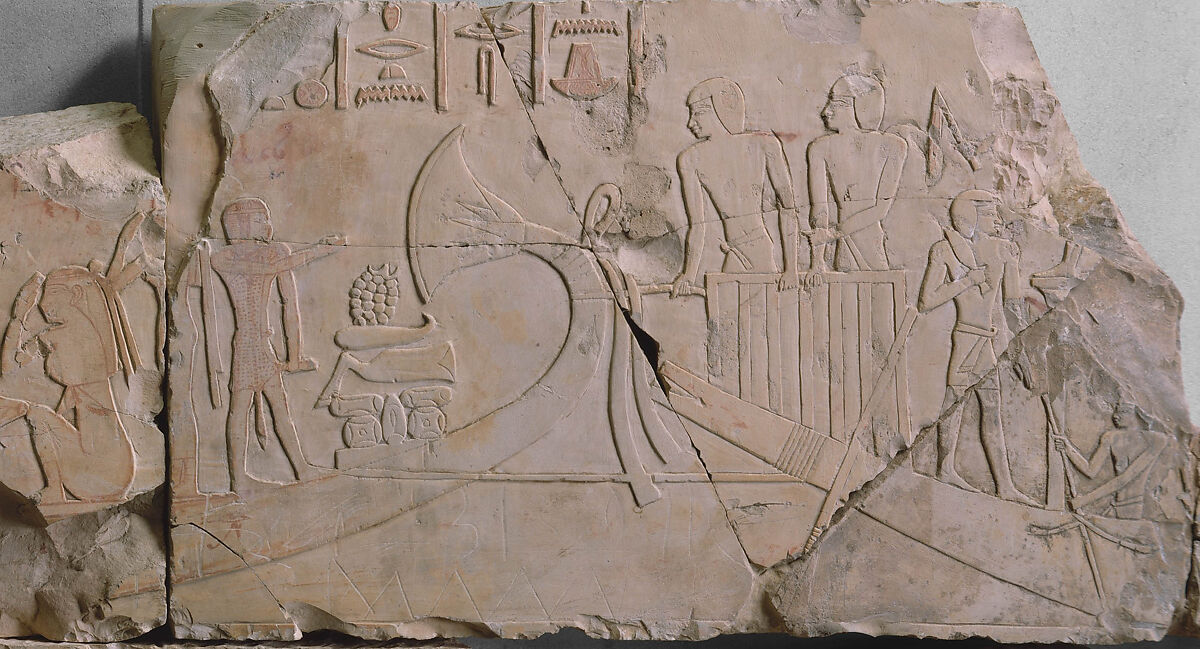
From the MET's collection of the Late Period

Late Period Egyptian Line of Battle

Now, as a designer I must take all the relevant information into consideration and try to figure out how the Late Period Egyptians can be represented in the Men of Bronze unit types.  It seems clear to me that we need a few different lists; one for the Battle of Pelusium (26th Dynasty or Saite Dynasty) period, one for the later Egyptian Revolts (27th Dynasty) and then then possibly the last days of the Egyptian independence in the 28th- 0th Dynasty using the capital of Mendes prior to the Persians re-taking direct control of the region.

Saite Dynasty

The bulk of the troops in the Saite Dynasty will have a core of Drilled Infantry and Archers.  These will be backed by Mercenary Peltasts and Warband infantry of conscripts.  Finally, I think the Saite Dynasty list will probably still contain a Light Chariot force. 

Saite Dynasty Line of Battle

0-1 Light Chariots*

0-2 Drilled Infantry

1+ Archers

0-2 Mercenary Peltasts

0+ Warband Infantry

0-2 Psiloi

Chariots

The Saite Dynasty Light Chariot will use the same profile as the Light Cavalry with the following special rules.  They must have the Bow upgrade in the Saite Dynasty list  

Later Egyptian Revolt

This list is intended to represent the Egyptian forces versus the Persian troops during the revolt of 460 BCE.  In this list, there is a stronger Greek component to it as the Athenians came to support the Egyptians in an attempt to weaken the Persians power around the Mediterranean Sea.  The Athenians engaged in this "empire- building" just prior to the outbreak of the Peloponnesian War.  

There intervention in the area proved to be ineffective as the Persians crushed the revolt and send the Athenians packing.  Two different sources cover the results, with one saying few Athenians survived and the other claiming they left relatively intact.  Most historians believe that Thucydides version with heavy Athenian losses is much more accurate.  

The Athenian intervention in the Egyptian Revolt could be the basis for a great short campaign as there were a few notable battles, sieges, and even naval battles involved.  Plus, there is great scope for "fleshing out" some of the smaller skirmishes or unrecorded battles as well.  

Troops wise, the Egyptians will mostly be Drilled Infantry, Warband Infantry, and Archers.  This list will have no chariots or cavalry.  However, it will have a stronger component of Greek mercenaries, including some Hoplites to represent an Athenian contingent.    


This list does have an interesting modelling opportunity depending on the "commander" you wish to use.  The command element could be an Athenian commander.  However, if you choose an Egyptian commander, this would be a great chance to model an officer in a chariot to integrate into a unit as the "leader" of an infantry or other unit.    

Egyptian Revolt Line of Battle

0-1 Drilled Hoplite OR Light Hoplites

0-2 Drilled Infantry

0+ Warband Infantry

1+ Archers

0-2 Mercenary Peltasts

0-2 Psiloi

Mendes Dynasties

The final Dynasty's of an independent Egypt used the city of Mendes as their capital.  Therefore, I refer to this last few Dynasties as the Mendes Dynasties.  "Free" Egypt was contained to a relatively small area in the Nile Delta.  However, despite this smaller footprint, it still contained many of the most important sites in Egypt.  The Persians continued to control the rest of the Nile valley down to Nubia.  

The armies of the Mendes Dynasties had a two fold purpose; defend the homeland and to claw back the rest of Egypt.  They were predominantly an infantry and archery force.  Much of their time was spent garrisoning cities and defending from Persian attempt to re-occupy the area.  

However, these later Pharaohs still had designs abroad as well.  Nectanebo I and II both cast their gaze on launching campaigns into Palestine and the eastern shore of the Mediterranean.  This was a traditional "sphere of influence" for Egypt and the Dynasties wished to rest control of the regions trade from the region.  However, these plans never really were able to get off the ground.  

These later Dynasty armies were mostly garrison forces and therefore relied heavily on Infantry and Archers.  The Greek mercenaries were less prominent and probably had a lesser heavy infantry role again.  The role of chariotry and cavalry is much less clear during this time, and I tend to think they were a non-entity during this period.  However, the Leaders probably still used chariots as their status symbol/command platforms.  

Mendes Egyptian Dynasty

0-4 Drilled Infantry

1+ Archers                              

0+ Warband

0-2 Mercenary Peltasts

0-2 Psiloi

Sample Lines of Battle

Below you can see some sample armies built from the Lines of Battle provided.  These give you an idea about what your force could look like.  They are built to a 38 point force.  They range from 5-8 Units per army.  

Saite Dynasty

  • 1 Light Chariot-  Commander
    • Bows
  • 1 Drilled Infantry
  • 3 Archers
  • 1 Warband Infantry
  • 1 Psiloi      
Egyptian Revolt
  • 1 Drilled Hoplites- Commander
  • 1 Drilled Infantry
  • 2 Mercenary Peltasts
  • 3 Archers
Mendes Dynasty
  • 3 Archers
  • 2 Drilled Infantry- 1 w/Commander
  • 1 Warband Infantry 
  • 2 Psiloi
Battle of Papremis (460 BCE)
During the Egyptian revolt, the Athenians re-routed a force near Cyprus to the region.  It was commanded by an Athenian admiral named Charitimides.  It is unclear if the Athenian assistance in Egypt was his full force, or just a detachment.  Initially, this force was intended to harass and reduce Persian influence in the Med.  The re-route to Egypt seems like pure opportunism by the Athenians to cause a head ache to the Persians.  

Diodorus, Herodotus, and Thucydides all reference this battle.  However, despite the three sources there is very little detail about the battle itself.  We know next to nothing about the force composition.  All we know is that the Persians outnumbered the Athenians and their Egyptian allies when it comes to the two forces.  

Papremis was one of many cities in the Nile Delta.  The Persians were camped near the city along the Niles banks.  Once the Athenian forces arrived, they accepted battle with the Persians.  The Persians had an initial advantage as they had the greater numbers.  However, the tables were turned when the Athenian forces broke through the Persian line.  This caused the Persians to fall back to the "White Castle" which was a citadel in Memphis.  The Athenians won the battle, but the Persians were able to successfully withdraw and remained a threat in being. 


Forces
As usual, we know little of the forces involved.  These are some "best guess" lists based on the army lists provided above and the Men of Bronze rules.       

Egyptian Revolt
  • 1 Drilled Hoplites- Commander
  • 1 Drilled Infantry
  • 2 Mercenary Peltasts
  • 3 Archers
Persians
  • 3 Archers
  • 3 Drilled Infantry
  • 1 Psiloi
This Scenario could be either the Decisive Battle scenario from the Men of Bronze rulebook.  However, I could also see using the any o the scenarios if you wished.  We know little of the actual battle so any scenario can work.  Persians could be trying to ravage the countryside around Papremis or the Persians could be fleeing back to the gates of Memphis to represent the end of the battle as well.  

Set-up
This battle is played on a 48mu x 48mu board at a minimum.  This battle takes place near the banks of the Nile.  Therefore, I recommend placing a bit of river terrain on one of the flanks of the battlefield.  This should be impassable terrain as the Nile was pretty tough to cross.  The rest of the board you can deploy terrain per the normal rules found in the Men of Bronze rules.  

Special Rules
You can choose to play this scenario with no complications, or choose them as you and your opponent wish.  This scenario does not use any special complications.  

Victory
Use the normal victory conditions for the scenario as found in the Men of Bronze rules.  

Conclusion
We now have another interesting corner of the Greek world that we can use and highlight with Men of Bronze.  Interestingly the main antagonist for this list if probably NOT a Greek foe, but the Persian list in the rules.  The Greeks are more of the "Special Guest Stars" in this theatre and the Persians are more of the stars! 

There are a surprising number of primary sources, but they have scant detail.  Secondary sources are also very light for this timeframe.  That can be a blessing for wargamers as it gives us space to fill in what we need/want from our games.  This period has great fodder for linked battles, campaigns, and unique scenarios.  

In comments, please let me know of any model ranges in 28mm that would be good for these rules.    

You can get all of the updated materials including a FAQ, Campaign rules, and Lines-of-Battle in the Men of Bronze Supplement: Hercules Abroad.


You can follow Blood and Spectacles Facebook page for more fun: https://m.facebook.com/pg/BloodandSpectacles/posts/?ref=bookmarks&mt_nav=0

Or our website:

Or our Messageboard:

Or our Wargames Vault Page:

Monday, March 15, 2021

On The Painting Desk- Friends, Romans, Countrymen! Led me your paint!


The goal was to build a Roman army by November.  That is when Osprey's Wars of the Republic is due to come out.  I had been busy playtesting with Paper Templates but for the release and general play going forward I wanted to migrate to actual models!  

When we last left off, I had assembled the basic army using Victrix Republican Romans in Pectoral Armor.  This allowed me to put together enough models for the baseline army list I wanted.  This included the following units: 

  • Skirmishers
  • 2 Hastati
  • 1 Principes
  • 1 Triarri
However, I also had more than enough models for additional units further down the line.  However, these units were my initial goals by November. 

I had assembled all the units and undercoated them white.  I then painted their flesh.  Here is what it looked like...


One of the big questions I had for myself was how soon to switch to painting individual units versus painting them all together in a batch.  During the early Republic, Roman troops were levied and they had to supply their own equipment.  That meant each troop would have some level of uniqueness to them, even though they tended to get similar equipment.  How to paint efficiently while capturing some of this uniqueness was going to be critical.  

I looked across the troops, and looked for some things they all had in common.  They were all wearing sandals, they all had tunics, and they all had similar armor.  Therefore, if all their armor was bronze, I could paint all the Bronze at once.... in theory.  I also like to paint from the lowest level of a model i.e. skin; and then layer upwards to clothes, then armor, and finally weapons.  So I started by looking for batch painting opportunities first.  

I started with their Roman sandals....


I used three different colors to paint the Romans sandals.  I divided them into small groups, so the first two rows across the units got color 1, the second two rows got color 2, and the remainders got the final color.  I was using army painter paints.  I have to admit, after painting 100 sandals..... I was starting to question my life choices.  

You may have noticed that none of these Romans have any shields yet.  I always paint the shields separately and last.  Therefore, I tackle painting all the troopers and then switch over to their shields.  That being said, the easiest unit to "complete" was going to be the Skirmishers since they did not have shields at all!  After batch painting all those sandals I decided it was time to break into the individual units for a bit. 


 The eagle eyed amongst you may notice that these guys do not have the traditional Wolf pelts associated with Roman Velites.  The reason is simple.  These guys are not Velites.  Prior to Velites the Romans used standard Skirmishers.  The main difference is that Velites had javelins, long daggers, and small shields.  Skirmishers skip the shields and wolf pelts.  They are even lighter troops.  In the rules, Velites are treated like Light Infantry such as Peltasts and other Javelin and Shield armed soldiers.  

From there, I was going into a weekend where I did not think I had much time to paint, so I decided to paint just the 4 banner bearers.  Signifiers I think they are called.  


Then, after finishing those guys, I dug into the "leader" models.  In Wars of the Republic the leader model acts as the focal point of the unit.  The unit forms up around the leader, uses the leader for measuring distances, and uses them for Line-of-Sight purposes.  Therefore, you want to be able to see who the leader of the unit is at a glance.  I wanted to paint them individually.  


The guy on the left kind of looks like a thin, small Roman Thanos.  LOL.  

After completing these guys, I decided to go back to do some batch painting on tunics.  Like before, I just put paint pots next to lines of troopers and went from there.  I used two colors of blue, red, yellow, green, and white as my tunic colors.  The bulk of my troops I wanted in white robes as once I washed them they tended to look very impressive. 


 At this point, each unit only had 8 men to paint at a go.  That left me in a very manageable position to finish individual units 1 weekend at a time.  Then, once all the troops were done I could finish the shields in 1 weekend as well.  That meant I had about 5 weekends of work left to finish off the initial batch of Romans.  

While I was painting these guys, I did have some helpers along the way.  


My cat Oreo helped me decide on colors to use for sandals and tunics.  


My other cat Blink was less than impressed with my progress.  He felt we should have wrapped up and put everything away much sooner.  He wanted to lay in the sun but my table was in the way.  Hummphf. 


 As I finished up the tunics, Oreo wanted to remind me NOT to drink the paint water.  She wanted it and considered it a special treat.  Especially before bedtime! 

Maybe next time my dog and third cat will give me a hand.... errr..... paw too?  


Monday, January 25, 2021

Men of Bronze- The Etruscans


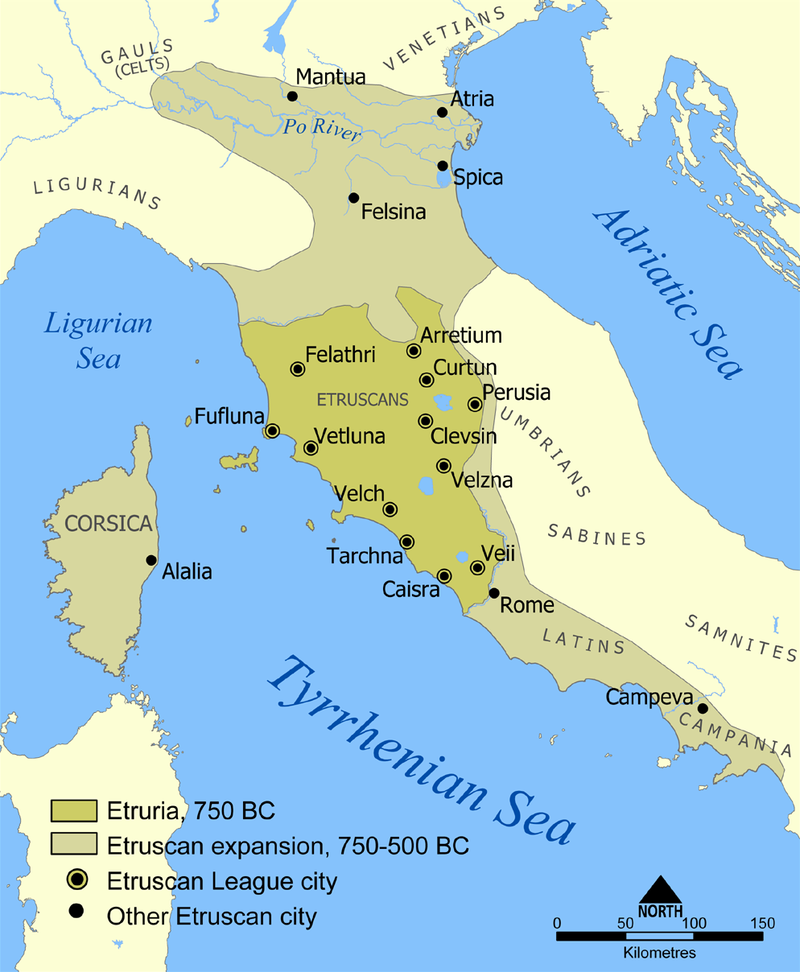
Most of the time, we associate the Etruscans with the rise of Rome.  This is true, but the Etruscans were not just rivals of Rome, they were also early rivals of Carthage and the Greek settlers into the western parts of the Mediterranean.  There was a period known as the Etruscan Expansion that brought Greeks and Etruscans into conflict.  Most of the documented battles were at sea, but where there is conflict at Sea, there is also conflict on land.  Since we have no remaining written Etruscan sources, such details have likely been lost to history.  

Who Were the Etruscans? 

The Etruscans were a loose confederation of powerful city-states of the North and Central Italian peninsula.    They were a regional power from 600 BCE to about the 4th Century, when they were caught between the rising power of Rome, and the expansionist nature of the Celts.  

Legend has it that 12 cities were part of this League.  Despite the existence of the League, Etruscan cities were fierce rivals and were not above feuding and fighting amongst themselves. 

The Etruscans themselves have very little written evidence that remains of their civilization.  Instead, we must rely largely on Greek and Roman accounts from a legendary age.  The other main source of information is archeology.  The Etruscans may have been colonists from Anatolia, but had a complex relationship with their mostly Greek neighbors and trading partners.  They entered and conquered much of the Northern Italy around 510 BCE. 

It has been theorized that much of the early culture of the Roman military came from the warrior culture of the Etruscans.  Some have theorized that Rome herself was a colony or vassal of the Etruscans in its early history.   Like the Greek city-states, the Etruscan model had social classes that made up the composition of the army.  The defining characteristic was the ability to purchase bronze arms and armor. 

The Etruscan elites made extensive use of sea borne trade.  They had extensive contacts with the Greek colonists of Magna Graecia and also the Greeks found in Sicily.  Greek pottery was a favored trade item.  Many of the existing examples of Greek pottery were found in Etruscan tombs.  Despite having many cultural similarities with the Greek City-State system, the Etruscans were a less egalitarian and more aristocratic society.  The tombs located with Greek pottery were family tombs of the Etruscan elite, an not for individual burials.     

How Did They Fight?

The main fighting force of the Etruscans used the Hoplite Phalanx method of combat.  The richest could buy the bronze shield, cuirass, and helmet needed.  These men represented the warrior elite.  From this class, the Etruscans formed a phalanx, cavalry, and even some specialized engineering units.  They acted as a “standing army”

The next levels were levied in wartime.  They were also equipped as Hoplites, but with less expensive equipment such as a wooden shield, or smaller breastplate.  The final two levels were slingers, skirmishers, and archers.  The poorest members of the society would not be used in combat operations at all.

It is believed that the Etruscan army was exclusionary in nature.  The main fighting force was probably drawn from those who were descended from the Anatolian settlers and acted as the aristocracy.  The native Italians formed the lower ranks of the military.       

Such a societal and military model meant many people were excluded from military service due to class and ethnicity.  Therefore, the Etruscan forces were not able to draw on the same manpower pools as their neighboring rivals such as the Gauls and Romans.  To supplement this, the Etruscans had to make use of vassals, allies, and mercenaries.

The Etruscans frequently used cavalry, however they preferred to dismount and fight on foot.  The horse  and chariot was a tool used for mobility and not fighting.  This meant they had heavier equipment, and would only stay mounted when fighting other cavalry units. 

The Etruscans had a warrior culture, and also had warrior brotherhoods.  They were skilled warriors and took devotional oaths to never retreat in battle.  This frequently formed a commanders “bodyguard” unit and could have been Hoplites, Axemen, or horsemen. 

Unlike other contemporary cultures, such as the Romans or Greeks; the Etruscans seemed to make use of the Axe.  It is unclear if they were mostly ceremonial or a weapon of warfare.  One theory has the armored axemen being used to cut enemy spear points off and pull down the shields of a Phalanx with heavy blows against the shield’s face.  This would allow a gap in the shield wall that fellow soldiers would then exploit.  However, this practice seems to have been abandoned during the 4th century. 

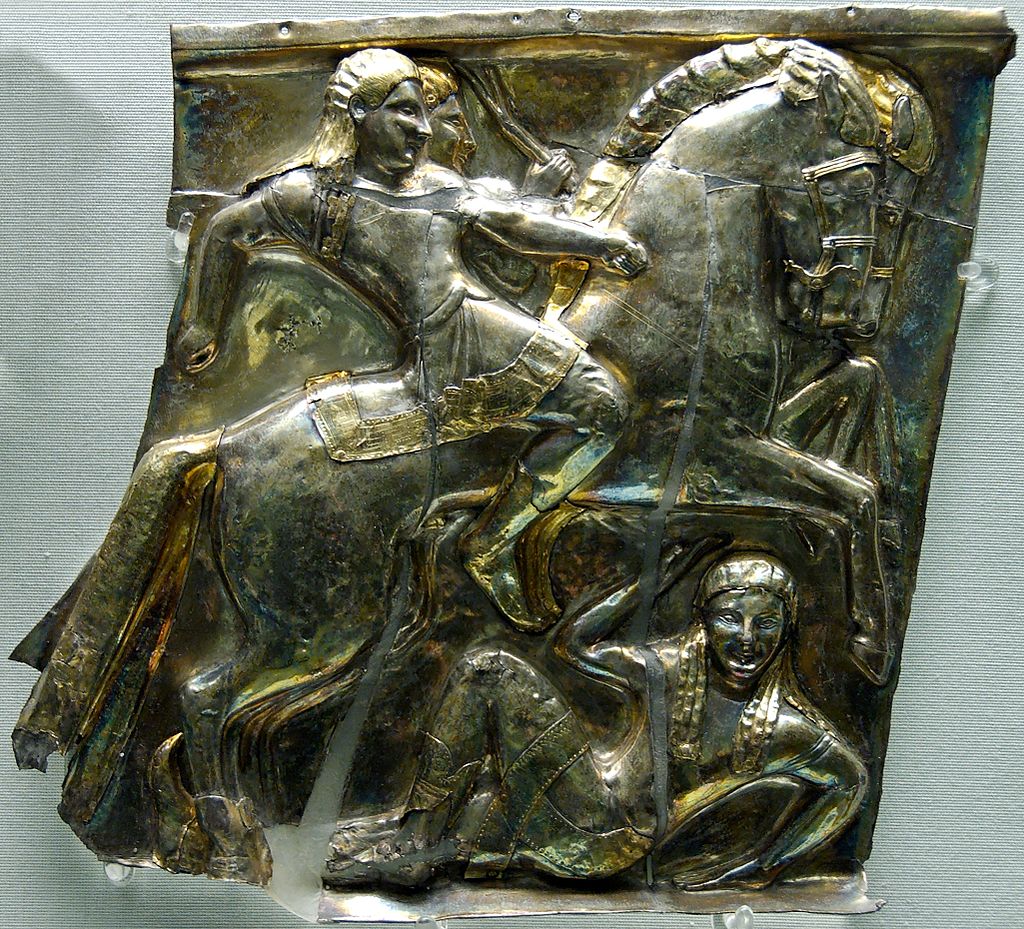
Illustration of Etruscan Warriors from Warry's: Warfare in the Classical World 

Building the Etruscan Line-of-Battle

The nature of Etruscan warfare allows us to make use of them using many of the Units found in the main Men of Bronze rules.  

When you look at the Etruscan military structures, there are two big questions to address.  The first is the extensive use of the Javelin as a prelude to Phalanx combat.  The main battle line seems to have exchanged Javelin fire prior to closing in an attempt to disrupt the enemy formation.  These pre-clash Javelin barrages seem to be a unique feature of warfare on the Italian Peninsula as opposed to battles in Greece and Persia.  There, Javelin men and light troops had a more distinct role separate from the Hoplite battle line. 

The second element to discuss is the role of Axemen within the Etruscan Hoplite formation.  Again, this is a unique element designed to disrupt the opponent's shield wall.  Javelins were to disrupt before and just prior to contact, while the Axemen were to disrupt during contact.  The tactic also seems to have fallen out of favor, so one must question its effectiveness on the battlefield.   

The easiest answer, is to not incorporate these elements into any special rules.  Instead, you could just keep them as separate units.  Javelin men could be Peltast and Psiloi as the units in Men of Bronze.  Axemen could simply by a form of Drilled or Elite Infantry.  In this scenario they are individual units in the Hoplite battle line instead of incorporating them into the battle line with special rules.  

The other alternative is to create an alternative "Special Rule" that is triggered by the use of an Arete point.  This special rule could either increase their attack value, or decrease the enemies Armor value to resist damage.  Upon review of how these Javelin and Axe tactics were designed to work, it seems as if reducing an opponent's armor rating aligns better with the tactics intent.  It was supposed to disrupt the enemy shield wall. 

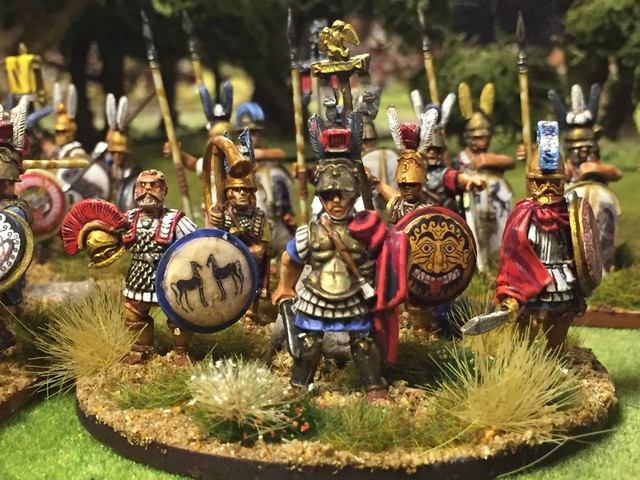
Kit Bashed Etruscans with Axemen and Javelin Men from various Victrix LTD Kits


DisruptionTherefore, let's introduce the following Special Rule for Etruscans: 

Units with this Special Rule have the following rules applied to them:

       Units that charge automatically use this ability if they paid the Arete Point token to charge.

       The unit that is being charged has their Armor rating reduced by 1 to a minimum of 1.

       If a unit is charged by the enemy, they can spend 1 Arete Point to use this ability.  The attacker has their Armor rating reduced by 1 to a minimum of 1.

       This reduction only lasts for the turn that the charge occurs.    

Ultimately, I will try to incorporate both solutions into the rules for the Etruscans in Men of Bronze.  I will make some tweaks to their actual forces available to them, and also apply a new Special Rule unique to this army.  In addition, the Disruption Special Rule will allow you to put a few Axemen into your units as opposed to only have a sperate unit of them!

Etruscan Line-of-Battle

Use the following lists to build your historical forces for Etruria. The Lines of Battle help to choose the appropriate units for your historical forces. These are sample lists and there to provide a flavor of potential forces. Players can always modify these lists as they see fit

Each Line of Battle will have an entry with a number. The number indicates the limit of that Unit you can take in the army. If an entry says 1+ your army must have at least one of these units in it. If it is 0+ any number of that unit may be taken. If a Unit is not on the list, it can not be chosen.

Etruscans

0-1 Elite Hoplites*

0+ Drilled Hoplites*

1+ Militia Hoplites*

0-1 Psiloi/Slingers/Archers

0-2 Drilled Infantry*

0-1 Light Cavalry

*- Unit can be given the Disruption Special Rule for +1 point    

In the army list above, you can see that the Disruption rule is being used to replace an individual unit of Peltasts and leaving only a single psiloi at the expense of archers/slingers.  It helps make the list unique from other Greek lists.  In addition, the adding of Drilled Infantry for additional Axemen does the same.  This makes the army relatively "aristocratic" and "Elite" in nature. 

Finally, the Disruption Special Rules gives us the final ingredient to help us capture the nature of Etruscan fighting compared to their Greek rivals in Magna Graecia and abroad.  

Sample Army List

Below you can see a Sample Army built from the Line of Battle provided.  It is intended to give you an idea of what an Etruscan Force could look like on the battlefield.  It is built to 38 points, and has X Units.  

1 Drilled Hoplite 

    - Disruption

1 Drilled Infantry

    - Disruption

2 Militia Hoplite

1 Psiloi

Late Etruscans from Aventine Miniatures:
https://aventineminiatures.co.uk/img_5812/

Battle for Corsica

Most of the recorded fighting between Greeks and Etruscans took place at sea.  This included the Battle of Alalia and the Battle of Cumae.  The Etrsucans were allied with the Carthaginians, who wanted to shut the expansionists Greeks out of the Western Mediterranean.  On the line were valuable trading points in Corsica and Spain. 

The Phocacaeans were settlers from Greek Asia Minor.  They were spreading westward, and had founded a colony on Massalia.  The Carthaginians had tried and failed to thwart these Greek efforts.  The Greeks also founded a city on Corsica called Alalia.  After the Ionian Greek coast fell to Persia, many of the Ionian Greeks fled to Alalia.  From here, the Greeks began to cause problems with the Punic and Etruscan trade routes in the area.   

The Carthaginians and Etruscans decided to put this menace down.  This time, the Greeks faced off against a combined fleet of Etruscans and Carthaginians in 540 BCE.  The Greeks won the battle.  However, they were forced to fall back to Rhegium.  Despite winning the battle, the Greeks had to flee and eventually gave up in Corsica. The Greeks founded Elea in Magna Graecia instead. 

This allowed Etruscan forces to establish themselves on Corsica, and to secure it.  Again, since the Etruscans records do not survive, and the Greek records are also scarce, much of this time period in the Western Mediterranean is poorly documented.  This gives us as Wargamers some space to operate and create "What If" or speculative scenarios for our games to operate.  

In this case, we will assume that the remaining Greek colonists in and around Alalia have joined forces to defend themselves from the Etruscan advance into the region.  To aid them, they have allied or hired groups of Corsi (and other local tribes) to fight as light infantry forces.  In the meantime, the Etruscans have moved to solidify their hold on the island and re-exert their influence.  The Etruscan army is made up of adventurers, brotherhoods, and nobles from the newly formed Etruscan League eager to expand their power.  

Forces: 

Etruscan League

1 Drilled Hoplite- Disruption

1 Drilled Infantry Axemen- Disruption

2 Militia Hoplites

1 Psiloi

Ionian Greeks and Allies

1 Drilled Hoplite

2 Militia Hoplites

2 Peltasts - Corsi and Others

1 Archer - Corsi and Others

There are no actual records of such a conflict, and indeed the people of Alalia may have actually just let Etruscan administrators enter the city and take over.  Who knows?  However, as wargamers it is more fun to create a conflict even if there are no documents to support any of it.  We just know the Etruscans and Carthaginians fought the Greeks in a few Naval battles around the Itallic, Sicillian, and Corsican coasts for control of the trade routes.         

Set-up:

This battle, could be a coupe of scenarios from the Men of Bronze book.  Indeed, it could be fun to create a series of linked battles into a small mini-campaign.  However, for this battle we will make it a stand-up fight between the two groups just after the Etruscans have made landfall in their Pentekonters (pre-Trireme even!) ships.  Prior to the battle, I imagine the Etruscans would make their claims to Corsica as Spear-won land, while the Greeks would assert their independence.  They would then agree to engage in a ritualized combat to decide the matter, with the winner raising a trophy and claiming Alalia without further bloodshed.  Battle in this period between city-states was ritualized, but Etruscans tended to fight for spoils and slaves; so perhaps battles between cultures would be less formalized?  We really do not know.  

This game should take place on a 72 Base width by 48 base width board.  Deploy terrain and roll for complications as normal.  Deployment in such a ritualized battle would also follow that found in the main rules.  Use the Set-Piece Battle scenario as a guide. 

 Special Rules:

This scenario is designed to allow players to feel how Etruscan armies play versus a traditional Greek army.  Therefore, no special rules are needed. 

Victory: 

Victory conditions should be the same as for a Set-Piece Battle scenario in the main Men of Bronze rule book.  


Final Thoughts

The battles between Etruscan and Greek colonists of Magna Graecia took place long ago and are poorly documented.  However, the Greeks were an expansionistic culture, and the Etruscans were an established trading empire and military force on land and sea.  It is inevitable that these two cultures would clash!  These clashes took place before Salamis and before Himera even.  They were long standing grudges.  Despite our knowledge mostly involving Naval battles the endemic raiding and warfare of the period does not preclude land conflicts as well.   

The Etruscans in addition to fighting Greeks from the Men of Bronze rules could also encounter the Carthaginians and Barbarian Tribes from the main rules.  These conflicts would eventually be put to an end by the rise of a third power house in the region; Rome.  

You can get all of the updated materials including a FAQ, Campaign rules, and Lines-of-Battle in the Men of Bronze Supplement: Hercules Abroad.


You can follow Blood and Spectacles Facebook page for more fun: https://m.facebook.com/pg/BloodandSpectacles/posts/?ref=bookmarks&mt_nav=0

Or our website:

Or our Messageboard:

Or our Wargames Vault Page: