Showing posts with label Persians. Show all posts

Monday, September 28, 2026

Wargame Design: Heirs to Empire - The Late Persian Army


This is a ruleset that has been out for a while now, and the focus is on the wars of the Diadochi after the death of Alexander the Great.  Therefore, all your favorite Greek generals get a shout-out and have their own Lines of Battle.  However, one thing I do not think the rules cover very well is Lines of Battle for the Late Persian Army or rather Lines of Battle for rebel Persian Satraps who mostly drew their forces from the remains of the Late Persian Army.  We know from the sources that Perdiccas and others had to contend with rebel Persians after Alexander's Death.

Therefore, this will be a post where I try to rectify that situation and "build a better" Late Persian list to be used in your games.  This is not the first time I have gone back to add a new Line of Battle for this game.  Long-time readers and fans will recall my efforts to add a Mauryan Empire list to potentially face off against Seleceus during his Eastern Anabasis.  You can find that here.  The very sharp-eyed of you will also see that I updated the games cover since those halcyon days too!  

This is also not the first time going to take a closer look at the Late Persian Army for me either.  The Ionian Revolt supplement for Men of Bronze also has an updated Line of Battle for the Late Persian army to update it from the core rulebook.  Therefore, the list you see here will build off this as a source.  That supplement also details many of the foes of the Persian Empire as well and is a great resource for those of you who want to expand your games with Persian armies.  I think it is also important that Heirs of Empire was written before The Ionian Revolt so my thinking and scholarship around these forces has evolved.   


Who Were the Persians?

The Persians were a vassal tribe of the Medes from the Iranian steppe. Their king Cyrus the Great led them to victory over the Medes, and then the Babylonians, and finally the Lydians.  At this point, the Achaemenid Empire was declared.  The empire continued to expand outward under other kings.  At its height, it covered the majority of the known world, stretching from the Indus River Valley to the Balkans to Egypt. 

Cyrus and his descendants brought a new model of control to the region.  The Assyrians had brought a reign of terror for their subject people including royal massacres, forced deportations, destruction of temples, and brutal military tactics designed to cause terror.  The Medes and the Babylonians followed this successful example.  However, when Cyrus took over he did not bring brutality with him.  Instead, he offered stability.  His empire respected local religions, kept local leadership in charge, and showed mercy.  The Persians had a relatively hands off approach to their provinces as long as the taxes were paid, the levied troops provided, and the Kings orders were followed.  This approach allowed the Persian Empire to flourish and grow.    

In addition, the Persians brought an efficient bureaucracy and administration to their holdings.  They built infrastructure like the great Royal Road that crossed the Empire.  This infrastructure allowed a series of message relays and a post-offices that made Royal communications swift.  In addition, the infrastructure allowed the King’s soldiers to get from one end of the Empire to the other rapidly to maintain order.  They also professionalized government officials and created a professional army.  

The Persians were very wealthy from the taxes they collected from their subject people.  They used this wealth shrewdly to expand trade, professionalize their leadership, and to de-stabilize their enemies.  After the Greco-Persian Wars, the Persians cannily used their wealth to play one Greek city-state off against another to keep them focus inward instead of on the Persians.  This policy was very successful for a number of decades as internal warfare kept the Greeks mostly focused inward.

The Persians were a religious people.  They believed in the Flame of Truth and its avatar Ahura Mazda.  To their way of thinking, as the Empire expanded they rolled back the darkness and brought the light of Truth.  Ahura Mazda was leading them to expel the darkness.  Despite this religious philosophy, they did not expect their subject people to convert to their religion or abandon their own gods.  Instead, the empire was tolerant of local custom and religious practices.  

The Persian Empire began to decline as outside pressures grew.  The taxation burden became heavy on the satraps who controlled the various provinces, and the economy began to stagnate from too much wealth not being re-invested.  In addition, the Empire’s hands off approach meant that no national identity or larger shared ethnic identity was ever achieved for the empire.  Therefore, when Alexander and the Macedonians took over, there was not real change to the average Persian Imperial citizen’s life.  They continued on much as they had before.      

How Did They Fight? 

By the late period of the Persian Empire, the way that they fought had evolved a lot over the centuries.  Generally speaking, by the late period the army was made up of 2 main branches.  They were the infantry and the cavalry.  There was also several "novelty" units like scythed chariots, camel cavalry, war elephants, and mercenaries like Greeks.  

Persian Infantry was drawn from across the Empire.  However, the backbone was the Medes and Persian troops.  These were primarily armed with spears, swords, and most importantly bows.  The Persians specialized in range firepower.  From there, other troops came from across the empire to fill their own niches like skirmishers, light troops, etc. However, as the Empire came apart access to these auxiliary troops became restricted.  

Much has been written about the Kardaks as a troop type in Late Period Persian armies.  I tend to think that this was a reference to Persian troops.  It is unclear who they are, but they were light and heavy troops of various branches of the military.  It does not seem like they were a unique unit type and could possibly be "new recruits" or troops still in their training phase.  

Perhaps the most important arm of the Persian Late Period army was the cavalry.  Again, this was mostly Persian nobles who were the Heavies.  However, they also had lighter cavalry made up of allied groups like Bactrians or Sogdians.  The infantry would pin down the enemy troops with archery while the cavalry would maneuver for flank attacks.  The Persian army was known for its mobility as well as its size.

What draws many people to the Persian Army is their novelty units.  They had a wide variety of mercenary and specialty units in their forces.  This included Greek Mercenaries of the heavy and light variety.  War Elephants from India, Egyptian Marines, Camel cavalry from Arabia, and Scythed Chariots from the Steppe all had their place in the Late Empire army.  Of course, after the death of Darius and the sundering of the Empire access to all of these troops might no longer be available thereby limiting the Line-of-Battle.                      

Building the Line of Battle for Late Persians for Heirs of Empire

It may have been a while since you have looked at the rules for Heirs of Empire.  However, it is a game that makes use of army wings on the table.  Therefore, the Lines-of-Battle focus on what units can make up the Left, Center, and Right of the army.  

We know that traditionally the Core or center of the army will be the infantry forces with the cavalry moving around on the flanks.  We saw this formation during the famous late period battles against Alexander.  Therefore, the Line-of-Battle should match-up with these formations.  

I wanted to add some infantry with bow armed troops integrated into the units.  Therefore, I am adding the following option: 

Bows
The bow was an integral part of the Late Persian Army.  Bows were a cultural icon of the Persians, and therefore many of the Mede and Persian soldiers were equipped with a compound bow. Therefore, mixed units of infantry and bows was a common feature of their armies.  

You can add Bows to Epilectoi Cavalry, Asphract Cavalry, Drilled Infantry and Warband Infantry for +1 Point.  They would allow the unit to have the following added to their profile: 

Bows: Shoot 2 (12MU)

Hoplite Mercenaries
One of the biggest employers of Greek mercenaries was the Late Persians.  They used these mercenaries as their melee-shock infantry.  The Persians preferred the bow and cavalry tactics.  Therefore, they were happy to let the Greek Hoplites be their heavy infantry.  

They have the following profile: 

Mercenary Hoplites                                                5 Points
Move    Attack     Armor    Courage     Discipline
6 MU    3            1                4                3

Special Rules: Phalanx, Drilled, Counter-Charge

Scythed Chariots
Part of the Late Persians "Novelty" units were the Scythed Chariots.  Xenophon writes a compelling account of how such units could be very effective against unorganized or isolated Greek troops.  However, against the Macedonians they were much less effective.  

They have the following profile:

Scythed Chariots                                                    5 Points
Move    Attack     Armor    Courage     Discipline
6 MU    3            1                4                3

Special Rules: Pursue, Counter-Charge

Other "novelty" units can be accounted for in the standard Heirs to Empire profiles.  For example, Camel Cavalry would simply be Asphract cavalry.  

Late Persian Line of Battle

The following is the Line-of-Battle for the Late Persians and their rebel Persian forces after the death of the Great King.   The Lines of Battle help to choose the appropriate Units for your Historical forces. Check the scenarios for starting point cost for a force. 

Each Line of Battle will have an entry with a number. The number indicates the limit of that Unit you can take in the army. If an entry says 1+ your army must have at least one of these units in it. If it is 0+ any number of that unit may be taken. If a Unit is not on the list, it can not be chosen.

Center: 
0-2 Skirmishers
0-2 Elephants
1+ Drilled Infantry
 -- Bows for +1 Point
0+ Warband Infantry
-- Bows for +1 Point
0-4 Archers/Slingers
0-2 Irregular Peltasts
0-2 Scythed Chariots
0-2 Mercenary Hoplites

Left/Right Wing: 
0-1 Companion Cavalry
0+ Epilektoi Cavalry
0+ Asphract Cavalry
0-2 Scythed Chariots
0-2 Elephants
0-2 Skirmishers 
0-2 Slinger/Archer 
0-2 Irregular Peltast 
0-2 Warband Infantry
-- Bows for +1 Point

Sample Line of Battle

Below you can see a Sample Army built from the Lines of Battle provided. It gives you an idea of what your force could look like. It is built to a 54-point force per the examples in the main rulebook. The Late Persians has 9 Units in the force. 

Center: 
1 Drill Infantry with Bows 
1 Warband Infantry with Bows
2 Irregular Peltasts
1 Mercenary Hoplite
1 Skirmisher

Left Wing: 
Epilektoi Cavalry with Bows
Scythed Chariots

Right Wing: 
Asphract Cavalry with Bows

Final Thoughts

These Late Persian Rebel Satraps will give a much different feel to a traditional Diadochi army.  Their hitting power is reduced up-close, but their ranged firepower is greater.  It will take a skilled commander to maneuver and fight these units against a Macedonian Phalanx force, but hopefully the extra troops and Commander's Gaze can give the Late Persian player an edge and the ability to "kite" against the harder hitting Phalanx units of the other Successors?  

I look forward to you giving them a try on the battlefield and letting me know what happens in the comments.  I think they lead to very different strategic and tactical challenges for your games of Heirs of Empire. 

Until next time.  


Become a Patron and get access to all the cool stuff, a peak behind the curtain of Blood and Spectacles, and early-access to playtest games!  


You can follow Blood and Spectacles Facebook page or Instagram for more fun! 

Check out the latest publications and contact me at our Blood and Spectacles website

Or purchase all out games at the Blood and Spectacles Publishing Wargames Vault Page!                       

Monday, September 23, 2024

On The Painting Desk- Persian Chariots


I have a pretty large Achaemenid Persian army all ready.  I painted it up to play the Ionian Revolt for Men of Bronze.  It has heavy and light cavalry forces, skirmishers, archers, Immortals, and Sparabara to make up the ranks.  However, one thing that I always wanted to add was some Persian Chariots.  Chariots had been a staple in Persian armies from the earliest periods all the way to the infamous scythed chariots used in the final battles against Alexander.  It felt odd not having more chariots in my force.  I had been bugging a few manufacturers to make a Persian chariot in plastic for a while now.  


Wargames Atlantic
heard my cries.  However, instead of just making a Persian chariot, they were much smarter than me.  They made a "generic" chariot kit that could be used with all manner of  chariot based armies!  They purposely left crew out of the kit, and gave you the space to put on any crew you wished from Persians, to Minoans, to Gauls, to Egyptians, etc.  Pretty clever really.  As soon as they were up for pre-order, I picked up a set, and I got a box of Persians to crew them. 

Most of my existing Persian force was from Victrix.  However, I had been happy with my Wargames Atlantic Dark Age Irish, so decided to give their Persians a shot too.  I could use extra soldiers to bulk out me large Persian force anyway.  I was contemplating putting on a Battle of Cunaxa from Xenophon's Anabasis.  As that was a civil war, the bulk of the troops would need to look like they came from the Persian army.       

I eagerly broke open the boxes to take a look at what I had gotten myself into.  First, I had been assembling a lot of Victrix and GW models in the last few years.  Therefore, I was a bit surprised when the boxes had no directions.  I gulped, hoping I would be able to figure it all out.  However, upon closer inspection, nothing looked to complicated.  

Chariot Sprues
 
Persian Infantry Sprues

Persian Chariots seemed to be a two-man variety, with two crew and four horses.  I based this take on the Gold Chariot model from the Oxus Treasure vault.  There is some speculation, that the Persians were the first to yoke four horses to a chariot.  Obviously, this set would only have two horses.  In addition, there were no parts for Scythes in this kit.  A few upgrades I think Wargame Atlantic could add to their 3D Printing Tribes options would be parts to make a four-horse and/or scythed chariot.   

I am going to go out on a big limb, and say that Scythed Chariots may not have actually been a thing.  What?  Impossible you say!  Xenophon talks about them, Alexander's biographers talk about them, and so do Romans!  How can you say they may not have been a thing?  Well, all of those sources are from a Western perspective.  There is not really any surviving details from an Eastern perspective.  It is possible, that Scythed Chariot is just a regurgitated trope about "exotic foreign armies" where the truth was something different.  

There is no doubt that Chariots played a role in warfare in the East.  We know that prior to selective breeding of horses to carry riders, they were the fastest way to get around.  In addition, not all areas were suitable for raising horses as strong, big, and skeletally sound enough to carry people.  Therefore, the Chariot as a weapon platform has a long history across the world.  However, Scythed Chariots?  Not so much data about them.  For example, the Oxus Treasure chariot model is NOT a scythed chariot.  In fact, I could not find any Persian references to them at all, but I am not an expert. 

However, whenever Western sources talked about facing off against Eastern and other "exotic foreign" armies the scythed chariot seemed to have been a trope.  The writers loved to talk about the vicious wounds that these weapons could inflict.  They also delighted in talking about how ineffective they were against the stars of western warfare "Heavy Infantry".  Therefore, I am not sure how much of the story of Scythed Chariots is propaganda, intended to entertain, or just a common trope of East meets West narratives.  Classic Historians were as interested in entertaining and story-tellers as much as they were interested in educating.  

Anyway, so that leaves the question how did the Persians actually use a chariot?  There are a few ways they could be used: 

  1. Shock platforms - Here is the "classic" example of the Scythed Chariot used in a charge to disrupt enemy formations through their speed, momentum, and power.  This is the de facto use in wargames for Scythed Chariots.   
  2. Missile Boats - Here is a more traditional Egyptian style of scooting around and firing arrows at the enemy.  In this model, they act more like a disruption and skirmish force, using speed to maneuver, get into firing position, and then get away before the enemy can retaliate.   
  3. Battle Taxi- In this style, the Chariots just move heavily armored soldiers around and drop them off in the thickest fighting.  This is the Homeric style.   
  4. Skirmishers - This is a similar approach as traditional cavalry, where they go out and attack stragglers, small groups, or chase down broken foes.    
Xenophon talks about them as both option 1 and option 4.  However, I find it very likely that Persian chariots probably made use of bow-armed troops.  After all, Persian armies focused on speed and firepower for their success.  Cavalry and lightly armored troops with missile weapons were the norm.  Therefore, I find option 2 to be a very compelling use case for a chariot in Persian armies.  


After putting together the models, I find it hard to believe that chariots could ever be used as a Shock platform, they are delicate little things.  I also have a hard time believing people fired arrows from the back with any accuracy.  You would feel every bump!  They must have raced to an area, stopped and fired, and then got going again.  

It is important to note that we never hear about Chariots being a decisive force in either Persian or Greco-Roman sources.  They are treated as just another form of cavalry.  In fact, Sources seem to indicate that they may not have been deployed in their own units, but were probably spread across the frontage of infantry units to act as Skirmishers themselves.  Again, these seems to lean towards Options 2 and 4 as compelling ways for the Persians to have used them.  It is unlikely they would have been operating in large swarms of Chariots!

Granted, the most common Persian enemy was Steppe peoples.  This was a mix of horse mounted troops and foot infantry but most likely lacking the heavy infantry we see in Western armies.  Against such light foot-based foes, the Scythed Chariot may have been very successful!  Sadly, we know very little about the Persia campaigns away from fighting Westerners.  The Persians themselves left us few records on the topic.    

All of this to decide a simple question, how many men in the chariot and how to equip them?  Looking at the model, I think I can only fit 2 in each car.  Therefore, I will try to have 1 soldier/driver and 1 archer.  This fits my conception of how the Persians would use chariots as another form of mounted skirmisher rather than a shock unit on its own.  I am sure others will feel strongly a different way, and I would love to hear your thoughts in the comments below.  


All crewed up.  I decided to give this guys all armored bodies.  An investment in a chariot must have been pretty steep.  You would probably try to make is survivable with some skilled soldiers in it.  I also kept the horses, cars, and riders all separate for ease of painting.  


With that done, it was time to go onto painting.  The first step was undercoating.  My original Persians I brush under coated with cheap white acrylic paint.  I did not want these guys to look noticeably different, so I figured I better do the same with them. 

This proved to be a big mistake.  I had trouble getting my Armypainter paints to adhere very well to the models.  In the future, before assembling Wargames Atlantic miniatures I think I will want to give them a bath in warm, soapy water to make sure any manufacturing chemicals are cleaned off.  These can make paint adherence and issue.  In addition, you may want to consider using a plastic spray primer instead of brush priming with a white acrylic.  I think the smoother application of a spray would help resolve this issue.  

I also went back to take a look at my Persian Cavalry, and tried to paint my Chariots in a way that will "fit in" with my existing units.  That meant lots of "natural" colors in yellow and brown, with some accents using orange, light blue, and purple.  I wanted my charioteers to be colorful.  


Once I had the basic colors blocked in, it was time for washing and touch-ups.  This is the technique I have traditionally used for my ancients and my other Persians.  These guys would need to fit in.  For wash, I used an Armypainter Soft Tone which is primarily a brown based wash.  


The wash always helps a model look finished!  The last step was to decide how I wanted to base these models.  I was unsure how to approach it.  For my gladiator chariots, I based them on 1 large base.  I dug around, and did not find anything similar I could use on these models.  I also had plenty of 60mm x 60mm bases I could use.  Ultimately, I decided to not base the models together.  Instead, I kept all three parts separate.  The charioteers can be removed from the chariot, the chariot can be disconnected from the horses.  That way I could swap out crew and steeds with other models if I wished.  

The horses and the Charioteers had puddle bases built onto the model.  Therefore, I decided to paint the Chariot crew bases Oak Brown.  That was the same color as the interior of the Chariot car.  The horses, I based using my traditional method of Territorial Beige cheap acrylic painted base with scatter sprinkled onto it.  

Here is the final result....


The last thing was to put them in with my existing Persian Cavalry and see how they looked.....


Overall, I am happy to add these chariots to my forces!  The Men of Bronze core rulebook has a Battle of Cunaxa scenario.  I think it it time to dig that out and see what I need to make that happen on the tabletop! 

It also got me thinking about the Carthaginians in Sicily again.  The first war against the Greeks on the island featured Carthaginian Chariot forces!  

Until next time.


Become a Patron and get access to all the cool stuff, a peak behind the curtain of Blood and Spectacles, and early-access to playtest games!  


You can follow Blood and Spectacles Facebook page or Instagram for more fun! 

Check out the latest publications and contact me at our Blood and Spectacles website

Or purchase all out games at the Blood and Spectacles Publishing Wargames Vault Page!                  


Monday, October 9, 2023

Battle Report: Men of Bronze - Before the Walls of Miletus


This is the continuing recreation of the Ionian Revolt.  The Ionian Revolt was a revolt against the Persian Empire by the Ionian Greeks and their allies prior to the Greco-Persian War.  It took place from 499 to 493 BCE.  It was a land and sea affair, so I am using a combination of Poseidon's Warriors and Men of Bronze to re-create the campaign.  Both are from the Osprey Wargaming Series.  In addition, Men of Bronze has a specific supplement for the conflict called The Ionian Revolt. 


Miletus was the Ionian city that instigated the Ionian Revolt.  As the Persians closed the noose on the revolt they decided to target the source.  The Ionian Greeks decided to try to face the Persians at Sea instead of on land.  This culminated in the Naval battle at Lade.  This battle was a Persian victory and the various factions of Greeks scurried back to defend their respective city-states.  This gave the Persians the space and opportunity to move in and place Miletus under siege. 

Victory there was expected to end the Ionian Revolt.  Ironically, Aristagoras the Greek who instigated the revolt in Miletus had left the city to campaign in Thrace and to start a colony.  He died during that campaign.         

One of the Optional Scenarios in the Ionian Revolt supplement is rules for a siege game.  This is an area that Men of Bronze shied away from previously.  They were represented by the Ravage the Countryside scenario or a Race to the Gates style scenario.  Siege warfare was common in the period, but did not seem that exciting to actually game.  Many of the ancient siege were probably resolved due to logistics, disease, betrayal, or simply negotiated to a conclusion.  However, with a closer look at the Ionian Revolt, it made sense to try to build some sort of scenario.  The supplement also has two other alternate scenarios, one for the burning of Sardis at the start of the Revolt, and the other for Naval battles like Lade.  Today, we are going to give the Siege scenario a shot.
  
Forces: 
We have no real historical information about what the Persian siege army looks like or what the defenders were composed of. 

Greeks of Miletus
1 Militia Hoplites - General
2 Peltasts
1 Psiloi
2 Archers/Slingers

The Persians
2 Drilled Infantry
2 Psiloi
2 Warband Infantry
3 Archers - 1 with General

Set-up:
The board will be 72MU by 48 MU with 1 MU to equal 1 inch.  

The Defenders have a wall that crosses across their deployment zone.  The details of how this wall works is in the Ionian Revolt supplement.   Terrain placement on the rest of the board is per the normal rules. 

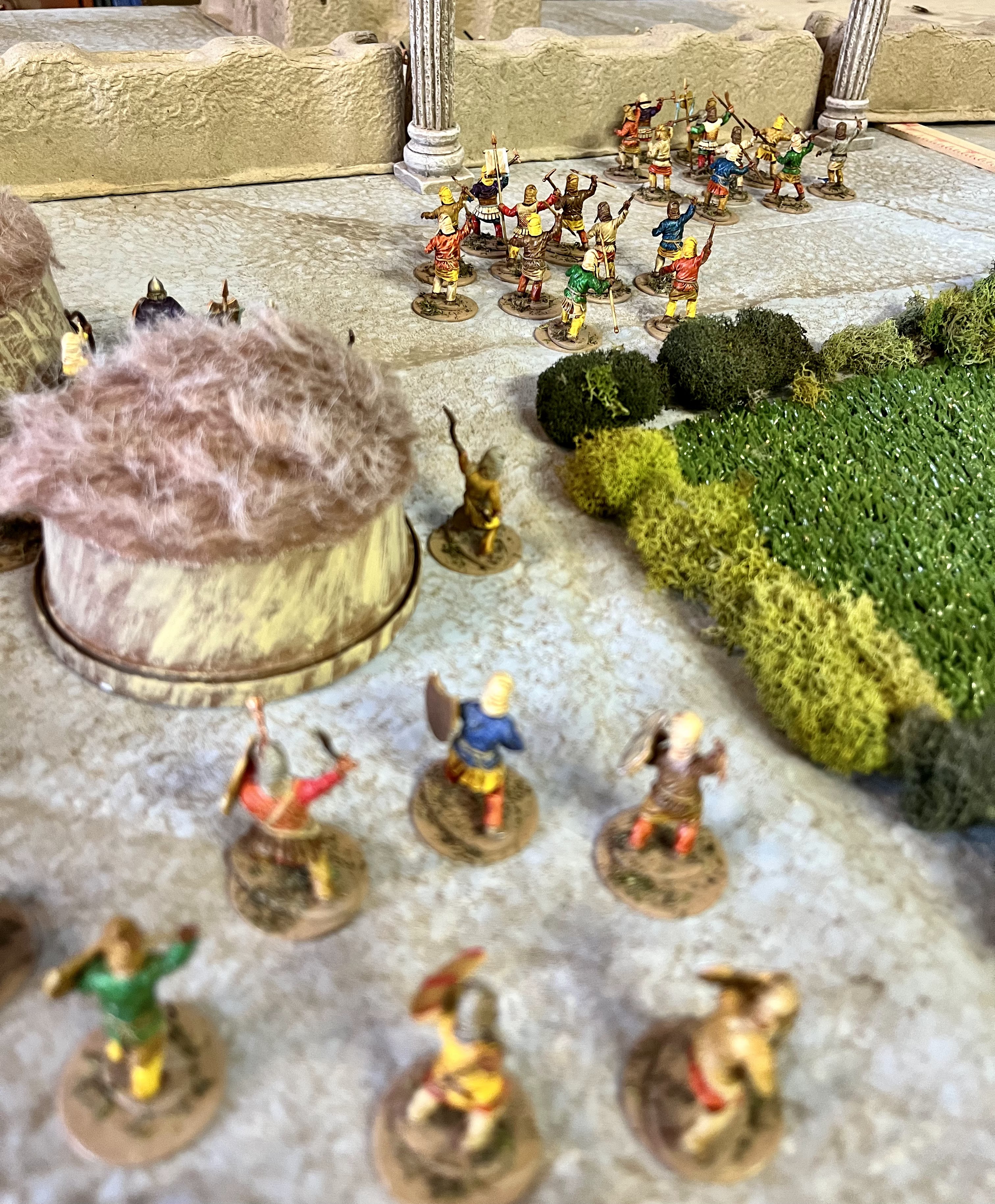
The Ionians have a speed bump force of Peltasts at the gate, perhaps trying to break-out and disrupt the Persian advance?  They are back-stopped by the Milita Hoplites in Phalanx.  Behind them a unit of Psiloi prepares to support them.  The flanks of the gate are covered by Greek archers and slingers to concentrate fire at the gates.  The last Peltast unit is out wide, perhaps hoping to add firepower, or sally forth when the time is right? 

Ionians prepare to defend the city!

The Persian assault force is set-up 12 MU in from their board edge.  They deploy with their warband infantry leading the way towards the gate, followed up by Drilled Sparabara.  

The main Persian assault force

The rest of the force spreads out to attack along the wall and try to use their firepower to suppress the defenders.  The Psiloi are approaching in the cover of the fields.  The attack is well-supported by Persian archers across the battle line.  

The Persians look to have the defenders outnumbered!

The two forces are deployed and ready to fight.  The Persians have an advantage starting with 9 Arete Points to the Ionian Greeks 6 points.  We will have to see if this imbalance makes the difference. 


Mission: 
Persian troops will be allowed up to 3 gaps in the wall based on a pre-game mechanic.  Per the rules, we established that the Attackers have managed to get one opening in the wall.  In this case, we decide that traitorous pro-Tyrant and pro-Persian forces have managed to open one of the many gates into the city.  Persian troops and Ionian defenders have rushed to the gate for the decisive battle.  

The mission objective is to try and force the opposing forces to collapse. 

Maneuver Phase:   
The Ionians pay enough Arete points to go first, hoping to use their peltasts in a spoiling attack.  They break from the gates and are quickly peppered with Persian archer fire.  However, their shields protect them well-enough and they press the attack.  

The Persians simply outbid the Greeks for initiative and the Persian archers quickly send the Greek spoiling attack fleeing back to the "safety" of the city.  The Persians press forward.  As the Persian Psiloi move towards the Walls, the Greeks try and fail to interrupt. 

Greek missile troops try to force back the Persian Archers in the village by the gate, but a horrendous roll and no Arete points stops them from having any effect.  The rest of the Persian host is just outside of the killzone.  The Ionian Militia falls back a step, hoping to lure the Persians into the kill zone before the decisive combat happens at the gates.  However, the fleeing Peltasts cause the Militia to start wavering. 


Battle Phase: 
The Persians again just bid more than the Greeks can manage.  However, this time the Greeks hold back and save the Arete Points for re-rolls and other commands. The Persian counter-battery fire is also ineffective from their archers, as most of them are still moving into position.  

The Persian Vanguard of warband infantry see the Militia wavering and try to charge them.  The Greeks try to interrupt, but fail.  This leads to a melee, where the Persians lose 3 to the Greeks losing 2.  However, the Militia troops fail their discipline check while wavering and end up losing another Courage. Neither side can gain the upper hand at the gates.  


The Persian Psiloi also launch an attack at the Greeks defending the wall, but the Greeks strong position leaves the attack thwarted. 

The Greeks fight back with a barrage of their own.  The Persian Archers in the village are reduced to 1 Courage and start to Waiver.  The Psiloi at the wall lose 1 Courage.  The Persian Archers screening the Drilled Infantry also take a Courage loss from the Greek archers in the city.   


The Psiloi in reserve behind the gate charge in and easily help the Militia Hoplites clear the Persians out there.  The way is clear.... for now.  The Ionian Psiloi let the Hoplites push back the foe, and separate again as a reserve.  The Persian follow-up forces watch the vanguard stream past in disarray, but they are unmoved by the plight of their comrades. 


The Persian Archers and Psiloi again rain arrows and Javelins on the Greeks, who respond in kind.  The Ionian Archers are reduced to 1 Courage and are wavering, the Peltasts on the opposite side of the wall also lose a Courage.  However, the Persians moving to the gate are not close enough to charge and keep closing in. 

This gives the Greek commander enough time to harangue and re-group is Militia hoplites into a Phalanx.  He reminds them of what they are fighting for and the soldiers steal themselves for battle and redress their lines.  The Greek archers also Rally.  The Greek missile troops rain hell on the approaching Persians.  However, the Persians were prepared and only lose 1 Courage.       


The Persians Drilled Infantry charge for the gate and the Greeks meet them half-way, a counter-charge of their own.  The two sides clash with the roar of war shouts and the crash of metal on metal.  The fighting is fierce, but the Greeks hold and push the Persians back a step or two.  The Persians are down to 2 Courage, as are the Greek defenders.  


Despite the noble defense at the gates, the Greek defenders take hits all along the walls from the full press of the Persian attack!  The Ionian archers are forced from the walls from combined Persian Archer fire.  However, the Persian Archers in the village are forced back as well.  


Greek losses force a collapse test across the line.  It is not good for the Ionians as the Psiloi reserve and the slingers both flee the field.  

End Phase: 
The Persian Warband Infantry charged in to support their brothers at the gate.  It was a close run and fierce battle, but the Persian ability to dump in re-rolls proved the difference and the gallant Hoplite defenders at the gates broke and fled to save their families and try to escape the city. 
 

The Peltasts began to re-deploy to try and hold the gate a moment longer, to try and buy time for residents to flee.  However, they took more Courage loss for the Persian Psiloi trying to force the wall.  

The Ionian Peltasts avoid a barrage of Persian Javelins as they redeploy.  They get the gate just in time to see the Persian Drilled Infantry storming through.  They set their feet and throw, causing enough damage to reduce the Persians to 0 Courage.  They turn and flee.  This triggers Persian collapse tests.  


The Persian Warband Infantry and a battered Psiloi unit decide that the battle is won and fall back to camp.  It is a token victory that buys the city folks a bit more time to flee, but the outcome of the battle is clear.  

Conclusion: 
The Persians have won and the Fall of Miletus has begun.  The Ionian Revolt has been squashed by the Persian forces. 

In the Ionian Revolt Supplement, the final battle is a different scenario than the one we played today.  It is one that does not require specialized terrain like walls.  However, my opponent and I are satisfied that this siege scenario is an appropriate end to the campaign.  The optional siege scenario was a success!  That will be a great addition to a number of Men of Bronze campaigns!  

In the course of seven battles, the Ionians won 1, compared to the Persian 6.  A decisive defeat on land and sea for the Ionians.     


Become a Patron and get access to all the cool stuff, a peak behind the curtain of Blood and Spectacles, and early-access to playtest games!  


You can follow Blood and Spectacles Facebook page or Instagram for more fun! 

Check out the latest publications and contact me at our Blood and Spectacles website

Or purchase all out games at the Blood and Spectacles Publishing Wargames Vault Page!        

Monday, July 24, 2023

Battle Report- Men of Bronze: Battle of Pedasus


This is the continuing recreation of the Ionian Revolt.  The Ionian Revolt was a revolt against the Persian Empire by the Ionian Greeks and their allies prior to the Greco-Persian War.  It took place from 499 to 493 BCE.  It was a land and sea affair, so I am using a combination of Poseidon's Warriors and Men of Bronze to re-create the campaign.  Both are from the Osprey Wargaming Series.  In addition, Men of Bronze has a specific supplement for the conflict called The Ionian Revolt. 


Herodotus gives us details of three battles between the Persians and the Carians . The Persians won
the first two engagements, despite a strong challenge by the Carians . These twin defeats had the
Carians on the ropes and desperate. They resolved to fight the Persians one more time, but this time
launch an ambush on the road near Pedasus.

As the Persians approached near night, the Carians attacked. The ambush was a great success and
the Persian general Daurises and his commanders were killed. This forced the Persians to fall back
to regroup, and saved Caria from a siege.

For today's battle, we decided to skip over the 2 defeats of the Carians by the Persians.  We know very little about them but they seem to be relatively straight forward battles.  The first was the Persians forcing a river crossing.  The Carians were then reinforced by the Milisian army and fought again at a sacred grove.  The Persians won again.  

That was the lead up to the ambush at Pedasus.  A last roll of the dice by the Carians versus the Persian war machine.   

Forces:
Despite the various losses to the Carian army, we are going to assume they still had a relatively standard Greek army at this point.  That means, we will go with: 

Carian Army
Drilled Hoplite - General
2 Militia Hoplites
Peltasts
Psiloi

The Persians will be using a more standard campaign field army. 

Persian Field Army
Cavalry - General
2 Archers
2 Drilled Infantry

Set-up: 
This game has a unique set-up, but uses the normal 72MU by 48MU board.  However, this game will be played length-wise instead of long-edge to long-edge. You can find the details of the set-up in The Ionian Revolt supplement.  

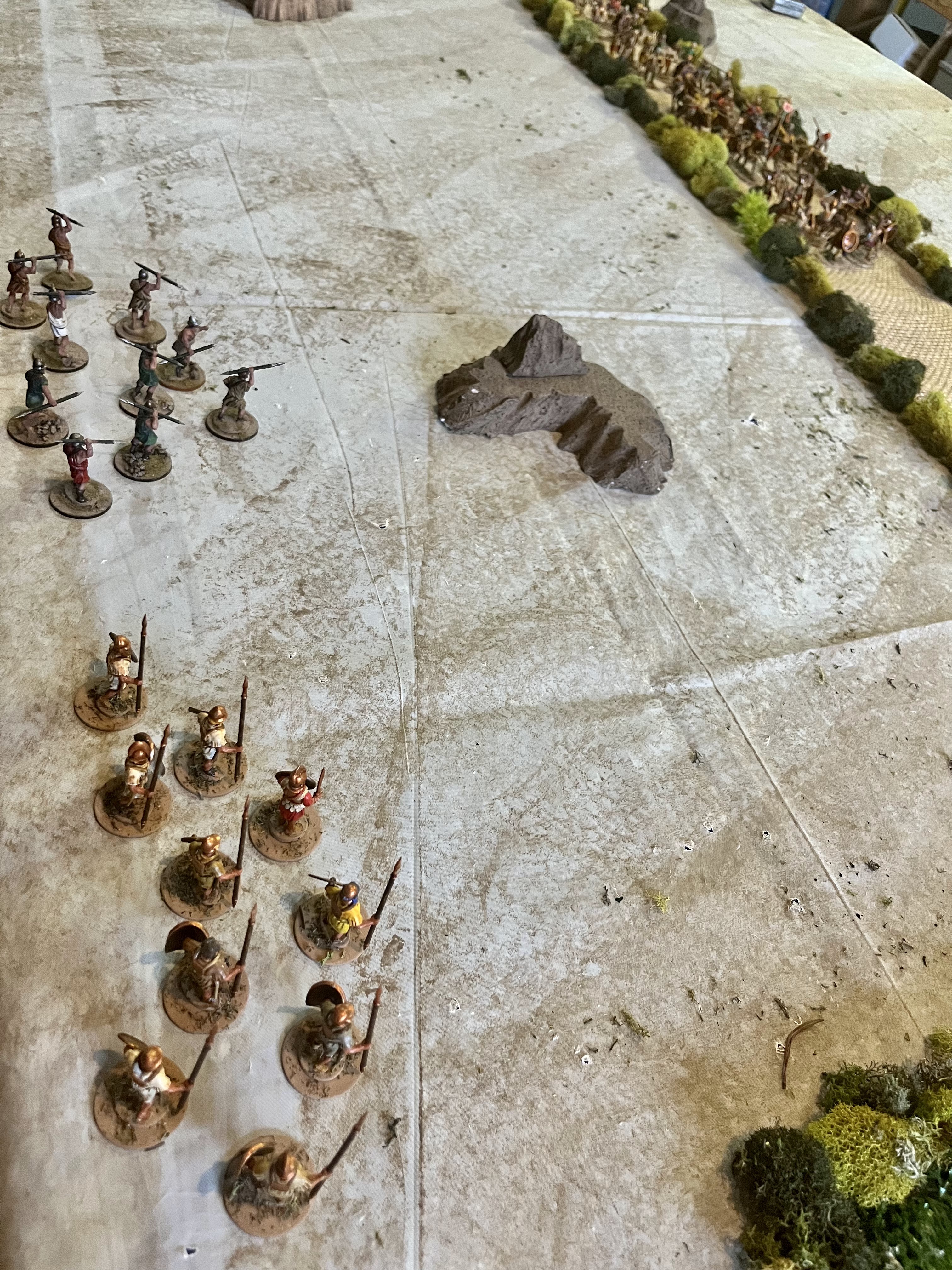
The Persian column sees Carian Drilled Hoplites emerge from Pedasus

The Persians vanguard was the Drilled Infantry, followed by the cavalry, archers, and more drilled infantry as the rearguard.  The Carians are in a crescent to ensnare the head of the Persian column with peltasts and psiloi on the edges, then militia hoplites, being anchored by the drilled hoplites in Pedasus. 


Mission:
The game will use the rules for Men of Bronze based on the Ambush scenario.  This game will also have the Dusk Approaches complication.    

A bird's eye view of the deployment

For this battle, I will not be following every detail.  I have found this method really hampers and slows down the game play!  Instead, I will be covering the action in three main phases; the Maneuver phase, the Battle phase, and the End Game.  The Maneuver phase is where the armies are mostly closing the gap and set-up their attack plans and is typically turns 1-3.  The Battle Phase is typically where most of the fighting occurs and normally falls in turn 4-6, and the End Game is the final moves to determine the ultimate victor and often are turns 7-8.  

The Maneuver Phase: 
The Greeks begin to close the net on the Persian column.  Meanwhile, the Persians begin to shake out into a batteline.  The Greek light troops are leery of getting too close to the Persian archers, who can easily wreck the Greek light troops in a barrage of arrows.  The Persian cavalry goes out wide to threaten the peltasts on the Greek flank.  The Greek drilled infantry form phalanx and easily block the road. 

Battle Phase
The Battle begins with the Peltasts trying to move up and throw javelins at the Persian Archers, but they fall just short.  No pre-measuring can do that!  The Persians then interrupt with an Arete Point, and return fire.  The Peltasts are hit hard.  This barrage is followed up by a Cavalry charge that sends the Peltasts packing in short order.  First blood to the Persians!


The Persians re-shuffle their lines and let the Greeks take-over again.  The Drilled Hoplites on the road charge into the Persian Drilled Infantry opposite them, who counter-charge.  A bloody melee breaks out, but neither side has the upper hand.  


On the opposite flank, the Persian archers try to eliminate the Psiloi, but fail.  Their nearby Drilled Infantry then charge the Militia Hoplites, who counter-charge them back.  The injured Psiloi jump in to support their fellow Carians. The Militia Hoplites win and push the Persians back into their Archers.  


On the road, the Persians face stiff resistance from the drilled Greeks and are quickly pushed back.  The Persian back is broken when the other Militia Hoplite unit joins the fray! However, as the Greeks turn to butchery on the road, the Persian General slams into the rear of the melee with his Cavalry, reducing the Greeks to near breaking!  


On the Persian right, more catastrophe as the Militia Hoplites and Psiloi break the Drilled Infantry and Archers there.  This leads to the last Archer unit to also turn tail and flee.  They failed a collapse test.  The Persian army is in tough shape.


End Phase:
The entire Persian army has collapsed with the exception of the General and his Cavalry bodyguard.  The Greeks are injured but in no real danger of losing at this point.  They use heir Arete Point advantage to make sure they go first.  

The Greeks on the left reposition themselves to finish off any Persian survivors from the center melee.  They then decide to see what happens there.  The rear attack by the Persians cause the Greek General and his Drilled Hoplites and Militia allies to flee. However, they take heavy casualties in return and are also routed.  

Seeing their comrades flee, the other militia Hoplite units collapses! This leaves only the Psiloi left!  The Greeks barely hold the field of battle! 


Conclusion:
The first win for the Greeks during the Ionian Revolt and another historical outcome. I thought this was going to be a much more decisive loss than it turned out to be.  It actually went down to the last dice roll again.  If the Psiloi collapsed we would have had a draw. 

I think my plan to turn the flank and get my cavalry behind the Greeks worked well.  However, their line engaged my about a turn to early.  Then, the Greek Hoplites decisively beat their Persian opponents across the entire front.  Only my rear cavalry charge kept me in this game. 

The next battle will be a sea battle using Poseidon's Warriors.   See you next time in the Ionian Revolt.  


Become a Patron and get access to all the cool stuff, a peak behind the curtain of Blood and Spectacles, and early-access to playtest games!  


You can follow Blood and Spectacles Facebook page or Instagram for more fun! 

Check out the latest publications and contact me at our Blood and Spectacles website

Or purchase all out games at the Blood and Spectacles Publishing Wargames Vault Page!