Showing posts with label Wild West. Show all posts

Monday, July 7, 2025

RPG Design: Badlands - Wild West Adventures


Badlands came about because I was thinking a lot about Westerns.  I was thinking about what made them work, what tropes did they lean on, and why they were so popular as a genre.  I had been thinking about trying to get my local group, The True Crit Gaming Guild; into some Cowboy gaming.  However, all this thought led me not to a designing a new wargame, but into another Role- playing Game instead!   


There are a couple of things that I wanted to accomplish with Badlands: 

  1. Mechanics based on Poker, a staple of the Wild West
  2. Ease of character creation that intuitively creates Role-play
  3. Use a Meta-currency for the GM and Players to influence game play
  4. Lean harder into narrative than crunch
  5. Create space to tell Wild West based stories, natural and super-natural  
Poker as the Unifying Mechanic
I am not much of a Poker player, but I have a basic understanding of the various hands and how they interact.  I wanted to make these rules a core mechanic for the game because Poker is an iconic tradition of the Wild West, and is tied to the American Mythology of the period.  The Gamemaster is called the Dealer and they hand cards out to the Players.  When there is a Challenge Check, it is resolved by the impacted Characters building a hand of cards and trying to beat the Dealers' hand.  

Attributes, Values, and Skills have numeric values that indicate the number of cards to be used to Build a Hand.  No one can ever have more than 5 cards in their hand.  If the Player has a better hand, their character succeeds in the Challenge. If the Dealer wins, the Character fails the Challenge.  

Poker Hand Chart from Wikimedia Commons


Intuitive Role-Play
Characters are built using 4 Attributes and 4 Values.  Attributes are physical components, while Values are more about the characters outlook on life.  These are built on with Skills, Traits, Assets, and Backgrounds that help flesh out what a Character is good at, and allows different abilities while Building a Hand.  Characters also have Drives to manipulate Meta-Currency and Weaknesses that can be used to manipulate Meta-currency and Asset availability.  All of these mechanical features allow clear and distinct levers for role-play as well as mechanical benefits too.   


Meta-Currency
The Dealer and the Players all start with a pool of Poker Chips they can draw on.  The Players have Luck Chips while the Dealer has Danger Chips.  As Players cash-in Luck they are converted to Danger Chips for the Dealer, and as the Dealer uses Danger Chips they convert to Luck Chips for the Players. As the game progresses, these Chips get passed back and forth for various effects on the game.    

From Canva

Lean into Narrative
This is a rulings over rules type of game, and it is designed for the Players and the Dealer to lean into the story.  It is not "crunchy" but there are a lot of decisions to be made thanks to how the different Character details help "Build a Hand" and the use of Luck/Danger within the game.  At the end of the day, the Scene will React no matter the outcome of any Challenge Checks.  

The game also encourages Dealers to structure Badlands adventures like TV shows and movies.  It recommends a three act structure with a Beginning, Middle, End.  It also uses the language of cinema such as Inciting Incident to trigger Challenge Checks, Final Scene for the dramatic finish, and Epilogues to help wrap up loose ends.  This is a Narrative first game. 

Tell Wild West Stories
Badlands spends time dissecting what makes a Western work on-screen.  There is discussion of Themes, Stakes, and Genre Tropes so that the Dealer and the Players can engage in authentic feeling Wild West stories.  However, the game is loose enough that your adventures can be any of the many types of Western stories, singing cowboys, wagon trains, cattle drives, outlaws, sheriffs, lone rangers, and more.  There is also space for "straight" Westerns with white hats and black hats, or something a bit more supernatural like werewolves, shamans, cannibals, or even aliens!  You can make your Wild West as wild as you want. 


Some Details
The rules are 71 pages long.  It includes almost everything you need to play.  This includes a blank character sheet, a Quick Refence Sheet of rules, a Poker Hand chart, and an Index.  The rulebook also has an initial adventure set in 1849 on the Oregon Trail to kick-off your Badlands experience.  All you need to do is provide a deck of standard Poker cards with Jokers, and a handful of Poker chips.    

Final Thoughts
Of course, if you have been reading this blog you know I have some core ideas and preferences about my RPGs.  I tend to design games that I would want to play.  Therefore, my preferences are on full display.  Badlands is no exception.  

Therefore, if you like narrative and character driven based RPGs that use a traditional story-telling format, this might be a good game for you.  This is not a game to challenge the Players with survival like an OSR, it is focused on telling stories and looking for characters to grow and change.  It is rulings over rules and forces the players to ask the question, "What is the right thing to do?".  This question is about morals, ethics, and values more often than it is about survival in the Badlands 

Check it out and let me know what you think! 


Become a Patron and get access to all the cool stuff, a peak behind the curtain of Blood and Spectacles, and early-access to playtest games!  


You can follow Blood and Spectacles Facebook page or Instagram for more fun! 

Check out the latest publications and contact me at our Blood and Spectacles website

Or purchase all out games at the Blood and Spectacles Publishing Wargames Vault Page!    


Monday, June 21, 2021

Review: Dracula's America Supplements- Osprey Games


I was lucky enough to pick-up the Core Rules for Dracula's America as well as all the supplements in one go.  I was able to read through and review the core rules a few months ago, but had not been able to look into the supplements too extensively.  I liked what I saw in the Core Rules and am eager to look at the next two soft cover books.  

The supplements are called: 

  • Hunting Grounds
  • Forbidden Powers  
I believe Hunting Grounds came out first, but if I recall correctly there was not a big gap between publications.  They probably had them all done around the same time, but needed to stagger the print dates.  

On the back cover of Hunting Grounds has the following additions: 

  • Two new Factions: Tong and Forsaken
  • New Weapons
  • New Powers
  • New rules for the Hunting Grounds
  • A Narrative Campaign
Forbidden Powers claims to cover the following: 

  • Two new factions: Church of Dagon and Salem Sisterhood
  • Stealth rules
  • Expanded Arcane Powers and Insanity
  • New Scenarios
  • Hired Guns
  • Monsters
  • Skills
  • Gear
Seems like a lot of good content.  I am not sure my usual process of reviews will work, but we will see what I can do.....

The Manitou! 

The Hunting Grounds
The Hunting Grounds are a spirit realm that can over lay the board.  Scenarios and locations impacted by the Hunting Grounds allow models to move between the physical and the spiritual realms.  This reminds me of the Astral plane in Shadowrun, the Warp in 40K, or even the Grid in Reality's Edge

Models can move into this realm and access objectives there.  When in the Hunting Grounds, models can only be impacted by others in the Hunting Grounds.  However, using magic and summoning while in the Hunting Grounds is much more dangerous and prone to summon abyssal beasties.  In addition, these creatures could also follow you OUT of the Hunting Grounds while you depart!  I was very pleased to see some classic American critters like Manitou, Wendigo, Thunderbirds, and Mothman on the new Bestiary related to the Hunting Grounds.  Some of these creatures are VERY lethal.  

Some new weapons are also added that probably should have been in the original rules.  Weapons like a Musket, Tomahawk (Thrown weapon), sword, and spear.  The original book had a Native American faction and a Confederate Faction so I am surprised these did not make the first cut.  Must have been space limitations.  However, when adding the 7th Cavalry you must have swords (sabres), and Tongs often make use of melee weapons.  

New arcane powers also come into play.  Each seems to get some form of teleportation, which I am not a huge fan.  Those caused some balance issues in Frostgrave so I am not sure how they will play out here.  There is less of a focus on "Treasure gathering" even though it is a component of some scenarios.  Including ones in the Hunting Grounds.  

The game comes with two new factions, the 7th Cavalry Forsaken, and the Shadow Dragon Tong.  In addition, there are rules to further personalize a Skinwalker tribe as well.  Finally, there are some rules for Outlaw gangs for the campaign.  The Forsaken have beast-mode members, while the Tong have Shadow-walkers.  Both add some flavor and additional muscle to the gang.  The Skinwalker Tribes allow some customization of the Tribe to better fit what "tribe" they are from and some limited benefits such as access to horses, different totem animals, and other features.  The Outlaw rules remind me a lot of the ones from the old Necromunda.  

Half of the book is new campaign rules.  This includes adding Riding and Leadership skills.  Then, there is also new gear including the Gatling Gun!  There are more Hired Guns, like the Medium that can help with gangs not set-up for the Hunting Grounds. There are also new territories and events for game set in the Indian Territories and Deadwood City where the Hunting Grounds are most prevalent.  The rules also add Hide-out upgrades which were not in the first book.  Finally, the added rules include adding some additional ways to acquire money in the campaign stage of the game via Bounty Hunting.  

There are 7 new scenarios in the game.  These revolve around the Hunting Grounds and making use of the special abilities of the campaign setting.  However, they are structured as part of a narrative campaign.  Therefore, you can play them in order or use them as stand-alones.  This section also has some rules for how to incorporate the Hunting Grounds into other scenarios from the main book.  

I always appreciate a Tong faction!


Forbidden Powers
This book moves the action away from the Wild West and Indian Territory and to the Deep South.  In addition, the new Eldritch Horrors have begun to stir.  The story links the Salem Witch trials, Benedict Arnold, the Necronomicon, Betsy Ross, George Washington, and the Masons, Cyclopean Ruins in the Bayou, Vodoo, and the Confederacy all into a tale.  Wow!  That is a big lift, and it does a great job setting the scene in a few short paragraphs.  

Since we are now in the Swamps, the book adds some rules for the new environment.  This includes swimming, deep water, treacherous conditions, and Swamp events.  There is also a new bestiary for the region.  These creatures include regional favorites such as the Dire Gator, Ragman, and Skunk-Apes.  
To add to the Deep South setting, they unleash new equipment, Eldritch Relics, and Swamp encounter tables.    

From there, the rules for Stealth Missions are unveiled.  These cover sentries and how to raise the alarm.  When a sentry is activated, there is an opposed roll to see if the Attacker or Defender moves the model.  In addition, the Stealth section has 4 scenarios for use with the rules.  

Since this supplement is adding the Mythos to the game, it must add rules for Madness!  This takes the form of a token pool on the side of the table, I would imagine poker chips would do nicely and fit the theme of the game.  There is a new phase where the Madness pool can go up or down.  As the pool gets too high, various Eldritch events may occur.  An entity may be manifested, a Model might need to check for insanity, or other factors.  The rules add a new Insanity table for individual models who lose their minds as well.  

Of course, when dealing with the Mythos, that means there needs to be new Eldritch Horrors in a bestiary.  There is also Eldritch magic that is added to the game.  Both are tied to the Madness pool.  Eldritch entities increase it, while spells can only be cast up to the Madness Level at that point in the game.  Also, if you Miscast an Eldritch spell, guess who gets to roll on the insanity table? They also add some Vodoo and Necromancy powers to fit the theme of the Deep South.  

Two new Factions join the ranks of Dracula's America.  The first is the Church of Dagon.  Naturally, this one allows you to use Eldritch magic, and also gives you two hybrids with random mutations in your posse.  The second is the Salem Sisterhood, who are a group of white witches trying to protect the arcane balance.  Interestingly, this group allows access to 3 Arcanists and they grant benefits to each other when they are within 3 inches.  They also get a Bodyguard type model.  This one seems like it would be tough to play since there is a huge incentive to keep most of the group in a big "clump".  

New hired guns are also present to tie into the Mythos, add to the Dark Confederacy, and provide benefits in Stealth missions.  One interesting one is the Hog Tamer who is basically a beast master of a wild boar.  They also introduce some named Mercenary's for the setting.    

The book is wrapped up with a 7 scenario narrative campaign.  There are also some rules for running more generic encounters in the Swamps and having Eldritch encounters.  Oddly enough, none of the Narrative scenarios appear to be "Stealth" missions that I could see.  

What is that distant call?

Final Thoughts
These two books contain about what you would expect from a good supplement.  There are new factions, gear, powers, and beasts.  They introduce new "settings" and how to use the settings in your games.  They seem to deliver the goods on expanding your Dracula's America experience.  

That said, it feels a bit bloated if you included everything from all three books in one game, you would have the core rules, Bystanders, the Spirit realms, and Madness Tokens all in play!  That is a lot going on in a skirmish game.  It seems like a group might best move through a specific location or time period at a time, or tailor their local campaign in a particular part of Dracula's America instead of trying to take it all in at once.      

These books do not cover solo-play.  However, the author came out with some options for that in a supplement online called: Rough Night at Red Rock (Which is a clever play at the classic Western Bad Day at Black Rock that may or may not feature a vampire) Perhaps it is a sign that a 3rd supplement maybe on the horizon?  Only Dracula may know. 

Salem Sisterhood artwork


Monday, April 20, 2020

Review: Dracula's America- Osprey Games

A long time ago, I started some preliminary work on a Weird Wild West game.  It never really came to fruition, and instead the core mechanics morphed into something else entirely.  Eventually, the mechanics did make it into a game called Turf WarHowever, the itch of Weird Wild West was still sitting there in the back of my mind.

Then, along comes Osprey Games with this game.  Dracula's America: Shadows of the West.  I wanted my wild west game to take a more Mythos approach similar to Strange Aeons, but after reading those rules I know I couldn't out Mythos them.  So, then I started to think about other "Horror Tropes" to use.  Dracula's America clearly settled on applying Gothic overtones and North American themed genre tropes to the Wild West.  Good choice!

It took a bit of time, but I eventually picked up all the books.  Sadly, I have not had a chance to read them or review them.... until now!  There was always some other work just taking a bit of priority over them.  Now, with the Pandemic of 2020 going on, it seems like the perfect time to break out these rules and settle in for a read.

Let's open the casket and see what is moldering in side shall we?


Things I Liked
When a player wins activation, they have two actions to complete.  At first I was unimpressed, as many skirmish games love this dual action/action point process.  I am not personally and fan, but realize I am in the minority.  However, I was interested when the player had the choice to spread these activations over more than one model.  So, you could have two models each take 1 Action, or a single model make 2 activations.  Now we have a decision point!  Very simple, yet elegant.

Models have 180 degree line of sight to the front, so facing matters in this game!  That is a simple and effective way to create Tactical Game Play.

When shooting, you must target the closest enemy.  However, you can decide to make a test to override this and shoot a different target.  However, if you fail you loose the chance to shoot at all.  A simple decision point that adds more Tactical Play.

Models are either Novices, Veterans, or Heroes.  This indicates the type of dice they use to make tests with.  Novices use d6, vets a d8, and a Hero uses d10.  This indicates improved skills and abilities in a simple and elegant way.  Most shooting and fighting is done with a three dice test looking for 5+ for success.  This is pretty straight forward with modifiers removing dice in the test.  The more success, the harder it is to resist the damage later.  The more you fail a save by, the more injury you take.  Therefore, Novices are more prone to injury than Heroes and Vets. 

Instead of hitting a guy in Close Combat, you can "shove" them.  This allows you to break combat, knock them off a mount, or over a cliff.  This is a fun little bit of rules and adds a simple decision point to hand-to-hand. 

If half of your Posse is down, you need to start making Bottle Checks to stay in the fight.  For your boss it is a simple 3 dice test.  However, if your boss is down, the test is reduced to a 1 dice test.  Therefore, you actually have to decide how to use your boss to maximum effect.  Normally, he is one of your Heroes or Vets, so a good fighter too.  However, if he goes down your chances of running just went way up.  Oh no!  More decisions!

All of the Weird Wild West rules are a completely separate part of the rules.  This is a Wild West game at its core, which allows you to "bolt-on" as much fantasy as you want.  That's pretty cool.  It adds supernatural creatures such as Zombies, Vampires, demons, etc.  It also adds a different event table, Income encounters, bystander rules, new hired guns, gear, and bestiary. 


Things I Did Not Like
I was not a fan of the card based activation process to determine initiative.  Essentially, each player gets a number of cards in their hand based on the number of models on the table at the start of a turn.  Players than place a card face down and flip it over.  High card wins, except Black cards go before Red cards.  It creates a bit of resource management and decision making around activation, BUT I do not feel it is worth the time this process takes for what could just as easily be an alternate activation system or some other system.  If cards were used as a larger part of determining action results, I could see this activation process having more value.  However, as it is the cards are ONLY used for activation purposes.  Sure, cards are very Wild West, but I am not convinced that this adds much to the game beyond novelty in activation mechanics.

So, I am a fan of the Novice,Vets, and Hero delineation for dice used.  However, I find the stat line and keyword combination to be less than satisfactory.  I tend to favor stats over keywords.  However, these game seems to have an okay balance.

This game allows pre-measuring.  Typically, I am not a huge fan of pre-measuring, but especially in time periods where man-portable range finders and other distance measuring devices were not common.  If the actual human has to estimate, I think the player should too.  Again, an old-fashioned and minority opinion I have.


Meh and Other Uncertainties
The game clearly covers your most common rough and tumble movement like going through windows, climbing ladders, jumping gaps, etc.  Disengaging from combat is interesting as you make a test.  If successful you leave combat, but if failed you immediately make a save from damage.  They just assume the enemy hits you instead of giving free attacks and the like.  Much easier.

The game does have an overwatch mechanic that a model may choose to go into as an action.  I find this useful in skirmish games.

The game makes use of complications such as Bystanders and Events built into the core mechanics.  If two player try to activate using the same card, it triggers and event.  In addition, models can interact with bystanders during the game by grabbing them, holding them hostage, protecting them, etc.  The game comes with 7 basic scenarios.  In addition, each scenario will have each faction having a secondary "agenda" to try and achieve in addition to the scenario objective.  All of these features add to the replayability of the game.

Of course, the game also has a campaign system.  It follows the usual campaign system elements of injury, advancement, income, etc.  Of course, you can also recruit and hire Hired Guns too.  The income section rolls 4d6 or 5d6 depending if you won or lost.  Interestingly, on duplicate results you can have different post-game encounters that add flavor to your games.  In addition, there is an underdog mechanic which seems to be a must in campaign games.

Final Thoughts
This game is really two games in one.  It is perfectly suitable as a Wild West game, and all the rules allow such a game.  In addition, there is Dracula's America which is a Weird Wild West game.  That is value right there!  Two games for the price of one!

Overall, this is a really well done game.  The balance seems pretty solid, even in the campaign game.  The flavor elements are well done as well.  I look forward to digging into the supplements to see what I find there too.  The rules are pretty straight forward and there do not seem to be many If This Then This scenarios.  Some more scenarios would be nice, but those can be developed by players pretty easily, and agenda, bystanders, and events can probably keep things interesting for a while.

Now, I am really unsure what to do.  My family wants to play Burrows and BadgersHowever, I think it will be easier to start a campaign game of this locally rather than Frostgrave.  I can easily see getting people to play this game, especially ones who liked the old Necromunda as it had a wild west, sci-fi flair.  I may change the basic premise to gangsters though.... I have a lot of gangsters...... not so many cowboys.  We will see! 


You can follow Blood and Spectacles Facebook page for more fun: https://m.facebook.com/pg/BloodandSpectacles/posts/?ref=bookmarks&mt_nav=0

Or our website:

Or our Messageboard:

Or our Wargames Vault Page:
https://www.wargamevault.com/browse.php?keywords=blood+and+spectacles&x=0&y=0&author=&artist=&pfrom=&pto=    

Monday, July 15, 2019

Battle Report: High Noon- Attack at Fort Ridgely


With the launch of High Noon it seemed appropriate to share a large game we played loosely based on the battle of Fort Ridgely in the Dakota War of 1862. I have long wanted to build and play a wargame campaign for this conflict, and have even loosely based my All Quiet on the MartianFront games on the campaign. However, I have not really had a chance to put it high enough on my Hobby to do list to actually get it on the table. I have a few sketched out drafts for core rules, and a basic idea of the campaign flow, but that is about it. If I can't play a full fledged campaign, I can at least play a game loosely based on the events.

In the history, after a flare up of hostilities between the Dakota and white settlers in Minnesota; a local war broke out. There were the typical massacres, some battles between local militia and Indian tribes, that eventually culminated in the Dakota attacking Fort Ridgely. Fort Ridgely was a wall-less fort similar to many forts on the prairie frontier and during the Indian wars in America. It was composed of only a few buildings, and had a relatively small garrison. The Dakota were attempting to drive the white settlers out, and by attacking the fort they hoped to force better terms from the Europeans.

High Noon is part of my series on Dexterity Combat along with Green Army Men: Plastic Men, Steel Resolve and Total CARnage. Therefore, there are no dice rolls, rulers, templates, etc. Everything is resolved as WYSIWYG, coin flips, coin flicks, or hand based templates. This is a very family and non-wargamer friendly game.


Forces
Forces were selected by taking every Indian figure I had and giving it to the Dakota. I then took all the Cowboys with Rifles standing up that I had and put them on the opposite side. I added a couple of pistol packing dudes as Officers.

Fort Ridgely Defenders:
2 Dual Pistols
3 Pistols
10 Lever-Action Rifles


Dakota Tribe:
5 Long Rifles
2 Shotguns
2 Knives and Shields
10 with Spears


The actual defense of Fort Ridgely feature the use of some artillery pieces, but I don't have any of those so I skipped them for this.

Set Up
The table is a 6 x4 table covered with a brown desert mat. I placed four boxes in a rough square in the center which corresponds roughly with the lay-out of the fort. I then placed some rocky outcroppings near the edges for some cover. Fort Ridgely is actually in a clearing of woods and has a small gully beside it and tall grass in the “dead zones”. Not too much like what I set-up here, but that's why it is “based” on that battle and not that battle.


Mission
We discussed playing a specific mission, but my players really wanted to just do a Last Man Standing type of scenario. The Indians had the advantage in numbers, but the defenders had the advantage in firepower and move OR shoot weapons. Therefore, the battle was roughly balanced.

The Dakota were scattered around the edges of the board in groups of 3-5 figures. Each group had at least 1 rifleman for cover, and a spearmen or two. The defenders were mostly concerned about the template firing shotgunners, but they started in cover to help protect them from long range fire.


The Defenders were placed along the insides of the boxes, facing the center of the board. This was to represent them leaving the shelter of the buildings at the surprise Dakota attack.


The Game
I did not take detailed notes during game play on a figure by figure basis. Therefore, the below is a high level overview of the battle. The defenders won the Coin Flip to activate a figure first. All actions are alternate activations.

The Defenders got to go first, and opted to try and stay within the fort, and move to the edges and try to use long range shooting on their foes. The Dakota pressed towards the edges, moving and shooting whenever possible. The Dakota rifleman tried to clear the way with a barrage of fire, before the Dakota spearmen moved up to mop up exposed defenders. The initial Dakota sally towards the North side of the building was repulsed by the defenders with firepower. The Dakota attacking from the open took particularly heavy casualties on the North East corner.
Never bring a knife to a gunfight....

Despite the success in the North, the Southwest corner was left vulnerable, and the Dakota moved in. Their numbers advantage allowed them to move forward with relatively light resistance. Only a pair of officers tried to hold them back with pistol fire.


The Dakota advantage in numbers became clear once the spearmen were able to get in cover behind the forts buildings. The close range firefight that broke out forced the defenders to move to get firing positions, which limited their firepower. 

.... the Knife worked! 
In addition, one of the Indian shotgunners was able to move up and blast the officers defending the Southwestern edge of the fort. This left a large breach for the defenders to try to plug.

This is my boomstick!


Ultimately, once the Dakota managed to get to the perimeter of the fort, their numbers were able to turn the tide and the last of the defenders were killed by spears. It was a costly victory as the Dakota were reduced to only a handful of warriors.
Oh the humanity!


Conclusion
That did not go anything like the battle of Fort Ridgely. However, it was a close fought and exciting game with some cinematic moments and amazing flicks, both good and bad. One defender as killed by a misfire, as I flicked it so poorly that he took himself out! One of the Shotgun Dakota was killed by his own allies due to a bad flick. An Officer with a pistol took out two Dakota warriors with a single shot. All good times.

The game took about 1 hour to play, including set-up, and brief rundown of the rules. This was a rather large engagement. Most have fewer figures to start with. Plus, we had 4 players instead of 2. However, none of these factors bogged the game down and it went at a brisk pace. There were no rules disputes and after the initial rules brief very few follow up questions. We were focused on playing the game, hootin' and hollerin', and having a good ol' time.

Monday, July 8, 2019

Wargame Design: High Noon: Plastic Men, Steel Resolve

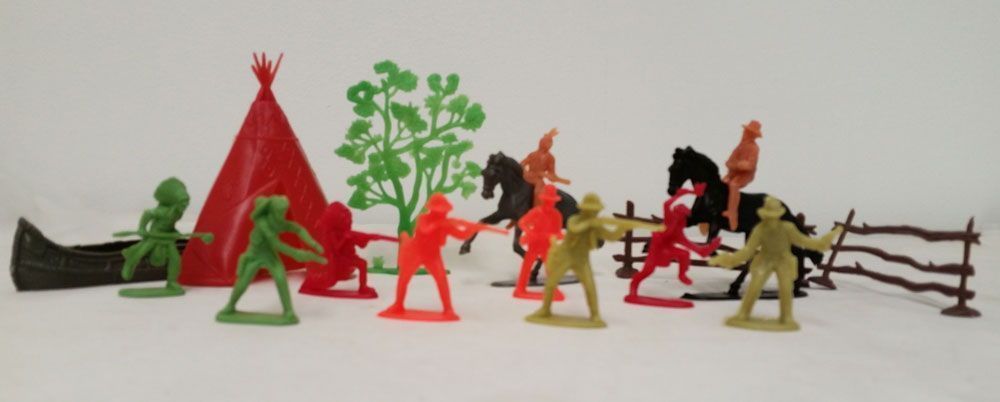
At my local grocery store, they have a small section to sell toys to the little sprogs.  It is 4 lonely feet mixed in with the sugary cereals.  A perfect place to ambush an unsuspecting parent!  In this forsaken section of toys, they had a bag of plastic cowboys and Indians.  It had been a long time since I had seen a bag of these toys.  I managed to resist buying them for several visits, but eventually my willpower cracked and in a moment of weakness I bought them.


As many of my long time readers will know, I love using toys for my wargames.  Of course, my first though was to use them for some Wild West themed game like Legends of the Old West, Dead Man's Hand, Fistful of Lead, or Dracula's America.  I had been toying with the idea of a Weird Wild West game myself for a long time.  I never actually got it down on paper, and eventually that game morphed into Turf War instead.  However, here I was with a nice set of multi-colored cowboys and Indians with no game to call home.

When I showed my family what madness I had wrought, my daughter was quick to solve the problem.  She asked if I was going to make another dexterity game with them!  Genius!  

I had first been introduced to the ideas and mechanics with the Z-man game Flick'em UP!  At first I had been skeptical.  However, after playing several games with players of all skill level and ages I was won over by the concept.  I had successfully used dexterity combat mechanics to make games before.  You can see the successful results in Total CARnage and Green Army Men: Plastic Men, Steel Resolve .  At that point, I decided that this rule set was going to join the Plastic Men, Steel Resolve family of games.  


So, the big question was how to make it a unique experience.  It was clear it would still use the WYSIWYG (What You See Is What You Get) mechanics of my other dexterity games.  I still wanted the flick and flip mechanics too.  Finally, I also had dice "coin shifting" for different weapons lethality.  These were all features of Green Army Men: Plastic Men, Steel Resolve as well.  

Most of the flavor came from a few sources:  

1. Unique weaponry- The Wild West was well known for a few key weapon systems; the revolver and the lever action rifle.  Of course, those were not the only weapons.  The question was how to make them unique.  This was done by adding special rules not present in Green Army Men: Plastic Men, Steel Resolve   

         
2. Scenario Design- The flavor of the Wild West needs custom scenarios like stage coach robberies, jail breaks, showdowns at high noon, etc.  

3. Horses and Wagons- Riding horses and wagons was a key part of the Wild West.  Without horses, you loose the flavor of the period.  Therefore, there are rules for mounted models too! 

From Chick's Discount Saddlery
With those key elements identified, it was time to put the new rules together.  Thankfully, I was able to build off of an existing framework.  However, a revolver in the this Wild West game ended up working very differently than a pistol in Green Army Men: Plastic Men, Steel Resolve .  In addition, this new game had twice as many scenarios to play than its predecessors.  High Noon: Plastic Men, Steel Resolve was born.  


You can find this game (along with my other works) at my Wargames Vault page here: https://www.wargamevault.com/browse/pub/11064/Blood-and-Spectacles-Publishing

Here is a quick start of a Battle Report to get a feel for game play: 

Black and Blue Bart and his gang of outlaws were trying to scout out a watering hole.  They came across a band of Native Americans.  The Indian war party recognized the outlaw, and decided to try and hunt him and his posse of outlaws down for the bounty.  

Forces

Black and Blue Bart and his Boys
1 Two Pistols
1 Pistol
2 Lever action rifles

Indian War Party
Knife and Shield
Spear
Spear and Shield
Shotgun
Long Rifle

Forces were selected by dividing the toys up by color.  Then reaching into the bag and pulling out random figures and using what they were armed with.  Simple.  

Set-up
The board was set-up on a 4x3 table with a desert mat.  We then placed four pieces of random stuff I had within arms reach.  Terrain is 1 for 1 in this game so What You See Is What You Get (WYSIWYG).  If you have Wild West themed terrain that is great, but it is not needed.  

Mission
We looked at the three pages of scenarios and we decided to do a basic Rootin' Tootin' shoot-out.

Turn 1
The coin flip let's the Cowboys go first.  Bart moves up with his two pistols and shoots ineffectively.  He is countered by the knife wielding indian going up the center as a distraction.  An outlaw rifleman runs forward and fires at a spear men, but misses.    


A second spear men moves up and a well aimed throw puts the Outlaw out of the game.  First blood to the War Party.  

However, the second rifle armed Outlaw stands still and fires across the board.  Since he stood still, he can take two shots with a lever action rifle.  His second shot finds its mark despite the distance!  The Indian spear man goes down and is out of the game.  

  
The Long rifle and Shotgun Native Americans move up the flank, while a pistol armed outlaw tries to cover the center of the board.  

That ends Turn 1 with both sides using alternating activation to move and shoot, shoot and move, or to simply shoot.  Not moving let's some weapons fire more often.  

So, that should give you a general feel for the game play.  Now you can decide if it is a game for you.  You can find this game (along with my other works) at my Wargames Vault page here: