Showing posts with label Horse and Musket. Show all posts

Monday, July 6, 2026

Review: Travel Battles- Perry Miniatures

Now that I have a restricted gaming space, it seemed like a good time to take a closer look at this title from Perry Miniatures.  This might be the "Ultimate" Kitchen Table Game.  The entire Hook to this game is that it is a full-sized wargame that can be played in a confined space.  In this case, the authors claim the game was to be played on a train ride, written in the 90's!  It was a homebrew mini board and miniature armies.  They have a picture of the original proto-type in the back of the rules pamphlet.  

The box is about the size of a laptop case, and comes with the terrain board in two plates, a red vs blue army of identical 8mm minis, bases, and a few pieces of terrain to help finalize forests and built -up areas.  There is a short rules pamphlet, just a few pages really.  There are four dice; two red and two blue d6s.  Finally, the box comes with foam as you are expected to use this box to carry the game around to travel with.  It even has a helpful little plastic handle!      

I watched a video on this one and that is what encouraged me to pick it up.  I would give you the link, but it has been lost to my terrible memory.   I recall seeing this game when it first came out, but it slipped out of my mind until now.  I was not interested in something like this at that time, but eventually the right time came.  

So gather your Brigades, heft your big furry hat, and mount up on your horse because it is time to march forth into the smoke and get into this box.....   

Things That I Liked

The rules are literally 6 small-pages long.  However, they still manage to put a lot of variety into the unit types!  There is an artillery unit, Heavy Cavalry, Light Cavalry, Infantry, Guards Infantry, and Commanders.  There is small but significant differences in these unit types.

Each army is made up of a matching force.  However, how you organize it is up to you.  Each player has 3 Brigade Commanders.  Each of them controls a Brigade, but the composition of that Brigade is mostly up to you!  You can make them small or large, you can mix your units how you wish.  There are some examples in the rules.  This allows the players some Strategic choices prior to the battle that will impact the tactical elements of the game.  

The boards are rather clever too.  There are two plates of equal size with pre-formed terrain on them.  In addition, they are divided into grids.  As part of deployment, each player takes out one of the two plates.  They then roll a d6 to determine which side of the plate faces them.  The plates are designed to fit together no matter which sides touch.  This gives a surprising amount of variation and replayability.  

Artillery is the only unit that can fire.  It has a range of 6 grid spaces, however the number of Grid spaces away is what you need to hit the target.  You can also fire over intervening units if it is placed on a higher hill.  Nice.  

All fighting is done between units that are in adjacent grid spaces, even diagonally.  There is also organic support methods in the rules as well.  However, in a fight each player rolls one or two attack dice and the defender rolls a dice.  There are also other special rules that may impact this.  However, it is pretty simple.  If the results are the same, draw.  If one wins by 1 the other unit is pushed back 1 and turned around.  If the winner is by 2, the unit is pushed back to the back of the table and turned around, it is routing.  If the winner is by 3 the unit is simply removed as destroyed.  Turned around units can not move or fight until they are turned back in the appropriate phase of the game.  


Things I Do Not Like

The pamphlet has a few lines about how to paint up the terrain and forces.  Nothing elaborate.  However, I wish I had read them earlier!  Apparently, they claim you do not need to undercoat them before painting!  D'oh.... too late.  I undercoated them with Grey Seer spray.

Deployment alternates by brigade.  The game is IGOUGO.  You roll Initiative and the winner gets to move all his units, fire with his cannon, fight, and rally any units.  Then the second player does the same.  I would have preferred some alternating Brigade activations by phase.... but this game is so quick that it may work fine with IGOUGO.      

Like most Horse and Musket games, there are a lot of If This Than That rules.  This is normal, because such fighting was very paper-rock-scissor focused.  Therefore, these rules are what allow for Tactical Gameplay.  Things like infantry in Square get an additional dice when fighting cavalry, but suffer +1 to damage rolls if hit by artillery.  If you play a lot of this period it makes sense.  However, if you don't you will want to keep the rules pamphlet handy, thankfully it is only 6 pages with a how-to assembly guide and painting guide included!  


Meh and Other Uncertainties

This is a Horse and Musket game, so follows some of the Tropes associate with those types of games.  Cavalry move fast, infantry is slow and steady, cannons shoot far.  Of note, only the artillery has any ranged attacks, with the rest only fighting when they come into contact.  The winner of the game is the one that can eliminate two out of the three brigades you start with.  If you have played Horse and Musket before, such rules are par for the course.  

Units can move forward, backward, straight, sideways, or even diagonally.  Roads give bonuses if you start and end your move on them.  All units in a Brigade have to be touching grids in order to move. Only one unit per grid space, except infantry that can double up, which has advantages and disadvantages.  Infantry can even form square by placing them horizontally.   

Deployment is by Brigade.  Each unit is 1 grid square, and the Brigade must all be touching another Brigade member, and each Brigade must touch their commander somehow.  Commanders can not fight, and units that are not connected to their Brigade can not move.  Brigades are placed up to two gird spaces onto the board, automatically this creates a layered attack and reserves for a game.  If you deploy poorly, you will not be able to reinforce your attacks and defenses.        


Final Thoughts

I love a nice, simple ruleset.  Much of the "crunch" of the rules has to be abstracted but this covers the 4Ms easily.  Even better it also captures the feel of the period the game is trying to capture.  The rules are pretty simple but have some depth to them for tactical gameplay.  I see them as the bare minimum needed to play a game of this type in this period.  I see no reason why someone could not play this game "scaled up" to 28mm minis on a full-sized table if they wanted to.   

The real innovation here is the terrain plates and the grids and how these are used to create replayability.  When you combine the identical armies with build-your-own Brigades it adds even further options.  I look forward to playing this "on-the-road" with my wife.  She is not familiar with the tropes or styles of this type of game, so I am wondering how quickly she will pick it up.  

Lastly, I have undercoated all the pieces and hope to have it painted up and assembled very soon.  

Until next time!  


Become a Patron and get access to all the cool stuff, a peak behind the curtain of Blood and Spectacles, and early-access to playtest games!  


You can follow Blood and Spectacles Facebook page or Instagram for more fun! 

Check out the latest publications and contact me at our Blood and Spectacles website

Or purchase all out games at the Blood and Spectacles Publishing Wargames Vault Page!                

Monday, April 8, 2019

Review: Rebels and Patriots- Osprey Wargame Series


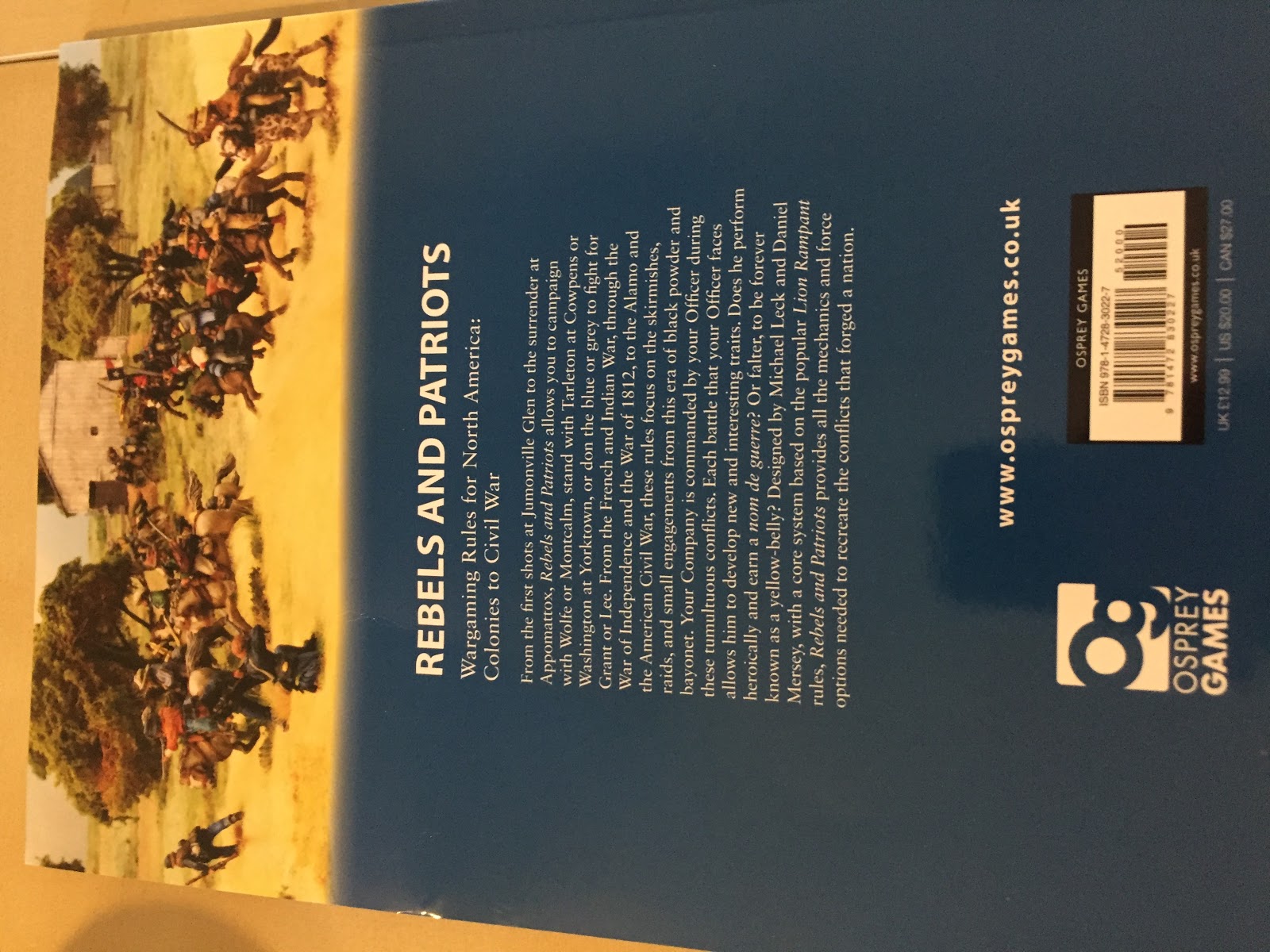
Rebels and Patriots is number 23 in the Osprey Wargaming Series. The focus of this game is battles in North America from the Colonial Period up to the Civil War. Basically, it is Black Powder or Horse and Musket for the New World. Since I live in the New World I was interested.

I had intended to use Chosen Men to play games set in Wisconsin during the War of 1812. However, I have never really gotten that project off the ground. I had gotten distracted by Greek Hoplites and Men of Bronze instead. Now I have even more reason to getting going on the 1812 in Wisconsin project with more rules to try out! I have also always wanted to do a Dakota War project and these rules may help out there as well.

The first thing you will notice, is that these rules are by Michael Leck and Daniel Mersey. Of course, those familiar with the Osprey Wargaming Series will recognize that Mr. Mersey has written, co-written and inspired many rules sets in the Osprey Wargaming Series line. I tend to think of these rule sets as the “Rampant” Series* of rules as they frequently have certain similarities in the core rules. I think it could be said that Mr. Mersey is the “Godfather of the Osprey Wargame Series”. He wasn't the first author in the series, but he maybe the most influential to other authors in the series. I know I found a lot of inspiration in Mr. Mersey's work.

This is also not the first collaboration of Mr. Mersey and Mr. Leck. Daniel Leck was the co-author of Pikeman's Lament as well. He also is a popular wargames blogger. I have a feeling this is not the last collaboration between these two, and look forward to see what they come up with next. They claim this is the “final” expansion, but I doubt it. The system still can easily be applied to other eras and wargame styles such as Sci-fi, Bronze Age, Mythical Age, etc. They probably just have not come up with the next concept yet!

As always, the game begins with Designer's Notes in the introduction. I love this aspect of the rules as it allows a glimpse into the process. In addition, it gives me clear criteria for determining if a writer was successful in their goals. In Rebels and Patriots, the goals were comparable to others in the Rampant series of games:

  • Model and scale neutral
  • Focus on North America
  • Company sized engagements
  • Officers matter
  • Hollywoodized version of History
  • Easy to remember and consistent rules

Well Let's see how they did! It might help if you have read some of my previous reviews of the Rampant series to get a better feel for my thoughts on this game.


*= In my mind, the Rampant Series includes:

Even though he wrote Dux Bellorum, I think the mechanics diverge enough to not be part of the “Rampant” Series.

Things I Liked
As with other rulesets in the Rampant series, the Company creation process is easy, intuitive, and quick. Unit types are grouped into broad categories. Most infantry is Line infantry that you can apply simple traits to to match historical or unique units. However, you can have Light, Skirmishers, Natives, Shock infantry. Cavalry has Light or Shock. Then there are basic artillery units from light, medium, to heavy.

Once a unit is activated, you can only choose one action from a list of actions. This is a great way to force Tactical Play on a player. A player must choose what is important and the troops can not do everything you want, equally well. You have to make a choice about what matters.

I was happy to see that this game also uses a Group Leader for movement, facing, etc and other measurements where models are then placed within 4 inches of the Group Leader. The idea is similar to Chosen Men and Menof Bronze. However, unlike those other rulesets, who the player uses as their Group Leader can change from turn to turn.

The actions are easy to follow and generally follow the same basic rules. They are consistent and easy to follow. These will make for a good, simple to resolve game. There is not too much If This/Than That style rules. In addition, the terrain effects are relatively uniform and common sense. These rules do a good job of streamlining play like many in the “Rampant” family of games.


Things I Did Not Like
The rules as written use model removal for casualties, which I am not a fan of anymore. After spending lots of time painting the models, I want them on the board the whole game! However, it is easy enough to make a few changes to use counters or casualty tokens instead of model removal.

The game essentially uses I-GO-U-Go method. To act, each unit must pass an activation test. However, if failed, play does not immediately go to the opponent. You can continue to try to activate other units. This removes one of the biggest criticisms of Lion Rampant. However, I preferred The Men Who Would Be Kings method where there were certain actions a unit could ALWAYS take without testing to activate based on the unit type. I also kind of like failed activation causing play to turn over to the other player as a form of “friction” that a general had to try to overcome. In this current system, I am unsure if an activation test does anything more than just add a needless dice roll as a half-way point between previous activation methods.

The game also adds a very Black Powder like critical success/failure type mechanic on the activation tests. If you roll double 1s on activation, you roll on a chart and consult what terrible thing happens. If you roll double 6's, you do the same. I am not a huge fan of the “blunder” system in Black Powder as I do not think it really adds anything of value to the game play except another chart to roll-on and look up in the middle of the game. However, other players love this type of thing, so your mileage may vary.

I am not a huge fan of random charge distances for close combat/attack actions. This rule sets uses the activation roll as the distance moved in the charge. At larger scale games, I could see this working better to represent terrain that can not be seen/detected at the scale but at this smaller scale I am not sure I am a fan. The uncertainty of the activation roll is friction enough for me. I do like that there are some actions a charge unit can try to take depending on the unit type such as evade or counter-charge. 

Meh and Other Uncertainties
The game continues to expand on the Officer ides introduced in The Men Who Would beKing and expanded on in Pikeman's Lament. This is an easy way to add some narrative and campaign elements to the game that has little impact on the actual game play itself. However, it can be distressingly easy for your one officer to start with a very bad trait. Thankfully, after various games he could get promoted or even killed so even a bad trait won't last forever.

Like other games in the Rampant series, the unit sizes are relatively static at 6 or 12 models. For example, light cavalry is 6 models, while infantry units are 12. Each company typically has 24 points to it, or about 4-6 units. That is about 72 models or so. Not bad. There are various traits you can give the units as well to match “historical” units. Some are downgrades and others are upgrades, but impact the abilities of your troops.

The game comes with 12 scenarios, which is more than the other game books if I recall correctly. One of the more innovative ones is the Great River Chase scenario. Essentially, your troops are attacking or defending three supply rafts coming down the river. Retreat tot eh Sunken Road is also interesting as the outnumbered Defender is trying to hold onto a road for 5 turns with no casualties in a row to win. Overall, there are some interesting scenarios that feel like they were culled from actual historical events.

Finally, the game has some example 24-point starter armies to choose from based on the North American war from the period. It covers the French-Indian Wars, American War of Independence, Northwest Indian War, War of 1812, Mexican War of Independence, Mexican American War, Mexican Adventure, the Civil War and many more. Overall, a pretty nice selection of armies for a diverse array of models.

Conclusion
Ultimately, if you enjoy the “Rampant” series of games, I see no reason why you will not like this latest edition. It has many of the strengths of the series and worked hard to minimize some of the criticism of the earlier works. I liked that failed activation turns over play, but many players do not like that model; and this version of the rules makes the necessary changes. Overall, I think the designers accomplished what they set out to do, and I would call this another success for the “Rampant” series of games.

Overall, I am now torn on what to play my War of 1812 in Wisconsin and Minnesota-Dakota War of 1862 with? Should I use these rules, Chosen Men, or The Men Who Would Be Kings? There is only 1 way to find out! I will need to play them all!

Monday, January 30, 2017

American Civil Paw- Battle Report- Battle of Miller's Creek


In 1862, the state of Kenteddy had declared themselves neutral, but Tederalist and Contederates had both moved into the region.  Contederate sympathizers established an alternate capital at the city of Bowling Green.  However, their numbers were inferior to that of the Tederalists in the region. 

Luckily for the Contederates, the command in the west was fragmented between several competing commanders for the Tederalists.  This led to confusion and an inability to unify their efforts.  Tederalist Brig. Gen James Bear Garfield  attempted moved to drive Contederate Brig General Humphrey Bearshall from the area as they had been using it to recruit new bears to their cause. 

After maneuvering, the two, roughly equal forces met not far from the fork in Miller’s Creek.  They fought over a small field and swampy region between the woods and rocky ridge line that was the border of the creek.  This battle would help decide who would control Kenteddy.       

The Forces
The American Civil Paw: Battle of Teddysburgh is an interesting version of the American Civil War since is being fought by teddy bears.  

Tederalists
-          Brig Gen. James Bear Garfield- Brigade Officer
-          3 Infantry
-          1 cavalry
-          1 Battery of cannons

Contederates
-          Brig Gen. Humphrey Bearshall- Brigade Officer
-          3 Infantry
-          1 Cavalry
-          1 Battery of cannons

I purposely chose identical armies for this battle so that I can test out the rules fully and highlight how they work.  I am interested to see what I find out. 

Set-up
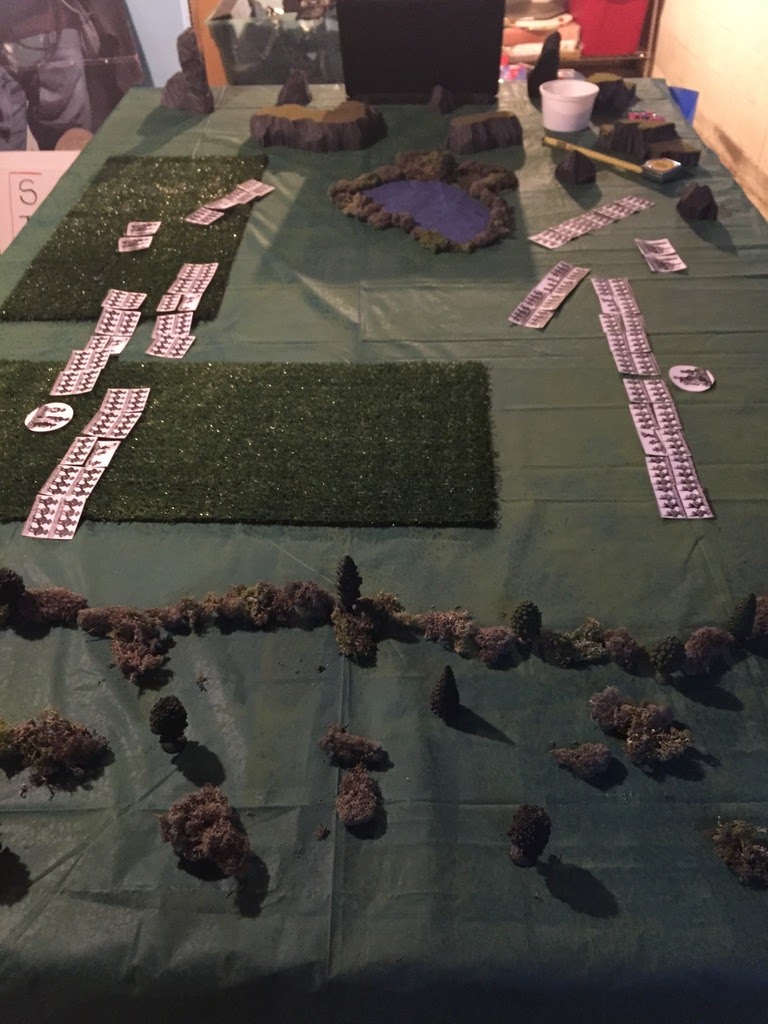
The board is 6 x4.  It is flanked by difficult terrain with woods on the west side and rocky ridges on the east.  On the north side is a couple of small fields that the Tederalists are deployed in.  The field will be difficult terrain, but also offer some light cover.  A small pond and swamp are off-center.  On the South side, the Contederates are deployed in the open. 

The Contederates deploy with the cavalry on the left, then two regiments of Infantry in line, their cannons, the General, and a column of infantry in the ridgeline.

The Tederalists have two lines of infantry backed up by the third line with cannons on the left of them.  On the far left behind the pond is the cavalry.

 Mission
This will be a straight forward battle where each side is trying to run the other side off the field and out of the state of Kenteddy.  No fancy mission objectives here just knock the stuffing out of the other side. 

Turn 1:
The two sides close in on each other, they are still too far away to fire, but anticipation is in the air. 

Tederalists on the left and Contederates on the right. 

Turn 2:
The Blue Jacket cannons ring out and the balls find their mark in the advancing Grey cavalry.  This is followed by Union infantry firing into the Contederate hobby horsemen, and a charge by Union Teddy’s own cavalry.  The Contederates are sent reeling backwards with 4 hits and panicked! 

The Contederate infantry advances and manages to injure some of the opposing infantry in a brisk exchange of musket fire.  On the Western flank, musket fire through the crops does not go the Contederates way. 

Turn 3:
Tederalist troops move up and pour fire into the 1st Contederate infantry regiment.  The Contederates respond with a charge, but are sent reeling back in a panic.  The two cavalry units clash again, and the Contederates are forced back reeling. 

The third Tederalist troops form column and charge into the second Contederate infantry.  However, these Contederates are made of sterner stuff and force them back panicked.  The Contederates must have a spine of steel as they counter-charge and smash back the Tederalist cavalry and beat the remnants of the Tederalist infantry again, forcing them back in a further panic! 

This gives general Bearshall some breathing room and he is able to call in his reserve infantry units.  They dash forward in column and then change to line to back up the 2nd Contederate infantry regiment.  He also manages to rally his panicked cavalry.

Tederalist General Garfield is not as lucky and fails to rally any of his panicked units.  This could be the decisive moment of the battle!

Turn 4:
Contederate cannons find the Tederalist cavalry with a barrage, but fail to break them.  The fierce Contederate 2nd infantry switches into an assault column and charges into the Tederalist 2nd Infantry in line, who has been untouched by fire.  However, the thin blue line holds and pushes back the Contederates in a panic! 

The 1st Tederalist infantry unit tries to Volley fire, but is too unorganized.  However, their shooting is still effective, and the 1st Contederates are near the breaking point!  Sensing that the 1st is about to scatter, General Bearshall shuffles his 3rd infantry into place to back them up.  This re-shuffling was just in time as the 2nd Tederalist’s fire breaks the 1st Contederate infantry and they scatter and rout to the rear!  They are first unit broken in the game.  General Bearshall rallies the pancked Cavalry and orders them to fill the game in his line by the pond.  Ineffectual fire from the rallied unit fails to tell on the 3rd Tederalist forces. 

General Garfield fails to rally the panicked 3rd infantry and they stay in their panicked columns.  The Tederalist cavalry charges home on the Contederate brothers.  However, they are again repulsed and sent panicking backward.  The third infantry manages to pull themselves together enough to change formation and set-up to backstop the Union lines.  With the flight of the Tederalist cavalry, the artillery fires at the Grey cavalry but fails to cause significant injury. 

Things look bad for the Contederates.


Turn 5
General Bearshall rallies the 3rd Infantry of the Contederates and they shake out of column and into a firing line.  The 1st and 2nd Tederalist infantry fire on the reformed Contederates with volley fire, but failed to do more than scratch them! 

Gen Garfield rallies his cavalry, but they let eh artillery do the dirty work.  The Union battery blasts the Contederate cavalry from the field with a precision barrage.  With the Contederate cavalry fleeing, their batteries try to return the favor on the bluebellies, but fail to get the range.  This allows the Tederalist cavalry to hit the flank of the Contederate 2nd Infantry, but the Contederates repulse them easily! 

Turn 6
The Contederates try to reform their lines, but an exchange of fire between the 3rd Tederalist and 2nd Contederates leaves the Grey bears routing the field.  They had had enough.  The Contederate artillery battery manages to rout the 3rd Tederalist infantry unit.

Gen. Garfield managed to rally the panicked cavalry, who rushed forward and opened fire on the last Contederate unit.  However, their fire was mostly ineffective. 


Conclusion
Gen. Bearshall surveyed the field and decided discretion was the better part of valor.  He ordered a withdrawal, and his last remaining units retired under artillery fire.  His troops withdrew to Teddessee and left Kenteddy to the Tederalists.  The secessionist legislature fled, following after Gen, Bearshall and his troops. 

Gen. Garfield was unable to follow-up and pursue as he became caught up in the bearocracy of the Tederalist War Department.  The chain of command was unclear.  Despite freeing Kenteddy from Contederate forces, further follow-up would not come to later. 


Final Thoughts
Interestingly enough, shooting was much more effective in this game that a first read through would indicate.  The long charge range seems to indicate that charging is a preferred attack.  However, I had almost zero positive results from charging.  Assault columns were rebuffed by line formations, cavalry was repulsed by infantry, and even a flank charge failed!  My reading of the ACW would seem to indicate that this is accurate to the warfare of the time and that charging was a last desperate strategy.  However, I was really disappointed by the result of the flank cavalry charge. 
We were also late to learning the amazing firepower of artillery in this game.  I should have been using it more effectively, but my own troops often screened their firepower.  It will take careful planning to make the best use of it next time. 


On game mechanics I think some work still needs to be done on flanking, LOS, and partial LOS/cover firing.  I enjoyed the initiative system immensely but once a unit was destroyed mid-turn there needs to be a way to remove a counter.  I am unsure how that would work.  However, it was a quick game and ran smoothly.            

Saturday, January 7, 2017

Review: American Civil Paw: The Battle of Teddysburg- Slave2Gaming

As you know, I play a lot of All Quiet on the Martian Front, and am relatively active in their online community.  Through this connection, I connected with Slave2Gaming.  They are an online miniature maker from Australia, who made a range of Dark World War 18mm figures that were useful during the gap between Alien Dungeon closing and Ironclad picking up the AQMF product line.  Their cavalry is very cool.  The models themselves are sculpted by Mike Broadbent and he is the primary sculptor for Slave2Gaming.  Drew from Slave2Gaming reached out and asked me to take a look at and review one of their upcoming releases and I agreed. 


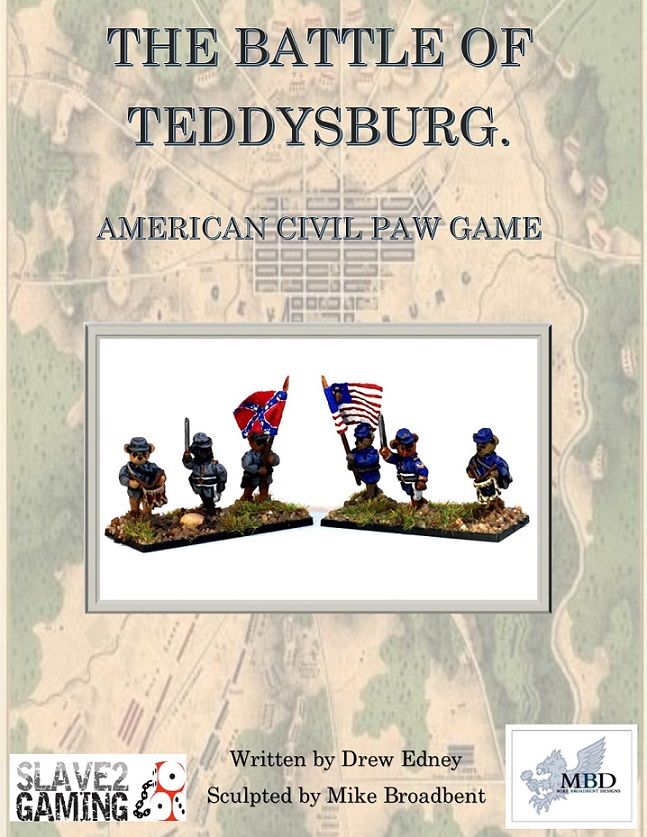
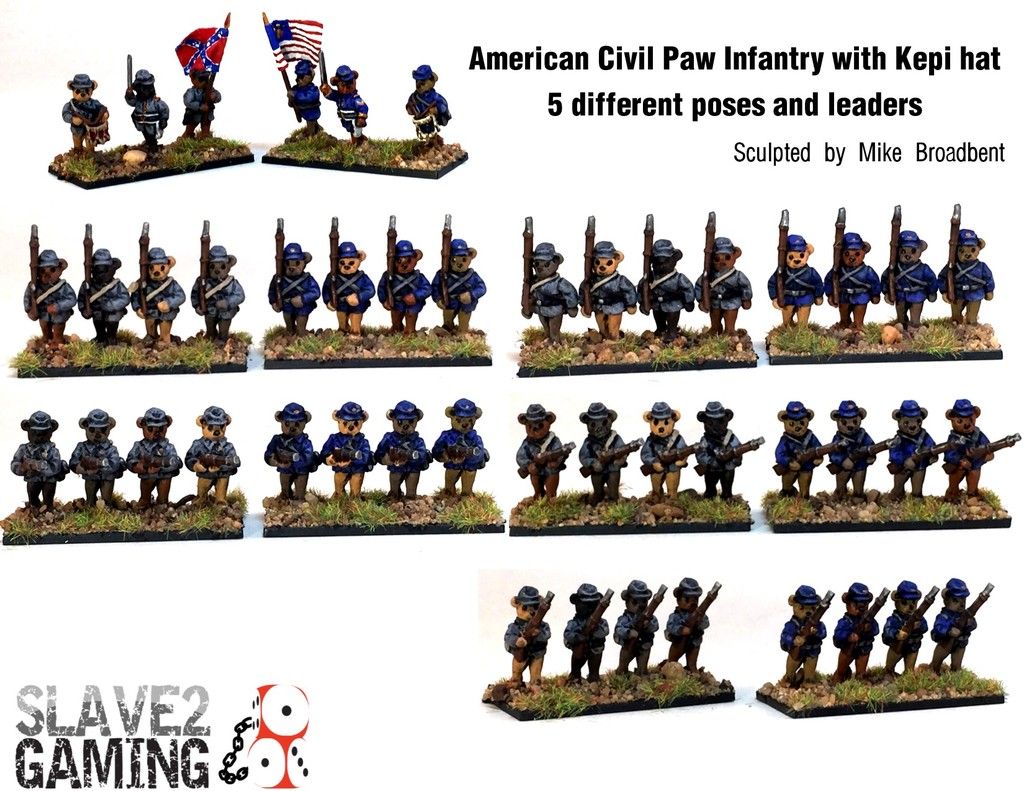
The game is called: AmericanCivil Paw: The Battle of Teddysburg.  It is a set of American Civil War rules with a bit of a twist.  The combatants are all teddy bears re-enacting the “War between the States”.  Therefore, some of the conventions of that era are adhered to, but it is a bit more whimsical take on the subject.  The objectives were to create a relatively quick, streamlined set of rules less than 25 pages that would allow the Teddy’s to take to the table top.  The rules were intended to be a “Mass Battle” game using 18mm figures formed into multi-based regiments.  At the moment, the rules are in PDF download format only, with a more official book potentially being released with the range.

Before printing the booklet, the designer would like to get feedback and make changes.  Therefore, the PDF version of the rules is currently in BETA.  Hopefully, some of you with a lot of experience in ACW games will be able to give them some insight before they pay to print the book.  He is especially interested in adding more unique Fantasy traits to the game but still keep the ACW theme.    
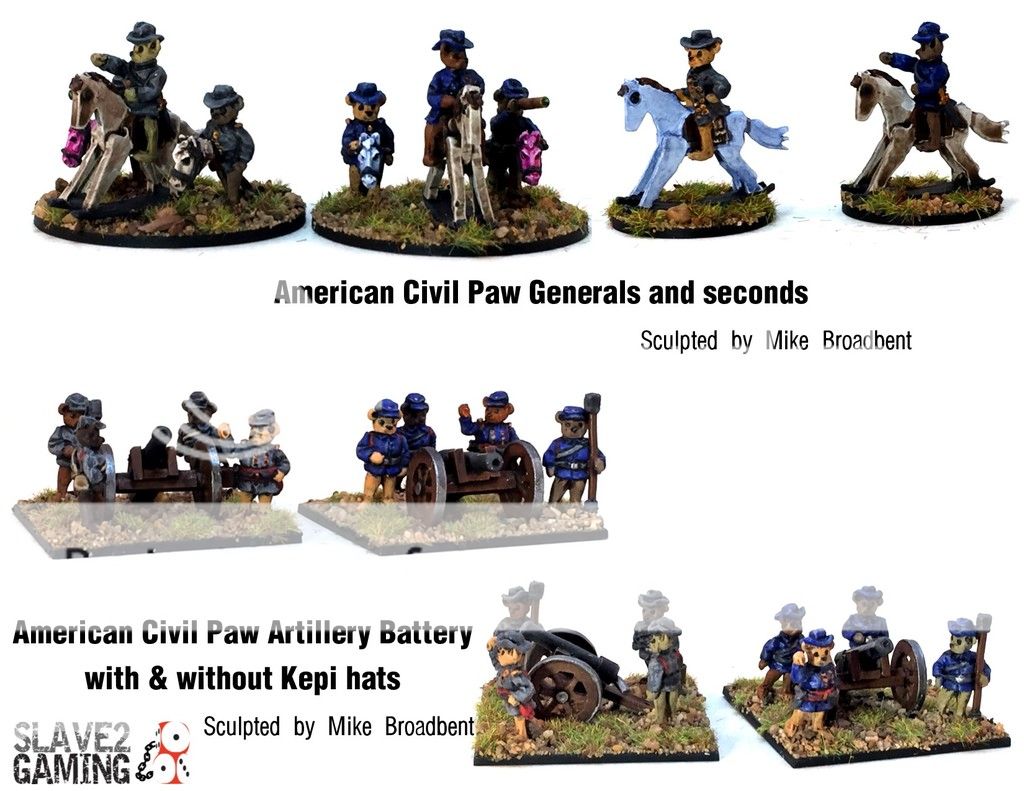
Of course, besides the rules they are releasing an adorable range of miniatures that Mike sculpted.  They are up to his usually standards of high quality and they should be great for Horse and Musket players looking for something a bit different, gamers who play other generic fantasy settings such as Dragon Rampant or Kings of War, and also gamers introducing the concept of wargaming to the next generation.  The range by Mike will be a great bridge between fantasy and historical gamers and also act as a gateway for newer gamers.  Teddy Bears don’t need to worry about their uniforms as much as real ACW toy soldiers! 

Too cute!  They also have other hat variants.  Wargamers love fancy hats!.  


You can find the BETA rules here at the moment: American Civil Paw: The Battle of Teddysburg


Once more into the fluffy breach then?

Things I Liked
The game follows many standard staples of a Horse and Musket ruleset.  You have different formations such as line and column.  You have forward 180 degree fire arc.  You have movement based on a leader base.  You have firepower based on the number of bases that can shoot/combat.  So, if you have played Horse and Musket games many of the core mechanics are there for you.  It will be easy to pick-up and play. 

There is no casualty removal.  All bases are left on the table until the unit flees off the board or is completely wiped out.  That way, all those nice Teddy Bear figures you spent time painting will be in the thick of it for most of the battle.  No one likes to buy and paint troops to have them removed before they even do anything.  Instead, it uses a “hit Point” style system where each Base in the unit provides a “hit”.  Infantry units are a bit more resilient with 10, while cavalry has 8, and Artillery only 2.   

Units can always move and Shoot/charge without any test so your lads will always have something to do.  More complicated actions require command tests.  Units that have taken a certain level of injury MUST have commands to act.   

The system uses a Target Number system on a d10.  All units pretty much use the same target numbers, and there are very few modifiers.  This is good as it reduces the memorization needed to play.  Most modifiers are relatively intuitive for the period.  The game tends to avoid a lot of the “If This/Then That” type rules you can find in this periods games. 

The stick horses for cavalry.... too cute!
Things I Did Not Like
The game uses the Bolt Action Grab Bag approach to activation.  This is a solid and tried and true mechanic however I tend to prefer to play games with less passive activation systems.  When a unit has its chit pulled from the bag it is placed by the unit as a reminder that it has activated. 

Perhaps due to the streamlined nature of the rules, the game did not have any rules about flank attacks or enfilading fire.  I think such rules would help increase the desire to maneuver before engaging and add more tactical choices/depth to the game.  There are also no rules to cover if more than one unit engages another in combat/assault or the ability to support an assault.  Again, I feel these elements would help add to the tactical possibilities of the rules.       

The game is intended to be played on a standard wargames table that is trying to represent forests, creeks, small towns, etc.  I actually see this as a missed opportunity and a chance to differentiate the rules form standard Horse and Musket games.  Considering this is a game about Teddy Bear warfare, I feel it should use 1:1 scale terrain of household items so you could actually walk into any room and start a game on the floor with whatever is on it.  Carpets are your flat, open terrain with rugs acting as fields, and mismatched slippers as impassable terrain.  Now you have a unique and interesting gaming experience not found in most other wargames.  There are a lot of American Civil War games out there and I think this is the “gimmick” to help differentiate the game as opposed relying only on Mike Broadbent’s miniature line. 

Meh and Other Uncertainties
The game play is pretty straight forward and easy.

It would be kind of fun to add some variable leadership qualities to the rules as well.  The personalities of the American Civil War commanders played a large role in the outcomes on the battlefields.  This might expand the scope greater than what Slave2Gaming  were trying to achieve, but it would allow them to add more to the Teddy Bear theme and some silly puns.  Everyone loves silly puns…. well…. everyone who wants to play Teddy Bear ACW anyway.  Okay, maybe just me then….   

Rocking horses for officers.... too cute!

For morale, it is interesting that panicked units are very hard to use with a base Target Number of 9 to activate on an order.  Some of the modifiers would make it impossible to steady/rally them.  However I maybe misreading the rules on this segment, since being in Open Ground adds a +1 to the Target Number, making it a 10 required.  I am unsure how I feel about this as it makes sense in the context of the American Civil War game where units would sometimes just stop, but not completely break.  However, maybe it would just be easier to remove them?    

The rules have a few diagrams and illustrations to help demonstrate the rules.  This is a good thing.  I feel some examples of play would also help but the rules are clean and simple enough that it may not be needed.  Some fun pictures of Mike’s painted Teddy Bears in the field would be cool too.   

Army creation is straight forward and basic.  They have a couple of unique traits for each side, but I know they want to expand this part of the rules.   

Final Thoughts
The rules are a solid, simple way to get into the period and they are the right price at less than $5.  They will do the job of supporting the miniature range.  Plus, they will be a good base to build on for future additions to the game.       


The game itself has an interesting hook or gimmick; cute and cuddly Teddy Bears re-fighting the Civil War.  However, the rules themselves do not have that same hook or gimmick.  They are perfectly solid and serviceable set of rules that will allow you to play Teddy Bear Civil War battles but there just isn’t enough here to really differentiate them from a game like Blackpowder or Longstreet.  To me, there are a lot of ACW rulesets out there and it takes a little something special to make them stand-out rule wise.  I am not sure Slave2Gaming’s American Civil Paw: The Battle of Teddysburg currently has that something to stand out as a rules system.