Showing posts with label card mechanics. Show all posts

Monday, December 2, 2019

Wargame Design: How Do You Become a Wargame Designer?


The most common question I get asked about wargame design has nothing to do with mechanics, morale, resolution, or probability.  The most common question is much more basic. 

“How do you become a wargame designer?”

The answer is even more basic.  In our modern world, life is so much simpler.  If you want to be a wargame designer, than anyone can do it.  I have written about how I got started here.  In that blog post, you find the seeds of the answer to the question. 

If you want me to be more explicit, here are the two things you MUST do to be a game designer:

1.       You must create a game
2.       You must make it available for people to play


Today, we have access to a variety of tools to help us both create our games.  I myself have helped by creating a series of Wargame Design related blog posts that walk you through the basic process. Books, articles, and blogs exist across the internet to help guide the way.  In addition, self-publishing tools have progressed to a point that even basic computers have Publisher, PowerPoint, or even Word. 

There are a variety of distribution methods to get the games to the people.  The internet has made it   much easier.  You can distribute via message boards, your own website, other websites like the Wargames Vault, and Social Media.  You can easily reach the world-wide marketplace of ideas from the comfort of your home.    

That’s it.  Pretty simple stuff.  If it is so simple to do, how come more people do not do it?  Becoming a wargame designer is simple, but it is not easy.

I suspect there are a few different reasons why more people do not make the jump to being a designer:

1.       They are afraid
2.       They do not create a process for Creation
3.       They let the Perfect be the enemy of the Good


Fear is the Mind-Killer
I have read plenty of internet comments that are not very helpful and just mean about games and the people who designed them.  I can totally understand why a person would shy away from opening their creative labor of love to the world only to be attack, shredded and left for dead on the proverbial floor of the internet.  No matter what you try to do in life there is a line around the block of people who want to psychologically kick you in the junk, laugh about it, and then wander off to kick someone else in the psychological junk.  It is not fun to get kicked in the junk, physically or psychologically.

As a designer, there are two things that get me over this fear hurdle:

1.       I MUST create games.  I can not help myself.  It is a compulsion.
2.       I design games for a very niche target audience.  I design them for myself and no one else.

True designers or creators MUST create.  They can not help it.  I can not help it.  I watched the Matrix and immediately started writing out ideas for making it into a board game.  I couldn’t stop myself!  I had no intention of ever making a Matrix board game, but I wrote out the ideas anyway and put them in my concept folder.

If I did not create games, I would simply stop being who I am.  I would be dead. 

Secondly, I design for an audience of one.  I make games I want to play because I want to play them.  I do not try to make games for other people.  I am 100% convinced I have no idea what other people want to play.  I watch game reviews, play various games, and talk to lots of gamers.  Even with all of that research, what some people enjoy and others do not is still a mystery to me.  I don’t create for them, I create for me.      

Now, just because I create games I want to play doesn’t mean that other people won’t want to play too.  I leave that up to them.  I will still pitch ideas to publishers, self-publish games, and market them like crazy.  However, if someone else doesn’t like the way a game plays, I don’t mind.  It wasn’t for them anyway.  I can guarantee my games will always have at least 1 local player…. Me!  Any players above 1 is a great success.  Sometimes, other people even like my games!

These two factors help me get beyond the “Fear Factor” of becoming a wargame designer in the public eye. 


Creation is a Process
No game is like Athena and just springs from the mind of the creator.  To create is a process.  It can be a harsh mistress, but I have always believed in planning your work, and working your plan.  Then be flexible enough to change your plan....

To create a game requires time.  Time does not come easy.  The time you design games is always being taken by things like family, work, friends, and other choices.  You are always confronted with choices.  You have to prioritize the choices you make in a day.  I try to set about 1-2 hours a week to write.  Some weeks I do more, but I almost never do less.  Writing is a routine and you MUST get into the routine. 

However, creating a game is more than just writing.  It is re-writing, editing, testing, playing, etc.  All of which requires time and effort.  You must budget your time the same way you budget your money.  It is even more important than money.

Once you have a routine, the Creation process is much easier as well.  The more you do it the easier it becomes.  If nothing gets written down, then you won’t have a game.  Without a game, you are not a game designer.    


The Perfect is the Enemy of the Good
This impacts a number of wargame designers that I work with, collaborate with, and partner with.  I have fallen into the trap myself.  Sometimes, we get really hung up on making a perfect mechanic orsituation.  We will scrap something that works, because a one-off or edge case gets in the way.  Then, we go back to the drawing board, find nothing better and then get frustrated and walk away.  The game never gets done. 

To be a game designer, you need to actually produce games.  If you let the pursuit of perfection stop a workable game from hitting the table or playtesting phase, then you are getting in your own way.

This will be an unpopular opinion.  Of course you want to make the best game you can right out of the gate.  However, that is not typically how it works.  The more you play test, massage an idea, etc. the closer to perfection your mechanics and processes will get.  However, there is no such thing as perfection.  Instead, you want to get your current processes and mechanics as smooth, clean, and clear as you can.  Therefore, using this theory there is always one more step or modification to get your even better.  This is a trap!  If the mechanic and process works, then it is ready for playtesting. 


Conclusion
Being a game designer is very easy.  All you need to do is make a game.  Then play the game you made.  Bam!  You are now a game designer.  There is no special secret or magic to it.  It is simply a matter of sitting down and doing it.  Take those ideas, put them on paper (real or electronic) and keep adding on until you have a full game.  Then, play the game and see what happens.  The more you do it, the easier it becomes. 

The longest journey begins with a single step…. but more importantly it also ends with a single step.  Now, just go out and put the steps together in between and you are done. 

If you want to be a game designer, then make a game and make it available for people to play!            

Monday, November 4, 2019

Review: Ulterior Motives- Frostgrave


One of my goals for the year was to get more Frostgrave going in my local area. As part of this, I wanted to make sure I had all the latest Frostgrave supplements. I was confident that the all-female warbands coming out for Frostgrave would be a big draw for my family. However, that goal has gone nowhere this year. Related to that I picked up the Maze ofMalcor and Ulterior Motives. So far, this plan has not worked out at all and I have had not progressed in getting the game going. Instead, my family wants to play Burrows and Badgers so that will come next.


However, that doesn't mean I can't give you all a review. Unlike other Frostgrave supplements, this one is not a soft cover book. Instead it is a deck of 40 cards that are standard playing card size. Two of the cards cover some rules updates and how to use the cards. The rest are alternative side missions to add to the scenarios you are playing in the game.


Things I Liked
As I said in my initial Frostgrave review, much of the game will depend on the scenario and missions. The standard treasure hunting allows for a good basic game. However, the cards have some alternate rules even for Treasure placement.

Each card has a new alternate objective for the Wizards. These are in addition to the main scenario objective.

Each card has the following information:

The card name
A description
The rules
Red herrings

Red Herrings are generally other items that are placed on the board thanks to the card. There are a wide variety of options and most of them are not related to out right killing something. Therefore, the Ulterior Motives are trying to steer players away from just killing each others warband.

Since they are in card form, you can pull the cards out and put them on your side of the table to remind you what Ulterior Motive you have.

Things I Do Not Like
I like the new Treasure placement rules just fine. They are designed to force more movement on the board and warbands to interact a bit more. However, I do not like the fact that the rules are basically re-printed in the Frostgrave Folio.

Once the cards are drawn, you will get a pretty good idea of the Ulterior Motive of your opponent based on what new features or Red Herrings they place on the board. However, this whole mechanic is designed to off set the main weakness of Frostgrave. In addition, the players will have a lot of things to keep track of and focus on. This was intended to force warbands to interact but may do the opposite in actual practice.

The writing on the cards is pretty small and hard to read and small, especially for an old guy.

Meh and Other Uncertainties
I do not plan on reviewing and talking about all the cards in the deck.  After all, there are 40 of them!  Some are better and more fun than others.  Some you reveal so your opponent knows about them and others you keep secret.  A few you need special models or terrain bits for. 


Conclusion
So, this is a nice addition to Frostgrave. It allows the game to remain fresh longer. Plus, it will force players to work differently and think differently about what they are trying to accomplish. This will probably change up game play enough to keep a campaign going or to keep experienced players from drifting off to other games.

As a game designer, the deck of cards will give you additional ideas to make scenarios and secondary objectives for your own games. These complications or secondary objectives are a good way to try and avoid kill them all scenarios.

Overall, this is a good buy even if they are a bit expensive for what they are.

Monday, July 22, 2019

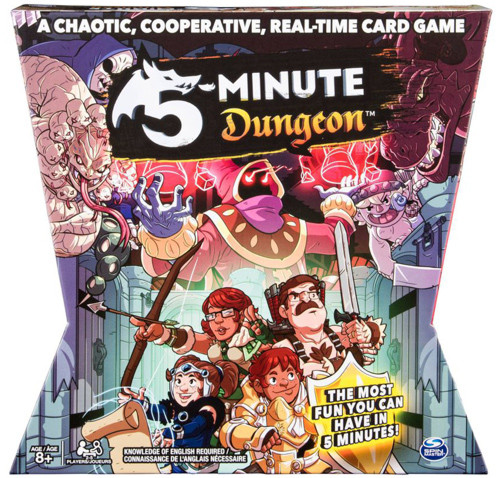
Review: 5-Minute Dungeon


Today is a look at a game I discovered at Wal-Mart, of all places.  Typically, they do not have the best selection of board games of the type I am interested in.  However, this one caught my eye for a simple reason it was designed to be a quick cooperative game.  As you may recall, my family likes cooperative games and I get tired of losing to my family all the time.  This seemed like a good compromise.  The game is called 5-MinuteDungeon and I bought mine for about $20 bucks.


Things That I Liked
The game is a cooperative card game.  I do not have a ton of experience with these types of games, so I am sure the features I discuss below will be very familiar to many of you card gamers.      

You choose between 10 heroes, and each group of 2 has a different set of cards, and all of them have a unique ability.  The card deck has different combinations of “suits” that make fighter guys better at fighting, rogue types better at sneaking, ranged guys better at shooting, and magic characters better at knowledge.  Therefore, each color deck has a unique mix of abilities. 

The “Dungeon” is a deck of door cards.  On the other side is various encounters where you need combinations of cards to bypass them.  Therefore, you will want a mix of Hero types to give you the best combination of abilities and likelihood of cards to bypass various encounters.  There are sub-bosses and then a large boss at the end.  Therefore, conserving the right cards for the end battle is a must.

If you run you run out of cards your character dies.  Therefore, if you are not using your cards well your team will probably not beat the dungeon as you need a mix to beat the harder encounter cards. 

Did I mention that it is cooperative?  Either the party all win, or you all loose.  Thumbs up!  


Things I Do Not Like   
You only have 5 minutes to bypass every card in the dungeon deck, with the dungeon getting progressively more doors/encounters as you go up in difficulty level.  I am not a fan of this timer approach for two reasons:

  • The game does not come with a 5 minute timer!
  • I think a more leisurely pace would allow you to “enjoy” the game further


Instead, you are so busy slapping down cards that you do not spend much time thinking about your team strategy, talking to each other beyond grunts, or appreciating the clever artwork/word play in the game. 

It also becomes clear pretty fast that characters that allow you to draw new hands or more cards are way better than characters who can bypass certain obstacle types.  Soon, the characters you are taking become pretty set as accessing more cards to play is better than discarding three cards and bypassing an encounter.  The one outlier are the special abilities that stop the timer.  A cool idea in theory, but a bit fiddly in the execution. 


Meh and Other Uncertainties
There are 10 Heroes, but really they are just slight variants of 5.  I applaud the attempt, but it just isn’t enough variety.

Since the game only takes about 5 minutes to play, it is a bit discouraging that set-up can take about the same length of time.  I mean, you have to shuffle each character’s deck, the dungeon deck, load the sub-bosses, etc.  Still you can play several games in 30 minutes to an hour.

It has decent re-playability as the dungeons get harder (I mean longer) you tend to die more often.  Plus, the cards get less interesting the more you see them.  However, the tactical play and strategy is not deep enough to play for more than an hour or so without getting tired of it all.  However, an hour of family time playing a game that is not on a screen is pretty decent value for $20.  We have sat down and played it as much as games like King of Tokyo, Pandemic, Flick’emUp and Machi Koro.  For a “specialty” game from a big-box retailer not know for such things; that is a pretty good deal.

Final Thoughts
Since I am starting to experiment and think a bit about how card mechanics works and how they could be used for various resolution mechanics this was an interesting buy for me.  It worked good for the type of games my family was interested in and helped me get a good basic overview of one way cards can help resolve mechanics.  Overall, I was pleased with my purchase.