Showing posts with label aircraft. Show all posts

Monday, December 4, 2023

Battle Report: White Star/Red Star - April 12th, 1951 "Black Thursday"


Dateline: April 12th, 1951
Location: Northwest Korea, MiG Alley

In early 1951, the Communist forces were able to dislodge UN forces out of the Kimpo area.  This success also led to an increase in Communist air activity in northwest Korea; MiG Alley.

April 12th, 1951 was nicknamed "Black Thursday" after 30 Mig-15s engaged and attacked 48 or so B-29 Bombers in MiG Alley.  The Bombers were escorted by F-80s and F-84s that were no match for the Soviet aircraft.  Several B-29s were lost or damaged.  No MIGs were lost.  This caused bomber operations to cease over North Korea for three months.

Today we will be playing another Bomber intercept mission similar to our last engagement.  However, this time we will be using a few more defenders and attackers and see if we get a different outcome from the historical, Black Thursday results.  

Forces:

USAF
3 B-29 Bombers - Experienced Pilots
4 F-84 Thunder Jets- Experienced Pilots
4 F-80 Shooting Stars- Experienced Pilots


Soviets
4 MiG-15s - Experienced Pilots
1 Mig-15- Ace Pilot


Mission: 
This will be a Bomber Intercept sortie with the USAF as the Attackers.  They gain a kill for each Bomber that makes it off the board. 

Set-up:
Today we are using 1 MU = 1 inch on a 72MU by 48MU across board. 

However, the sky is overcast at High Altitude, meaning that Detection is harder for aircraft at High Altitude and shooting is reduced to Combat range only. 

For fun and flavor, we scattered some Low Altitude terrain across the board at random.  These will only impact flying at Low Altitude.  


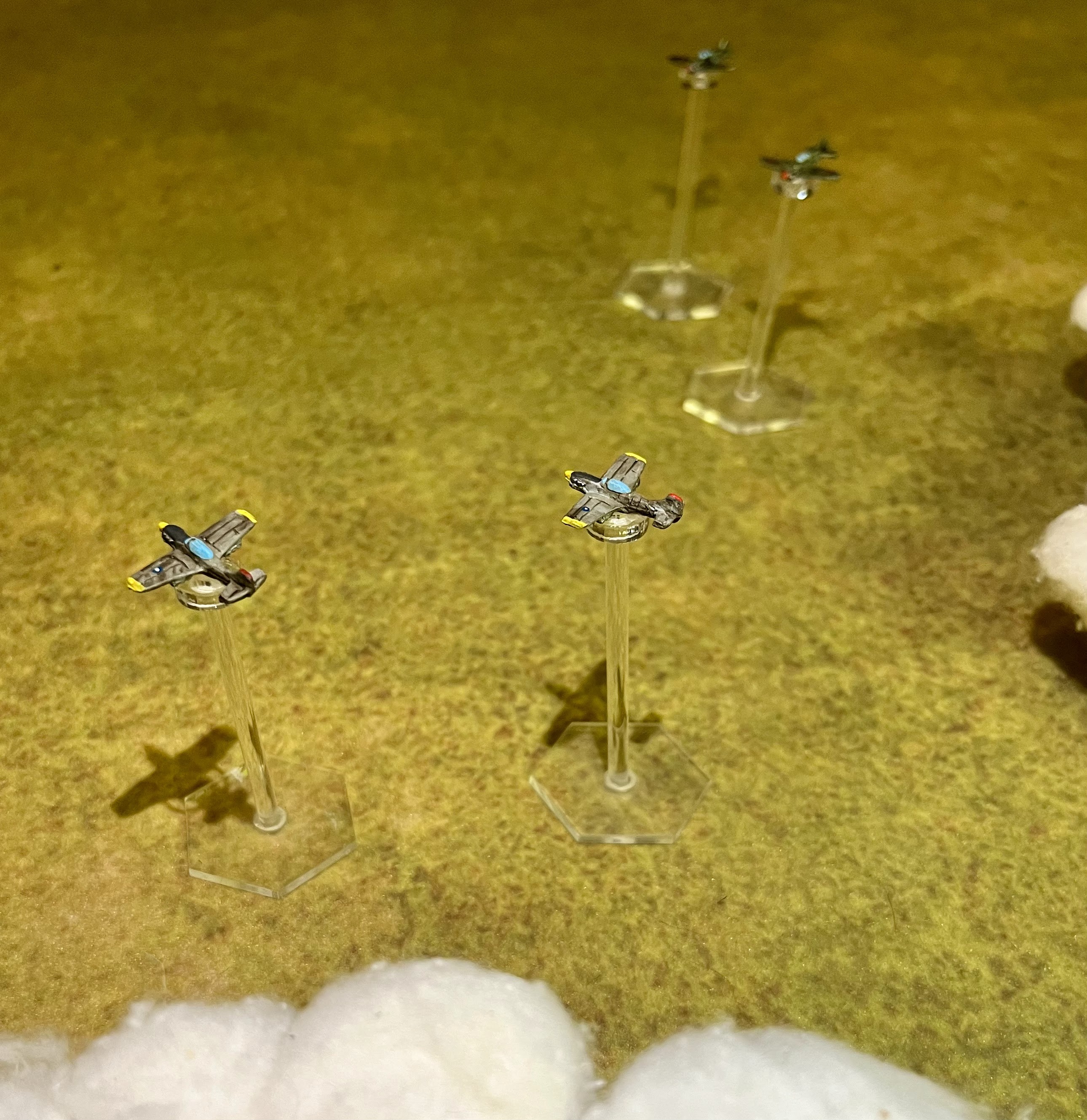
If an aircraft is off its base, it is at low altitude.  If it is on the base it is at Combat altitude.  If it has a dice behind it, the aircraft is at High-altitude.  As usual, I will be breaking the game down into three phases, Maneuver, Battle, and End phase.  I will not be tracking the turn-by-turn action as it makes recording the game and playing it easier.  

Maneuver Phase:
As normal for games of White Star/Red Star the table starts clear of any aircraft as none have been detected yet. A strong Soviet detection roll let them spot the B-29s and escorting Shooting Stars at High altitude, even with the Cloud Cover before they made it very far onto the board.  The following turn, the Thunderjets were also detected.  

Finally, the MIg-15s were spotted coming in low, along the hard deck.  They use their speed and low altitude to sneak beneath the F-80s in front.  


Battle Phase: 
The Soviet pilots use the amazing climbing ability of the Mig-15s to race up and engage the B-29s.  The Migs swarm the Bombers, and manage to take one down in a fire ball.  

1 Bomber Down!

However, it doesn't all go the MiGs way, as fire from one of the B-29's also takes out a passing MiG. The experienced MiG pilots race past, needing to reposition for another pass.  However, the Ace does a high-G turn and targets another bomber, but fails to bring it down. 

Scratch 1 MiG!

After frantically trying to shift position and get back into the fight, the MiGs manage to get in behind the second bomber and blast it from the sky.  The MiG on the outside runs out of ammo tangling with some F-80s, but no one goes down.  The Soviet Ace over-shoots the last Bomber, and has to break-off, pursued by USAF F-80s.  
2nd Bomber Down!

The pair of MiGs manage to be in a tailing position on the last bomber, after finishing off his companion, and they down the last B-29.  

The last Bomber just before getting shot down!

Disengagement Turn:
The USAF go back to High Altitude and turn for home.  The MiGs avoid any further engagements with their mission complete and break-off back across the Yalu river. 

F-84 Thunderjets flee for home.

Conclusion:
Soviets scored 3 Kills to the USAF 1.  A clear win to the Communists! 

A "Black Thursday" indeed.  The MiG-15s proved why they were so feared and effective at their job.  They easily out maneuvered the F-80s and F-84s and took the B-29s apart.  As the USAF player, I never had a chance as I was always out of position with my escorts.  I think I managed to fire with them twice.  Meanwhile, most of my shooting came from B-29s!  The Soviet Ace was all over me.  Being able to maneuver in all three phases is pretty good, but thankfully he couldn't hit the broadside of a B-29 or this would have been over much faster! 

I think next time we will have to put some Sabres up against some MiGs.  The Shooting Stars and Thunderjets are not up to the challenge! 


Become a Patron and get access to all the cool stuff, a peak behind the curtain of Blood and Spectacles, and early-access to playtest games!  


You can follow Blood and Spectacles Facebook page or Instagram for more fun! 

Check out the latest publications and contact me at our Blood and Spectacles website

Or purchase all out games at the Blood and Spectacles Publishing Wargames Vault Page!  


Sunday, October 29, 2023

Battle Report: White Star/Red Star - CAP July 29, 1950


Dateline: June 29th, 1950
Location: Suwon Airfield, Republic of Korea

On June 27th, an attack by the North Korean KPAF 1st Air Division on Suwon Airfield had been thwarted by F-90 Shooting Stars.  Despite this loss, the KPAF returned to the attack on the 29th.  This time, the American defenders were a group of F-51 Mustangs.  US Military leaders were on hand at the nearby town as part of a conference.  They were able to witness the defense of the base first hand.  

These attacks led to Gen, MacArthur to authorize air sorties to attack North Korean targets in order to establish air superiority.  

This will be a classic engagement from early in the war.  I could not really find any information on the North Korean attackers, but knew that the objective was to attack ground targets and that the North Koreans were equipped with a lot of IL-10's.  Those would be of little value in a CAP.  Therefore, I decided to use more "fighter" oriented planes for this sortie. 

Forces: 

USAF
4 F-51 Mustangs with Experienced Pilots


North Koreans
2 Yak- 9 with Rookie Pilots
2 La-9 Fritz with Experienced Pilots

Yaks on the left, Lavochkin's on the right

Mission: 
A simple Combat Air Patrol.

Set-up:
1 MU will equal 1 inch and the board will be 48 by 48MU.  

There is no difficult terrain on the board.  However, there are 4 cloud banks.  There are 3 cloud banks jumbled together at High altitude, and 1 smaller cloud bank at Combat altitude.  

In this case, the USAF is the Attacker.  The North Koreans are focused on getting to the air field to strafe targets.  The Mustangs arriving lead to a dogfight instead. 

Weather, sortie type, and Attacker were all determined using the methods found in the main White Star/Red Star rulebook.  

If an aircraft is off the base, it is at Low altitude, on the base is combat altitude, and on a dice is High altitude. I won't be following the details on a turn by turn basis.  Instead, I will break it down into three broad phrases; Maneuver Phase, Battle Phase, and Endgame and try to cover the battle in broad strokes rather than turn-by-turn, aircraft by aircraft detail. 

Maneuver Phase:
The first three turns go by fast as no planes are detected.  However, the North Koreans spot the Mustangs on Turn 3, and the USAF player has to place his planes up to 18 MU in.  Two Mustangs are at High Altitude near the edge of the board, while the other two are at Combat Altitude going into the cloud banks.  


The next turn, the Mustangs spot the Yak-9s coming in hot on the Mustangs at Combat altitude!  Since the USAF has more planes, they get to move first.  The two forward Mustangs decide to turn into the oncoming North Koreans to try to get in under the guns.  The Yaks fire a burst and then buzz past, the deflection angle was too much for them to score a hit. 


The next turn, the LA-9s are also detected, and they are also coming in hot on the Mustangs. Now, both sides have equal numbers and the Attacker goes first, the USAF.  The Mustangs try to maneuver, but the Experienced LA-9 pilots zoom in for the kill on the wingman of the first squadron. The Lead Fang pilots scores a hit and downs the Mustang! 

Now the real furball is getting started!

Battle Phase;
Now, the North Koreans have more planes, but choose to let the USAF go first. 

The Mustangs at High altitude manage to get in behind the Rookie Yak pilots thanks to their higher experience, and swat them out of the sky!  

However, that Maneuver put them into the sights of the La-9 pilots.  The wing leader manages to blast the Mustang wingman out of they sky, his second kill for the day!  However, he also uses the last of his ammo in the process.  


End Phase:
With both sides at half, this forces a disengagement turn.  It is the final turn of the game.  The USAF can choose to go first or second, and decide to go first. 

The Mustang in danger just throttles it and heads for home, breaking off.  The LA-9's try to maneuver back around, but the last Mustang out-maneuvers them and opens up on the lead aircraft. The USAF Mustang runs out of ammo trying to down the North Korean craft.  However, it is to no effect as the North Korean pilots weaves and dodges his way through the incoming fire.  


Conclusion: 
The battle ended in a draw, and a non-historical outcome!  So, what happened! 

The big sticking point was that the North Koreans managed to see the USAF before the USAF saw them!  This allowed them to get into a good firing position right away, and the Mustangs had a tough time shaking them.  The USAF had a chance for a win on the last attack run, but alas it was not to be! 

It was fun seeing the two players try to do the "Thatch Weave" and end up keeping the engagement close.  The Experienced USAF pilots easily downed the rookie North Koreans in the newer Yak-9s.  However, Experience paid off for the La-9 pilots, in worse aircraft.  

From here, I think I want to run a few games in the various segments of the war until the end.  Of course, this would represent the Air Battle of Korea, which lasted only a few weeks before the UN had gained air superiority over North Korea.  The North Korean offensive lasted until about September 1950.  The next phase of the war was the Chinese Counter-attack from October to January 1951.  This would be the introduction of the Mig-15 as they strove to bring down the day light bombers of the USAF.  

Onto the next battle!  


Become a Patron and get access to all the cool stuff, a peak behind the curtain of Blood and Spectacles, and early-access to playtest games!  


You can follow Blood and Spectacles Facebook page or Instagram for more fun! 

Check out the latest publications and contact me at our Blood and Spectacles website
Or purchase all out games at the Blood and Spectacles Publishing Wargames Vault Page!  


Monday, September 12, 2022

Battle Report: White Star/Red Star - CAP near Taejon, July 1950


July 19th, 1950 the USAF sought to establish air superiority against the invading communist forces.  This was know as the Air Battle of Korea.  At this stage in the war, the USAF was using a combination of piston and jet engine aircraft for this mission.  The primary opponents were the North Korean air force using propeller driven late WWII era aircraft.  

On July 19th, F-80's from the 5th air force took on advanced elements of the North Korean Air Force.  They engaged in a dogfight near Taejon.  In the engagement, the F-80s managed to down 3 enemy Yaks.   

I am super excited to get my Tumbling Dice miniatures out on the table to see how they look and feel on the table! 

Mission:
We used the rules from the book to determine the Sortie for today and came up with a Combat Air Patrol in clear weather.  This is a simple scenario to kill the other sides planes.  

Forces:
We have decided to use the North Koreans and USAF lists.  

USAF
3 F-80 Shooting Stars 
- Experienced pilots


North Koreans
4 Yak - 9 Franks
- 3 Rookie Pilot
- 1 Experienced Pilot


Set-up:
This games starts off with both players undetected.  There is also no need for terrain, but we added some for the look.  

The game is taking place on a 86 x 86 MU board.  1 MU is equal to 1/2 and inch.  

Two of the Yaks are connected as wing-men.  Everyone else is individuals in this furball. 

For reference, if a plane has no stand, it is at low altitude, stand is combat, and on top of a dice on a stand it is High altitude.  

Turn 1: 
Detection:
No one is detected this turn, so no planes enter play yet.  

Turn 2: 
Detection: 
No aircraft detected by either side still.  This is eating into the games turn limit, and allowing planes to deploy further in on the board once detection occurs. 

Turn 3: 
 Detection: 
Nothing. All pilots are still scanning the skies. 

Turn 4: 
Detection: 
The F-80's are spotted, and need to be deployed on the table.  Since it is the 4th turn, they can be deployed up to 24 MU in.  

The F-80's deploy with two at combat altitude and 1 at High.  They re moving diagonally across the board.

Rookie: 
The lead F-80 makes a 45 degree turn and heads towards the village.  The second stays high and straight, while the third makes a 20 degree turn and turns towards the village too. 


Experienced: 
The USAF continue to move.

Ace:
They all move straight, as they are Experienced pilots and can not make moves in this phase.  

Turn 5: 
This time, the USAF sees the North Korean Yaks.  The North Koreans can deploy up to 30 MU in from their board edge.  

The Yaks put their Rookie pair forward, going across the board to try and lure the USAF after them.  The other two are further back, with the last rookie at High altitude. 


Rookie: 
The North Koreans have to start moving planes first, since they have more of them.  Both sides begin to turn into the attack, looking like they are setting up to go head-to-head.  No one changes altitude. 

Experienced: 
The USAF have more Experienced planes and move first. The paired North Koreans have to move together as a pair, since they are a wing-man team.  

The USAF moves to bypass the rookie bait, and head for the North Korean Experienced pilot.  Both sides close the distance, and get ready to fire.  

Ace:
Neither side has any Aces, so the North Koreas move first.  All pilots can only go straight, and not change altitude.  They also can not shoot in this phase.    


Turn 6: 
Detection:
There are no more planes to detect, so this phase is no longer needed going forward. 

Rookie: 
The tailing Yak at high altitude banks 45 degrees to try and set-up against the high F-80.  Meanwhile, the Rookie pair turn at 20 degrees to dissuade the high F-80 from dropping down altitude. 

The Experienced North Korean Pilot and one of the F-80's are going head-to-head.  the North Korean fires, but the range is far enough for the USAF pilot to maneuver around the incoming fire. However, the North Korean pilot kept ammo in the hoppers for another pass with a disciplined burst.

The lead F-80 just misses the angle on the North Korean experienced pilot and can not fire.  The other F-80 is lined up after avoiding the incoming fire, and opens up a return burst.  The North Korean dodges the long range burst as well.  The USAF pilot also has ammo remaining. 


Experienced: 
This time, the USAF has the advantage as they have more experienced pilots.  The F-80 presses home the head-to-head attack on the experienced North Korean pilot, and this time is able to bring him down with a burst.  However, it was a long burst and the F-80's guns go dry.  He will want to break-off and away.  First kill to the USAF! 


The other North Korean pilots can not maneuver, as they are all rookies.  Instead, they go straight.  The High F-80 stays high and turns in to go over the Rookie pair.  Meanwhile, the F-80 leader turns back into the furball. 

Ace: 
No one can maneuver, so they all go straight! 

Turn 7: 
Rookie: 
The Rookie pair dive down to low altitude and make to break-off.  The F-80 that is out of ammo also turns away to break-off.  

The High Altitude North Korean Rookie sees a USAF F-80 bearing down, so he turns into the attack and fires.  However, he fails to hit the mark.  The incoming F-80 returns the favor.  However, he also misses.  Neither plane is out of ammo yet.  


The lead F-80 tries to duck in and cut-off the Rookie North Korean if he tries to break away or go lower.  

Experienced: 
The USAF F-80 fires on the Rookie Yak-9 pilot, who manages to dodge the shots.  The two aircraft race past each other.  Both with ammo remaining.  

The lead F-80 stays at combat altitude, incase the higher Yak dives.  

Ace: 
Everyone goes straight! 

Turn 8: 
Rookie: 
Everyone is faffing about and trying to regain position.  

Experienced: 
The F-80s still in the fight are using their superior speed and skill to get back in on the Yaks, cutting off their turning radius.      

Ace: 
Straight again! 

The F-80 that is out of ammo manages to disengage from the fight and head for home with 1 Kill to their record.  


Turn 9: 
Rookie: 
Lead F-80 is still 1 altitude level above his prey as they try to flee.  The last rookie Yak drops to combat altitude, hoping for a chance on the F-80 leader.  The last F-80 is still turning back into the scrum and at high altitude. 

Experienced:
The F-80s both dive.  However, the Lead F-80 can not get the angle on the pair of Rookie North Korean pilots.  However, their higher altitude pal also has no shot. 

Ace:
Straight ahead! 


Turn 10: 
Rookie: 
The North Koreans go first as they have more planes.  The rear Yak dives, but can not get a shot off.  

The second F-80 is still too high, but gets ready to cut-off the last North Korean aircraft.  

The Rookie pair try to cut in under the attacking Lead F-80, but he manages to fire a burst and take out the tailing plane.  The USAF pilots still has ammo.  


Experienced:
With 1 Kill under his belt, the lead F-80 breaks off from the fight and disengages off the board.  The second F-80 dives at the fleeing rookie Yaks, but misses the angle. 

The last Yak also has no shots, but does not have the skill to try a shot anyway. 

Ace:
They all fly straight. 

Turn 11- Disengagement Turn
With all three phases, the last planes can easily disengage off the board.  

Conclusion:
The USAF F-80s of the 5th Air Force managed to disengage with no losses, and 2 Kills to their record.  A successful day in the Air Battle of Korea

A couple observations from this battle.  Typically, I use 1 MU = 1 inch.  The shorter MU slowed the game down a bit, but allowed more maneuver.  With 1 MU is 1 inch, the game would have lasted closer to 6 or 7 turns instead and the action would have occurred much faster.  I think I will use the 1 MU = 1 inch going forward.  The shorter distance also made the aircraft feel slower as well.  

As the North Korean player, I was too aggressive with my Experienced pilot and when he was knocked down I did not have much to respond with.  My hopes for a draw fizzled when one of my Rookie wing-men got shot down.  Then, it was all about avoiding losing more planes and getting out alive! 

The faster Jets and skill of the American pilots played a part in the battle.  It was this advantages that allowed them to shoot my Experienced pilot down, and bag a Rookie.  A historically accurate result in this engagement.  


Become a Patron and get access to all the cool stuff, a peak behind the curtain of Blood and Spectacles, and early-access to playtest games!  


You can follow Blood and Spectacles Facebook page or Instagram for more fun! 

Check out the latest publications and contact me at our Blood and Spectacles website

Or purchase all out games at the Blood and Spectacles Publishing Wargames Vault Page! 


Monday, September 5, 2022

Wargame Design: White Star/Red Star


I have been working on a Korean Air War game for a while.  You can now find it on the Blood and Spectacles Wargame Vault page, and it is called White Star/Red Star.  The kernel of White Star/Red Star game were two main objectives: 

  1. How to model this "transition" period between WWII and Modern air warfare?
  2. How to reduce the complexity of flying for the player to focus on the wargame?
As many people know, I am a big fan of Aeronautica Imperialis as it gives a lot of tactical depth with simple rules.  The easy solution would have been to simply re-skin one of my favorite rules systems and make Korean War profiles for it!  However, that did not solve the fundamental challenges I wanted to focus on.  Even AI, you spend a lot of time simply flying your planes, and that was an area I wanted to explore simplifying.  

Therefore, I had a few different objectives as I built these rules: 

1. Simplify flying and assume that all pilots know how to fly, the player do not have to
2. Use action economy to differentiate pilot skill
3. Make detection a key component of the game
4. Finish games quick while including critical player decision making
5. Represent the key tactical challenges and aircraft of the Korean Air War
6. Scale and Model agnostic

Let's take a look at how I went about tackling these objectives then.


Simplify the Flying
At this stage, I made a number of abstractions to make flying easier on the player.  The rules first assume that the pilots all know the basics of flying.  They are skilled enough to not crash and keep the craft from stalling and the like.  Therefore, since the Pilot is doing the flying, the player is more concerned about where the plane will go in relation to the other planes on the board.  

1. All planes are assumed to be going at combat speed.  There are no speed adjustments to track.
2. Altitude is simplified to 3 levels only.  You can change altitude or turn in an activation, not both
3. Turns are simplified into basic categories; 20 degree, 45 degree, 90 degree, and 180 degree

These simple mechanics allow the player to put the planes where they want in relation to their fellows quickly and easily.  


Use Action Economy to Differentiate Pilots
Sure, all pilots know how to fly but some are simply better at flying than others.  Only a handful have the killer instinct it takes to become an Ace pilot.  What is the difference between a rookie pilot, an experienced pilot, or an Ace?  

In White Star/Red Star pilot skill level is differentiated by Action economy.  All pilots can participate in the Rookie phase, where they move and shoot using alternating activation as normal.  In the Experience Phase, Experienced and Ace pilots can move and shoot normally.  Rookies can only fly straight.  Meanwhile, in the Ace Phase only Ace pilots can move and shoot normally.  Everyone else just flies straight.  These escalating activations give Aces the edge in out-flying and acting compared to their lesser peers.  

In addition, when a pilot can initiate a turn action differs based on their skill level.  Rookies have the most limited window of action.  Experienced pilots have more latitude to change course.  Meanwhile, Aces can initiate turns freely.  It is also important to remember, that a pilot can either change altitude in an activation or turn.  With the stacking Phases, Aces will be able to make this choice three times as often as a Rookie.  


Make Detection a Key Component of the Game
Often times, the difference between living and dying in air combat is knowing the enemy is around.  The majority of kills occur on an unsuspecting target.  Therefore, detection is a critical and often overlooked component of air combat.  

To reflect this, deployment in this game is a bit unique.  Each turn, both sides make a detection role and compare it to the profiles of the enemy aircraft.  If the detection roll is successful for certain aircraft, they can be placed on the board anywhere in the deployment zone, at any facing and altitude.  If failed, the planes are not deployed.  It is easier to detect big multi-engine bombers than small prop planes.  

Every turn, the potential deployment zone is extended.  Therefore, the longer it takes to be detected the further onto the board the plane can be deployed.  As the turns go by, the detection roll gets easier as the forces close.  In playtesting, it was possible for planes to start detected coming in on the tail of an enemy plane!  However, such results were not common. 

Finish Games Quick and Focus on Critical Decisions
One of the key components to assist this was to make dice rolling quick and easy.  A pilot can roll 1 dice per their level of skill; rookies roll 1, experienced pilots 2, and Aces 3.  Success was always a 4+ and most rolls are opposed.  Therefore, whoever scores the most 4+ will win most rolls.  Modifiers take the form of +/- dice to the roll.  Therefore, this unified mechanic makes resolution easy.  

In addition, the game has a maximum number of turns and a disengagement level.  This made sure games did not drag out since a long dogfight during the Korean War lasted 5 minutes at most.  I wanted resolution of the wargame to align closer to actual dogfight times.  Most games are completed in less than 1 hour from beginning to end, with some being as short as 15 minutes.  

As for critical decisions, the dice modifiers are based on range and angle of attack.  In addition, the game has relatively narrow firing arcs so maneuver matters.  In addition, there is an Ammo roll when you take shots so you have to weigh the risk of running out of ammo against the chance of hitting before you roll the dice.  This makes players focus on the critical decisions and trying to get high-probability shots rather than fishing for lucky hits.       


Represent Key Tactical Decisions and Aircraft of the Era
Unlike World War II dogfight, Korean War dogfights between Jets was often vertical rather than horizontal.  The game tries to mimic this by giving the aircraft of the time stats that match the performance of the aircraft.  MIGS were great at climbing, so have benefits to climbing.  Sabres were great at diving, and this is reflected in the rules.  As planes decide to turn or change altitude, it immediately changes how far they can go in that activation based on the type of plane it is.  Since the LA-11 Fang was a poor climber, it suffers a greater loss of speed as it goes up, and it is applied immediately for that activation only.  

The rules also include how to use wingmen and wingman tactics directly.  Instead of acting independently, the wingmen operate together and perform the exact same maneuvers.  If the wing leader goes up 1 altitude, so does the wingman.  If the wing leader turns 20 degrees, so does the wingman.  They work together for good or for ill.   

Scale and Model Agnostic
Like all my games, I wanted it to be scale and model agnostic.  Korean War aircraft models come in all different scales from 1/1200 up to 1/48!  This system can accommodate any size aircraft you want to use and any space you have.  This is because the game uses generic measurement units that can be the equivalent to any measurement you want based on the play area and models you have.  Larger models and a small table may demand smaller MUs, while small scale and large tables could use larger.  

Also, measurements are from the center of the model, and firing arcs are wingtip to wingtip (or a circle depending).  Therefore, as long as aircraft are the same scale then they will be using the same mechanics for firing arcs and measurements.  Therefore, you can use whatever you want to play.  


Conclusion
This game went together pretty fast compared to my usual efforts.  I think I only worked on this one for 2 years!  However, it got more playtesting than my games normally get due to how quick it plays! Despite the "quick" turnaround, this game went through at least 4 major revisions, mostly to the action economy and detection.  

I am really proud of this game.  It focuses on what I want it to focus on, and I think handles air combat in a unique and innovative way.  The game was so easy, even novice wargamers were picking it up and grasping the tactics of the period right away.  I hope you enjoy them!

If you want to pick up White Star/Red Star at the Blood and Spectacles Wargame Vault page.         


Become a Patron and get access to all the cool stuff, a peak behind the curtain of Blood and Spectacles, and early-access to playtest games!  


You can follow Blood and Spectacles Facebook page or Instagram for more fun! 

Check out the latest publications and contact me at our Blood and Spectacles website

Or purchase all out games at the Blood and Spectacles Publishing Wargames Vault Page!


Monday, June 13, 2022

Castles in the Sky: Indo-China Campaign V - French vs British


Welcome back to the Indo-China campaign for Castles in the Sky from Osprey Games.  Previously in the campaign the British lost control of the Kra Isthmus to French backed rebels.  This caused issues with the British's proxy the Kingdom of Siam.  Therefore, the British attempted to bombard and destroy a rebel smuggling base where arms and supplies were being funneled to the rebels on the isthmus.  Commodore Duckworth was successful in his mission and bombarded the depot into scrap with the heavy batteries of the HMS Malayan.  However, it was not enough to quell the unrest.  

The French are leading the campaign 4 to 3.  The Final Battle scenario is triggered at 7 points and the leader must be ahead by 2.    

In addition, the French armored cruiser the Cuchinchina finished refit and repairs at Saigon and has re-entered the French fleet.  This is a needed boost to the French fleet as the Hue is still on training maneuvers off Tourane.  The British cruiser HMS Achilles is still undergoing repair work in Laem Chabang from the pounding it took against the French earlier.  In addition, the HMS Corsair comes into today's battle down 1 armor point if it gets used at all.  

Unlike the British, the French naval doctrine is reliant on the indirect approach.  For many decades, there officers have focused on a school of thought known as the Juene Ecol.  This approach focuses on less direct confrontation between ships, and more of a strategy of speed, maneuver, and sharp attacks by lighter forces.  The French were pioneers of the destroyer, air torpedo, and the sky mine.  With the British on the backfoot, Commodore Aubre has decide to continue to raise the stakes on the British commander.  

Earlier, the British had tried to blockade repair parts from reaching the Cuchinchina in Saigon.  With the HMS Achilles in port at Laem Chabang, Commodore Aubre has decided to return the favor.  However, after the failure of the British blockade, the French officer chooses a different path.  Instead of trying to actively blockade the area with his ships, he intends to mine the main trade routes into the port.  

Commodore Aubre waits until the right time.  A cloudy, moonless night is when he decides to strike for maximum surprise on the British.  Of course, Laem Chabang and the HMS Achilles are important assets for the Royal Navy of Siam.  Therefore, much of the British force is active in the area as well.  

Forces: 

L'Aire National

Camot- Commodore Aubre- Command 4
Charles Martel Class Heavy Cruiser (Battleship)   

Cuchinchina - Captain Gourdon- Command 2
Gloire Armored Cruiser

Tourane- Captain de Genouilily- Command 2
Descartes Class Cruiser

Tromblom- Commander Morice- Command 2 
Chasseur Class Destroyer - Sky Mines   

The Royal Navy (of Siam) 

HMS Malaya- Commodore Duckworth- Command 2
Queen Elizabeth Class Battleship

HMS Arrogant- Captain Knowles- Command 2
Arethusa Class Light Cruiser

HMS Medusa- Captain Butler- Command 2
Active Class Light Cruiser

HMS Corsair- Commander Montgomery- Command 4
Bull Finch Class Destroyer- Torpedo

Mission:
The French are the attackers and the British are the defenders in this scenario.  The French are trying to lay as many sky mines as possible within 6MU of the center of the board at Alt 3.  

However, there was a complication determined for this battle.  This battle will take place at night, which reduces Line-of-Sight.  In addition, there is also a layer of cloud cover at altitude 4 which also restricts visibility.    

Set-up:
The battle will be played on a 48MU by 48MU board.  We used a grid system to determine the terrain per the standard rules.  

1= No impacting terrain
2= Mountain alt 3
3= No impacting terrain
4= No impacting terrain

However, the complications will be more than enough cover for this battle!  It is going to get up close and personal.  Both sides can deploy up to 6 MU in from their board edge at any speed of height.

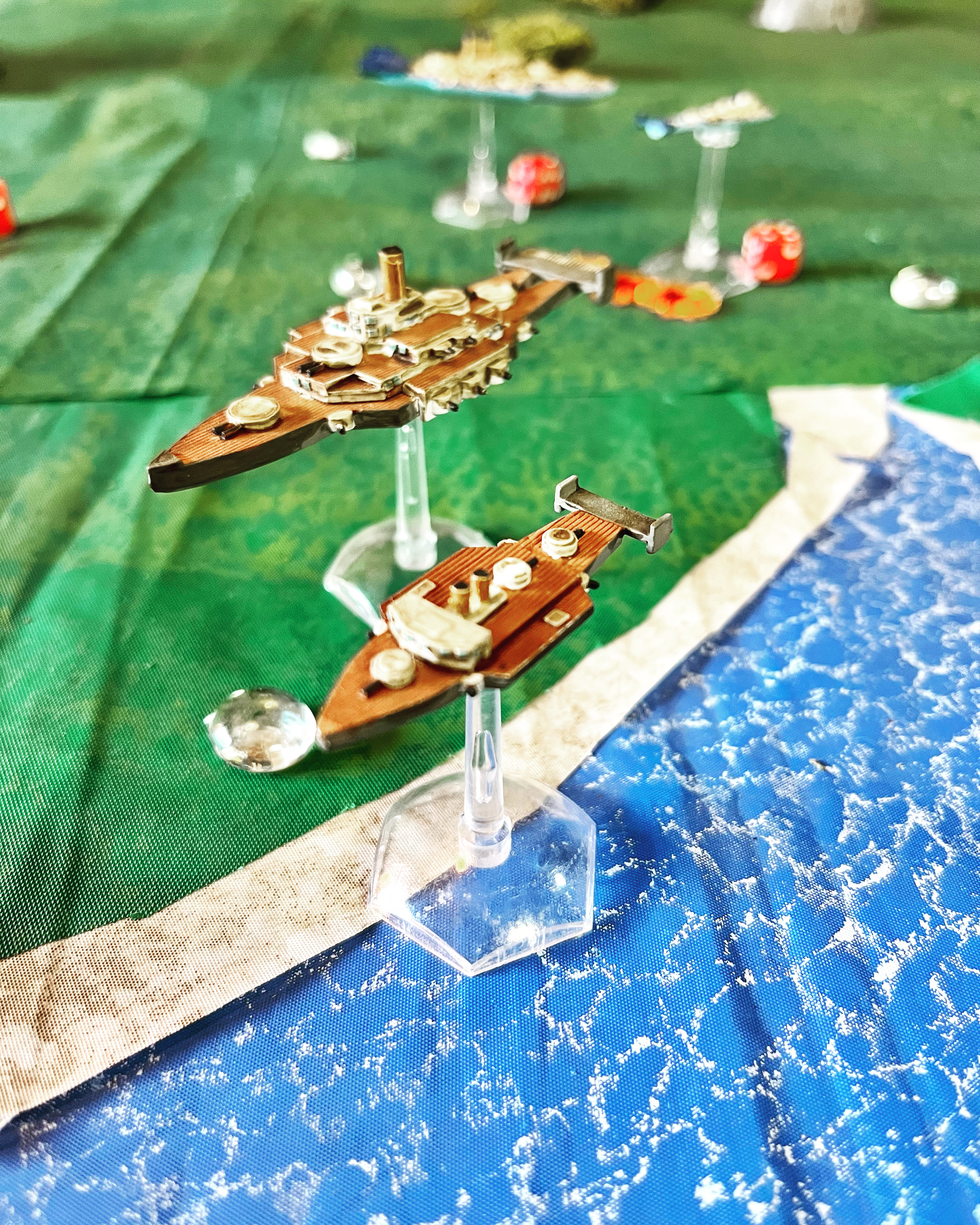
The British are divided into two groups, the Malayan and the Medusa are heading for the drop zone at Altitude 3, while the Arrogant and Corsair are in a flanking force at Altitude 4 and 5.  The Altitude 4 clouds will make this a tough battle to get line-of-sight.  


The French are coming in on a corner edge, led by the Camot at altitude 4with the Tromblom flanking it.  The Cuchinchina and the Tourane are also in formation but at altitude 5.  They are making use of the cover of the clouds.   


Turn 1: 
Initiative: Both sides score two successes, and since the French are the attackers, they win.  They decide to go first this time.  

Move:
The Medusa, Arrogant, and Corsair all increase speed to 6 as they probe for the French ships.  Ground observers spotted and reported the French ships moving into the area, and their target is clear to the British command.  The HMS Malayan makes for the center of the trade route to protect it.  

The French Camot and Tromblom stay in the cover of the clouds as they approach.  The Tourane and Cuchinchina are following, but taking top cover and searching for enemy ships.  

Battle:
None.  No one has the range or line-of-sight.  It is night time after all.    

End:
None

Turn 2: 
Initiative: The French get three commands to the British 1.  They elect to go first again. 

Move: 
All force continue on target.  The Arrogant and the Corsair are rocketing through the night at speed 8, while the Medusa slows to stay with the Malayan. 

Battle: 
No one can get a target at night and with the clouds.  This will be a short, and intense firefight up close and personal when it happens!   

End:
None


Turn 3:
Initiative: This time the British win three to 1, and decide to go first to get to the target zone before the French.... maybe?  

Move:
The Malayan moves up and turns slightly to put the majority of the trade route under the guns of their broadside at Altitude 3.  The Cuchinchina breaks off from the French fleet at Altitude 5, and turns towards the mountain and the reports of British ships in the area.  

The Medusa moves up with its charge, as the Tourane stays high at Altitude 5 on the opposite flank of the French fleet.  

The Arrogant drops to altitude 3, and into cruise's into the target area, hoping to get the jump on the French destroyer.  However, she is taken by surprise as the Camot drops out of the cloud bank and blows smoke as she approaches the Light Cruiser rapidly!  The Corsair stays high at altitude 5, but stays with the Arrogant.  The Tromblom also speeds up and drops altitude to stay with the Camot, and begin her attack run on the target! 

Battle:
The Camot is just out of range of the HMS Malayan thanks to the darkness of the night!  However, the Arrogant quickly opens fire on the French pre-Dreadnought.  However, the smokescreen does it's job and renders the Arrogant's weapons useless.  A snapshot from the Camot's bow heavy battery also goes wide of the Arrogant.  

End:
None.


Turn 4:
Initiative: ! command to 1, and the British maintain initiative.  However, this time, they opt to let the French go first, so they can get position on them.        

Move:
The Cuchinchina drops altitude and speeds up to 6.  They are in the cloud bank.  The Arrogant, spooked by the run in with the French battleship, gains height and races past the drop zone.  

The Tourane keeps going ahead, confident their path will cross that of the Arrogant or Corsair.  The Corsair keeps skimming the top of the cloud bank, reluctant to get stuck in too close due to their weakened armor.        
 
The Camot drives back up into the cloud bank, and blows smoke with a Command.  The British do not take the bait, and continue to cover the trade route, knowing the Tromblom will need to appear to drop her mines.  

However, the Tromblom dives into the trade area, but maneuvers frantically to curve out of the area, and keep her Mine Launchers in position to mine the area.  The destroyer is trying desperately to avoid the British fire.  


Battle: 
The French go first a begin with the Tromblom popping Sky Mines into the target area!  4 counters are in the drop zone.  Despite the Tromblom's efforts, she is in sight of the Malayan who makes a Fire for Effect order.  The little French Destroyer is hit with 4 friction and 2 hits from the Malayan's Light Batteries.  

The Tourane and the Arrogant exchange fire through the clouds.  The Tourane takes the worst of it with 4 Friction and 2 hits, to the Arrogant's 4 friction.  However, the Camot can also see the Arrogant, and fires with an obscured line-of-sight through their own smoke.  The Camot's starboard light battery jams, but the Heavy and Mediums manage to add 4 more friction and 2 solid hits on the Arrogant! 


End: 
The Tromblom loses 2 armor from the Malayan's fire.  
The Tourane has her screw fouled and rudder jammed by the Arrogant, while losing two armor.
The Arrogant's rudder is jammed and she lose 2 armor. 

The Arrogant and the Tourane manage to unjam their rudders.  However, the Tourane still has a fouled screw.  The Camot repairs its starboard light battery 

There is 16 Friction on the board.  The two commandore's clear 18 total, so no friction remains in play.  

Turn 5:
Initiative: Two commands to two, so the British maintain.  This time, they want to shoot first, so go first.  

Move: 
The Corsair bravely turns about, and drops to altitude 3, heading straight towards the minefield in an attempt to clear it with PD.  However, the Destroyer's plan may be thwarted as the Cuchinchina drops out of the clouds to cover the Mines.  

The Malayan turns to bring the Cuchinchina under fire, while the Camot flies over her bow and continues to blow smoke.  Meanwhile, the brave Tromblom turns back into the danger zone, and reloads more sky mines! 

The Arrogant turns about to try to catch the Tourane, but she breaks contact by diving below the cloud bank, and breaking Line-of-sight.  However, that maybe a bad idea as the Medusa and Malayan are also in the area.  

Battle: 
The HMS Malayan makes another Fire for Effect order, and opens up on the Tromblom with her light batteries.  However, her gunnery is far less effective and only inflict 2 friction.  However, her bow Heavy Batteries plaster the damaged Tourane!   

The Cuchinchina fires on the Corsair, but only causes 2 friction.  The Medusa's bow battery manages to hit the Tourane for 1 more hit, taking it down to 1 armor point left! 

The Tromblom and Corsair exchange fire, with the Tromblom taking a hit and jamming her bow gun.      
End:
The Tromblom lost 1 more armor.  
The Tourane lost 4 armor and was crippled! 

The captain of the Tourane chooses to strike his colors before losing the ship completely.  


The Tromblom unjams the forward guns.  

There is 10 Friction on the board.  The combined commodore's can remove 14, so no friction remains.  

Turn 6: Final Turn
Initiative: Both sides score 1 Command, so the British maintain the initiative and decide to shoot first.  

Move: 
The Arrogant circles the drop zone and goes below the cloud cover.  The Toruane tries to disengage and drops to Altitude 2.

The HMS Malayan moves to cut off the Tromblom, with the Medusa in support.  The Camot steals away in the cloud bank, while the Cuchinchina stays in the drop zone to exchange fire and support the Tromblom.  

The Corsair races through the minefield in an attempt to clear the mines.  The plan works as the Point defense blows up 1 mine, the other 3 attack and explode.  However, the destroyer takes 3 hits passing through! 

The Tromblom cuts across the drop zone, and stays in the Malayans stern arc to reduce incoming fire.  However, she is still in position to drop her mines.  


Battle:
The Malayan Fires for Effect one more time.  3 hits from the Malayan light batteries strike the destroyer, and the Captain orders her to Brace.  She shrugs off all three hits.  However, she can not drop any Mines due to the command.  The Malayan's stern heavy batteries also bounce off the Cuchinchina, causing 2 friction.  The French armored cruiser cause two friction in return.

The Medusa's stern battery also fires on the Tromblom, who shrugs the hit.  

End:
The Corsair loses 3 armor and has her screw fouled.  

The Tourane and the Corsair are unable to repair their critical damage.  


Conclusion   
The British win the battle decisively, scoring two campaign points!  Thanks to the Corsair's efforts, all the mines were cleared.  The British then won the armor loss battle, losing 5 to the French 10.  The Tourane's miscalculation to avoid the Arrogant, and stumbling into the front of the Malayan was a costly tactical error!  This puts the British up 5 to 4 in the campaign! 

The damaged ships try to repair what they can as they head for home.  The HMS Arrogant is successful and manages to repair both armor losses.  The Corsair also manages to repair the damage done by the Sky Mines, but is still down 1 armor point overall.  The Tromblom fails to repair any of her damage, and limps back to French territory with 3 damage.  The Tourane also fails to repair any of her damage en route, ship is in rough shape! 

The Siamese government also manages to crush the rebels in the Kra Isthmus and reclaim authority in the region.  The French backed rebels are forced back into hiding, and the Isthmus is back in the Royal Navy of Siam's strategic asset column.  

Participants gain the following Experience:

Malayan: 15 + 10 = 25
Arrogant: 1 + 4 = 5
Corsair: 6 + 4 = 10
Medusa: 6 + 2 = 8

Camot: 10 + 3 = 13
Tromblom: 5 + 4 = 9
Tourane: 12 + 1 = 12
Cushinchina: 3 + 1 = 4

Tonkin and Tourane had both previously received experienced crew upgrades, and the Malayan gained a Stoke the Engines to help it gain speed in previous battles.  This time, The Malayan gains Veteran Aircrew so they gain +1 on Evasive Maneuver checks.  The Camot earns Disciplined Crew which allows them to remove their own Friction markers in the End Phase.  

The British use the Phrae Nakron to complete repairs on the Achilles, which will take 1 more campaign turn.  They use the recently freed Kra Isthmus to complete repairs on the Corsair.  They convert Laem Chebang into a re-roll for next game.  

The Hue has one more turn off Tourane to complete training.  That leaves Hanoi and Saigon.  Saigon takes in the Tourane for a complete refit and repair which will take 2 campaign turns.  Hanoi begins work on the Tromblom and repairs 1 armor, leaving her down 2 into the next turn.  

The government of Siam crushing the rebels in the Kra Isthmus and regain control of the territory was a set back to Commodore Aubre's plans.  This put control of the region back into the balance, and the French forces failure to mine the airway left them on the back foot against an aggressive British commodore.  Worse, the Tourane took serious damage and would have to refit.  Despite the losses, the French embassy was comfortable with the situation.... for now.  

The British and Commodore Duckworth were buoyed by their string of victories, and ready to go back on the attack.  The critics in London of the Commodore were silenced.  Captain Montgomery was treated as a hero for his brave mine run, and was content to let his differences with Commodore Duckworth be settled.  The British were ready to attack.  

You can pick up the rules for Castles in the Sky at the link from Osprey. 


Become a Patron and get access to all the cool stuff, a peak behind the curtain of Blood and Spectacles, and early-access to playtest games!  


You can follow Blood and Spectacles Facebook page or Instagram for more fun! 

Check out the latest publications and contact me at our Blood and Spectacles website

Or purchase all out games at the Blood and Spectacles Publishing Wargames Vault Page!