Showing posts with label Men of Bronze. Show all posts

Monday, December 22, 2025

Men of Bronze- Italiotes


The information below is an extract from the Hercules Abroad supplement that can be found on the Wargame Vault.  This post has been sitting in my draft box for a long time, but as I have been working on the Carthaginian supplement Rise and Fall I might as well send it out into the wild now.  Merry Christmas!  

***********************************  

As we continue to expand the world of the Ancient Greeks, it is natural to expand westward into Magna Graecia.  This was a series of loosely affiliated Greek colonies located in Sicily and southern Italy.  This Diaspora was often attributed to the Greeks following in the footsteps of the "Journeys of Hercules".  This mythology was used to justify their expansion, colonization, and infringing on indigenous people's territory.  

We all ready have a list for Syracuse and the City-States of Sicily.  However, Magna Graecia had a vague definition and also included the Southern coastal regions of Italy.  These colonies existed before and during the rise of Rome on the Peninsula, and eventually were rivals to her growth.  The area of Southern Italy was ill suited for traditional Greek hoplite battle, so local variations were required in the military habits of the Greeks who found themselves there.  


This area began to see extensive Greek settlement in the 8th and 7th centuries BCE.  These colonists brought their Greek culture with them such as the idea of an independent City-state, religious traditions, and trade with their homeland.  These Hellenic cities became vital power houses in the region and began to fuse the native Italic cultures with Greek cultural practices as well.  

These Italic-Greek city-states eventually formed their own league for mutual support, trade, and protection against the neighboring Oscan tribes and other Greek rivals in 430 BCE.  This was known as the Italiote League and was controlled by the city of Tarentine in the late 5th century.  

How They Fought

As usual, nothing is known precisely about how the City-States of the Italiote League fought.  We can make some assumption based on how their founding city-states fought, and how rival Italic tribes fought as well.  In addition, there were some military trends in the Hellenistic World that would impact the Italiotes as well.     

Of course, the foundational unit of any Greek city-state army was going to be the Phalanx composed of the land-owning freemen farmers of the nearby lands.  They had the status to buy their own equipment and assemble for drill with their peers.  The Hoplite warriors in Magna Graecia was similar to their brothers elsewhere.  However, the terrain and conditions of Southern Italy were not conducive to the normal Hoplite tactics.  

Native Italic tribes tended to be lighter armored and more mobile than their Hoplite neighbors.  Hit-and-Run attacks and cattle raids were the de facto fighting style of the local tribes.  In this fighting style, speed, mobility, and lighter weapons were critical.  Distance fighting with Javelins was also a common feature.  

Therefore, the Greek colonists to the region needed to meet these needs of warfare.  To do so, Hoplites tended to avoid the use of the panoply and instead used a lighter, native garb that featured bronze pectoral armor plates in the front and rear.  In addition, their head ware tended to be open in the front allowing greater visibility and allow a greater field of vision.  Greaves were often reduced to a single leg or discarded to reduce weight and increase the soldiers ability to pursue or evade.  Indeed, the Hoplite of Italian Magna Graecia was a much lighter and nimbler foe than the heavily armed shock troops of the Greek Peninsula.    


In addition to the lighter hoplites the Italic Greeks made extensive use of Peltasts and Psiloi. These were used to supplement the infantry.  They could provide covering fire for the advance, or screen the other troops.  These were frequently mercenaries or poorer members of the city-state, much like Greece. The javelin was the favored missile weapon of the region.    

The Italiotes made great use of Light Cavalry.   These were designed as a skirmisher based force that utilized javelins and missile weapons, but also had small shields and curved swords for melee combat.  They were an excellent pursuit and scouting force.  This type of light cavalry was frequently referred to as Tarentine Cavalry, even though they were not necessarily native to the city of Tarentum.  It was in reference to the style of skirmish cavalry that was being referenced.  

The final element of an Italiote force would also be made up of Greek mercenaries.  These would fit the more standard Hoplite, heavy infantry role in an Italiote force.  They could form a solid core of heavy infantry.  

Italiote Army List

Armed with the information above, we can start to piece together an army list for the soldiers of the Italiote League or its member city-states.  The bulk of the infantry will most likely be composed of Light Hoplites to represent their lighter panoply and more mobile style of fighting.  This will be supplemented by good Peltast and Psiloi options as the Javelin was a popular weapon in Italian conflicts.

The Cavalry should be Light Cavalry, but the melee ability and skirmisher nature can not be discounted.  Therefore, I am going to add the following Option for the Tarentine Cavalry forces.  

Tarentine Cavalry - 8 Points

Move    Attack    Armor    Courage    Discipline

12BW    4            1            4                2

Shoot: 2 (6BW) 

Special: Evade, Pursue, Move and Shoot

This differentiates them from standard Greek Light Cavalry that focused more on skirmishing, missile fire, and pursuit.  Now, you have a Light Cavalry unit that had enough Melee capability to challenge other Light Cavalry, Peltasts, Warband Infantry, and Psiloi.  However, they are still no match for dedicated Heavy Cavalry, Elites, or Drilled units.  


Italiote Line of Battle

Use the following lists to build your historical forces for the Italiote League or other Itallic-Greek forces. The Lines of Battle help to choose the appropriate units for your historical forces. These are sample lists and there to provide a flavor of potential forces. Players can always modify these lists as they see fit

Each Line of Battle will have an entry with a number. The number indicates the limit of that Unit you can take in the army. If an entry says 1+ your army must have at least one of these units in it. If it is 0+ any number of that unit may be taken. If a Unit is not on the list, it can not be chosen.

Italiotes

1+ Light Hoplites

0+ Peltasts

0-4 Psiloi

0-4 Tarentine or Cavalry

0-1 Drilled Hoplites

0-1 Archers/Slingers

The list above gives access to regular Light Cavalry or you can use the upgraded Tarentine Cavalry provided in the rules.  In addition, the bulk of the force will be Light Hoplites to match the subtle differences between mainland Greece and their Italic colonies on the table.  

Sample Army Lists

Below you can see an example force for the Italiote Greek City-States.  It is built to the 38 point standard and is composed of 6 units.  

2 Light Hoplites

2 Tarentine Cavalry

1 Peltast

1 Psiloi 


Battle of the Elloporus

Most of the warfare of the Italiote League was between fellow Greek City-states and the nearby Latin, Oscan, and Samnite tribes.  However, the threat from Sicily by the Tyrant Dionysus I was a primary concern.  Some scholars speculate that the rise of Dionysus the I of Syracuse was the prime motivation for creating the Italiote League.  Therefore, eventually the rivalry between Syracuse and the Italiote League would come to a head.  This inevitable clash happened in 389 BCE.  

Unsurprisingly, we know little of the actual events of the battle.  We know that it was fought, and that Syracuse won the battle.  The armies were probably in the 15 to 25K range on both sides.  Sources also indicate the battle was fought in the toe of Italy near the Stilaro River.  That pretty much summarizes what little we know of the battle.  

To put it in perspective, this battle took place during the 3rd Sicilian War.  In the same year, the Spartan King Aegislaus II was crossing the Gulf of Corinth to attack the Arcananians.  Athens is getting involved with Rhodes and taking control of the Hellespont under the command of Thrasybulus.  Military activity across Greece and Sicily was common during this time period.    

Of course, situations like these allow for a wargame to fill in the blanks.  We don't know much about the battle strategy, tactics, or terrain.  We also know next to nothing about the forces involved.  Therefore, whatever we choose to do is as accurate as anyone else chooses to do! 

Forces

For this battle, we will be using the Syracuse list and the Italiote League Lists.  Neither of these can be found in the Men of Bronze rulebook itself.  Both lists can be found in the Hercules Abroad supplement on the Wargame Vault.

Italiote League    

2 Light Hoplites

2 Tarentine Cavalry

1 Peltast

1 Psiloi 

Syracuse of Dionysus I

2 Militia Hoplites

1 Cavalry

2 Archers

1 Peltast

Since we know nothing about this battle, we can safely use any lists we want.  I have opted to use the sample Lines of Battle provided for both forces up to 38 points.  

Set-up

We know so little about the Battle of Elleporus, that it seems like just about ANY scenario from the main Men of Bronze rulebook could be used.  However, I feel that the Set Piece Battle scenario maybe the best and safest option.  

The game should take place on a 72 BW by 48 BW board.  The only set feature would be a river traveling along one flank of the battle, probably with the deepest edge being no more than 8 BW in from either short edge.  This could be Difficult, Dangerous, or Impassable terrain depending on how restricting you want the terrain to be.  After placing the river,  I would recommend deploying terrain in the remaining sections of the board and rolling for complications as normal.  The Set-Piece Battle scenario should be a good guide.  

Special Rules

Again, since we know so little about the battle, its prelude, and what occurred we can use any complications that we wish!  No special rules are needed for this battle and the normal process for generating Complications should be sufficient. 

Victory

Again, we know so little that special Victory conditions do not seem to be necessary.  Instead, the Victory Conditions for a Set-Piece Battle should be sufficient.  

However, feel free to add any spice you want to the battle.  For example, the Italiotes could be trying to kill Dionysus I once and for all, and their Victory Condition could be routing the Unit he is in.  If successful, the Italiote wins.  If Dionysus I unit is not routed, then the Syracusans win.  Your choice really! 


Final Thoughts

The Italiote Greek City-States act as an interesting bridge between the world of the Romans and the world of the Greeks.  Since the Italic-Greek City-States began their life in the 8th and 7th Centuries that leaves a lot of time for them to clash with their fellow Greeks such as Athenian Marines or colonists new to the region.  They can also clash with the Barbarian tribe lists, or some of the lists from Hercules Abroad such as the Carthaginians, Syracusan/Sicilian Greeks, or the Etruscans.  There are always no shortage of opponents to fight in the ancient world! 

I think I am starting to wrap-up the world of the Greeks for Men of Bronze.  I have covered a variety of different regions and cultures far beyond Mainland Greece now.  The full list can be found below.  If I go too much further and deeper, I will be into the Roman period which will be covered in Osprey's  Wars of the RepublicNo need to to do that, since it is fully compatible with Men of Bronze

You can get all of the updated materials including a FAQ, Campaign rules, and Lines-of-Battle in the Men of Bronze Supplement: Hercules Abroad.


You can follow Blood and Spectacles Facebook page for more fun: https://m.facebook.com/pg/BloodandSpectacles/posts/?ref=bookmarks&mt_nav=0

Or our website:

Or our Messageboard:

Or our Wargames Vault Page:


Monday, January 13, 2025

Wargame Design: The Corinthian War - Men of Bronze Supplement


Find the new supplement here!

Honestly, this was really unexpected.  One day, I was thinking about the trouble I was having moving some games forward.  I was having challenges getting words on the page.  I kept hitting internal road blocks, despite working my usual system.  I was getting frustrated, and my output was suffering.  

I am not even sure what happened, but I decided I needed to pivot.  What I was doing was not working.  I don't even recall the conscious thoughts that led to this supplement for Men of Bronze/Wars of the Republic to happen, but once I pivoted and started working on it..... well..... it poured itself onto the page in a matter of days.  This was not on my "To Do" list at the end of last year, so to see it now is a surprise to me as it is to anyone else.  Writing can be weird sometimes.


What is it?

The Corinthian War is a supplement for use with Men of Bronze/Wars of the Republic that were published as part of the Osprey Wargaming Series of games.  This is the 4th supplement I have done for those rules the others being: 

This one focuses on the historical Greek campaign known as The Corinthian War.  This took place about 10 years after the end of the Peloponnesian War, and after the famous March of the Ten Thousand.  The details of the Corinthian War are documents by Xenophon in his work Hellenica.  There is also additional material in Plutarch's Lives and the works of Diodorus Siculus.  

The supplement focuses on re-creating the historical battles of The Corinthian War on the tabletop.  In this way, it is similar to The Ionian Revolt supplement.  Like  The Ionian Revolt this campaign was a combined arms, Land and Sea affair.  It involved a variety of Greek City-States backed by Persia in overthrowing the military power of Sparta.  Therefore, it had a wide cast of interesting characters, unit types, and miniatures that I could use from my collection.  The campaign also had traditional big hoplite battles, ambush actions, raids, and a variety of scenarios to make wargaming it a blast!   


What is in it?    

This supplement is a condensed work of about 25 pages.  This includes the following: 

  • A Brief History
  • Some Line of Battle modifications
  • The main Campaign
  • Optional campaign scenarios
Total there are about 10 scenarios and a very brief way to score the campaign for a result.  This includes a Naval battle scenario, a Coastal Raid scenario, a Strong Point scenario, and some more traditional scenarios.  The Line of Battle modifications add Freed Helots and Athenian Marines as unit types that did not really exist before.  Spartan King Agesilaus II gets his own Line of Battle as well.  

Artwork has a few miniatures that I have painted from Victrix, some cool artifacts from the period, and a snazzy map!  


Where do I get it? 

Of course, you will want a copy of Men of Bronze/Wars of the Republic first.  You can get those wherever Osprey Books are sold.  

If you happen to be one of my Patrons on Patreon, you all ready have it!  I provided it to all my paying Patrons back in December as an early Christmas gift.

If you aren't a Patron (Tsk, tsk!) then you can get it now on my Blood and Spectacles Wargame Vault page.  

Thank you for your support!  I put all the profits I make back into the business of wargaming!  That means more wargames, more RPGs, and more content for you to enjoy on my blog, Social Media feeds, and my Patreon.      

Find the new supplement here!    

Until next time! 


Become a Patron and get access to all the cool stuff, a peak behind the curtain of Blood and Spectacles, and early-access to playtest games!  


You can follow Blood and Spectacles Facebook page or Instagram for more fun! 

Check out the latest publications and contact me at our Blood and Spectacles website

Or purchase all out games at the Blood and Spectacles Publishing Wargames Vault Page!                


Monday, February 19, 2024

Wargame Design: Managing Criticism


Congratulations!  Your first (second, third, fourth, etc.) game is out into the world!  You went through all the steps of the process, play-tested it, finished it, did the post-production work, and now it is out in the wild and people are playing it!  If you are like me, this process has taken 2-5 years of your time.  However, you are now a wargame designer!  

I hope you are ready for the hard part.  People are not going to like your game, and they won't be afraid to tell you about it.  Some of this feedback is more helpful than others and you can learn from it for your next game.  Typically, it falls back into the following categories: 

  1. None at All
  2. Not Helpful
  3. Misalignment
  4. A Gift
None at All
Perhaps the most ominous type of feedback when you publish your game is None at All.  There is radio silence and no one is talking about it in any meaningful way.  That means, you did not even get someone interested enough to comment.  Perhaps the most damning, the most frustrating, and the most useless form of feedback.  As the Wargame Designer, you have no idea where the disconnect occurred and no one is engaging enough to tell you!  That makes it really hard to do better next time, is it the rules, the distribution model, the way you advertised?  You just don't know.    

Not Helpful
Some of my favorite and most colorful feedback falls into this category.  I actually printed out and posted this feedback on my work space wall because I loved it so much.  It comes from an Amazon review.


Absolutely love this review.  I am glad 4 people found it helpful to them.  I mostly keep it because it makes me laugh.  

However, the review itself doesn't give me anything to work with and no real feedback that I can actively go back and work with to make a ruleset better.  The only thought I had after reading this was, "If they though it was a waste of paper, they should have gotten the e-publication instead?"  The feedback I took was to start publishing more content electronically, after all I wouldn't want to waste paper.  

A lot of feedback you get will fall into this unhelpful category.  They will say things like, "It's trash" or "It sucks".  That doesn't give you anywhere to go with it, and follow-up questions would be needed to find out what the actual issue was.  On the other side, positive feedback can fall into the same category.  Saying a game is "Great" or "Perfect" doesn't help out much either.  However, it does feel much better than the other side of the coin!     


Misalignment
This is the most common source of feedback and criticism that you will find.  There is a simple misalignment between what your customer was looking for and what you delivered.  This is a very broad category and has a number of sub-categories.  
  1. POV
  2. Wants
  3. Expectations
A misalignment on POV simply means that the assumptions you made about warfare of the period or the setting do not align with what your customers POV is.  You may think that in your game it is Vietnam in Space.  Meanwhile, your players wanted Space Opera.  You may think that defined battle lines were less important, and that they were more fluid than traditionally thought, but your player disagrees with your assumptions.  This misalignment around what the rules should do leads to dissatisfaction with the game.  

A misalignment on Wants is similar.  Basically, it is a disagreement about taste and preference.  They wanted a crunch game, but you delivered a simple game.  They wanted 20 different unit types, while you simplified it into 5 broad categories.  They like a One Roll to Rule them All, but you used Dice Pools.  This misalignment around how the game is structured or built leads to feedback or criticism of the system.  

The last misalignment is around Expectations.  They player wanted something with a hard, defined time scale and you do not have that.  They expected to highlight armor, when the game you delivered focuses on infantry.  The player read your blurb and expected model-vs-model but got unit-vs-unit.  Essentially, the player had built up how they wanted the game to be, but you had other ideas.  This happens a surprising amount of times.

These misalignments are the number 1 driver of critique and feedback about your game.  These can be mined for useful ideas and thoughts to help you create a better, and different product next time.  

A Gift
The final form of feedback or critique you will receive is The Gift.  This is the rarest, and it is almost like catching a unicorn!  A Gift is feedback that helps you as the designer make your next game better. It is specific, clear, actionable and aligns with your own goals and objectives as a designer.  This is often very simple and specific things you can do and implement in your work for next time.  


A Case Study
It is no secret that Men of Bronze received a decent amount of feedback and criticism upon its release.  I was grateful that enough people tired it out to even give me this feedback!  There were four primary sticking points: 

1. It was not clear on how to use different scales and multi-based units
2. The abstractions were not to everyone's liking
3. Models could charge too far
4. The support rules did not make sense to players

So, let's dg into these critiques and see where they fall into the matrix of critique?  

1. Unclear how to be Scale and Model-agnostic     
This tended to fall into pretty reasonable discussion and I rated this as "A Gift".  I was able to rectify this with some simple clarifications in the FAQ on the blog, in Hercules Abroad the supplement, on the Message Board, and was incorporated into writing Wars of the Republic.  This feedback made future games better, and the verbiage has been an easy port into all my other MoB-centric systems. 

2. The abstractions were not to everyone's liking
This critique came in a number of varieties.  Some people simply hated that I put in a quick blurb using 10 models in 28mm for a unit.  This really got under people's skin, and their reaction was to often call the whole thing trash from that one sentence.  Of course, I have seen people play the game with units of 50+ models in 28mm too.  However, this one sentence sent some of the critiques into the Not Helpful territory.  

The majority of criticism on the abstractions were simple misalignment.  They had certain assumptions about how you should use figure/distance scales to represent space and unit size.  This was not that type of ruleset.  Others believed that the fundamental idea of "bathtubbing" or small forces for big battles wasn't what they wanted to play.  Others were unsure if this was a model-vs-model or a Unit-vs-unit game and came expecting one or the other.  

Some of the criticism that came in fell into the Gift category.  They had a clear understanding of what I was trying to do, and were able to give me tips and tricks to do it better.  

Therefore, when I wrote Wars of the Republic I spent more time and words to be intentional with explaining the abstractions.  This seems to have been successful, as commenters have been much more satisfied with the overall rule than with Men of Bronze.  I was able to carry this over into other games as well. 


3. Models could charge too far 
This was simple, straight forward criticism that fell into the Gift category.  It was easy to make an adjustment in this category in the FAQ and in future works.  I also tend now to give cavalry and mounted units a better charge, pursue, and evade distance than models on foot as well.   

4. Support rules did not make sense to players 
Most of the criticism here fell into the Misalignment side of the equation.  Folks with a strong Historical background had certain "expectations" of how supporting worked in a game.  Most of the decision-making of support came in the deployment phase and was not part of the actual gameplay.  Men of Bronze wanted supporting to be an active choice with risk and reward, and therefore had some big consequences that could leave holes in your battle line if you chose to do it.  In addition, you could incur greater losses if you gambled and failed.  

Ultimately, the criticism that explained the why behind the misalignment moved the criticism from a Misalignment to A Gift.  Then I was able to understand what they were looking for, and integrate some of that expectation and the decision-making I wanted around support into the rules for future games.  Indeed, Wars of the Republic is seen to have superior support rules than Men of Bronze.  I was still able to keep the decision-making aspect I wanted, but also incorporate or streamline the confusion players had by removing some of the less-popular aspects of supporting.  Now, these types of rules have become staples again in my game design for MoB-inspired sets.   


Final Thoughts
Many of the readers of this blog are or want to be miniature wargame designers.  Thankfully, it is easier now than ever.  All you need to do is complete a game and get it out into the public space for people to play it.  However, that is not the end of the cycle.  

Once your game is alive and in the public space, you can expect to get criticism and feedback for your work.  Learning how to deal with this feedback is critical if you want to continue writing miniature wargame rules.  Some of the criticism will be useless to you, most will be a misalignment between your Design Goals and the wants/needs of the player, and the last is very useful information that can help you be a better designer in the future.  

Take these gifts of feedback, and use it.  It will make you a better designer in the long run.  

Until next time! 


Become a Patron and get access to all the cool stuff, a peak behind the curtain of Blood and Spectacles, and early-access to playtest games!  


You can follow Blood and Spectacles Facebook page or Instagram for more fun! 

Check out the latest publications and contact me at our Blood and Spectacles website

Or purchase all out games at the Blood and Spectacles Publishing Wargames Vault Page!   


Monday, October 9, 2023

Battle Report: Men of Bronze - Before the Walls of Miletus


This is the continuing recreation of the Ionian Revolt.  The Ionian Revolt was a revolt against the Persian Empire by the Ionian Greeks and their allies prior to the Greco-Persian War.  It took place from 499 to 493 BCE.  It was a land and sea affair, so I am using a combination of Poseidon's Warriors and Men of Bronze to re-create the campaign.  Both are from the Osprey Wargaming Series.  In addition, Men of Bronze has a specific supplement for the conflict called The Ionian Revolt. 


Miletus was the Ionian city that instigated the Ionian Revolt.  As the Persians closed the noose on the revolt they decided to target the source.  The Ionian Greeks decided to try to face the Persians at Sea instead of on land.  This culminated in the Naval battle at Lade.  This battle was a Persian victory and the various factions of Greeks scurried back to defend their respective city-states.  This gave the Persians the space and opportunity to move in and place Miletus under siege. 

Victory there was expected to end the Ionian Revolt.  Ironically, Aristagoras the Greek who instigated the revolt in Miletus had left the city to campaign in Thrace and to start a colony.  He died during that campaign.         

One of the Optional Scenarios in the Ionian Revolt supplement is rules for a siege game.  This is an area that Men of Bronze shied away from previously.  They were represented by the Ravage the Countryside scenario or a Race to the Gates style scenario.  Siege warfare was common in the period, but did not seem that exciting to actually game.  Many of the ancient siege were probably resolved due to logistics, disease, betrayal, or simply negotiated to a conclusion.  However, with a closer look at the Ionian Revolt, it made sense to try to build some sort of scenario.  The supplement also has two other alternate scenarios, one for the burning of Sardis at the start of the Revolt, and the other for Naval battles like Lade.  Today, we are going to give the Siege scenario a shot.
  
Forces: 
We have no real historical information about what the Persian siege army looks like or what the defenders were composed of. 

Greeks of Miletus
1 Militia Hoplites - General
2 Peltasts
1 Psiloi
2 Archers/Slingers

The Persians
2 Drilled Infantry
2 Psiloi
2 Warband Infantry
3 Archers - 1 with General

Set-up:
The board will be 72MU by 48 MU with 1 MU to equal 1 inch.  

The Defenders have a wall that crosses across their deployment zone.  The details of how this wall works is in the Ionian Revolt supplement.   Terrain placement on the rest of the board is per the normal rules. 

The Ionians have a speed bump force of Peltasts at the gate, perhaps trying to break-out and disrupt the Persian advance?  They are back-stopped by the Milita Hoplites in Phalanx.  Behind them a unit of Psiloi prepares to support them.  The flanks of the gate are covered by Greek archers and slingers to concentrate fire at the gates.  The last Peltast unit is out wide, perhaps hoping to add firepower, or sally forth when the time is right? 

Ionians prepare to defend the city!

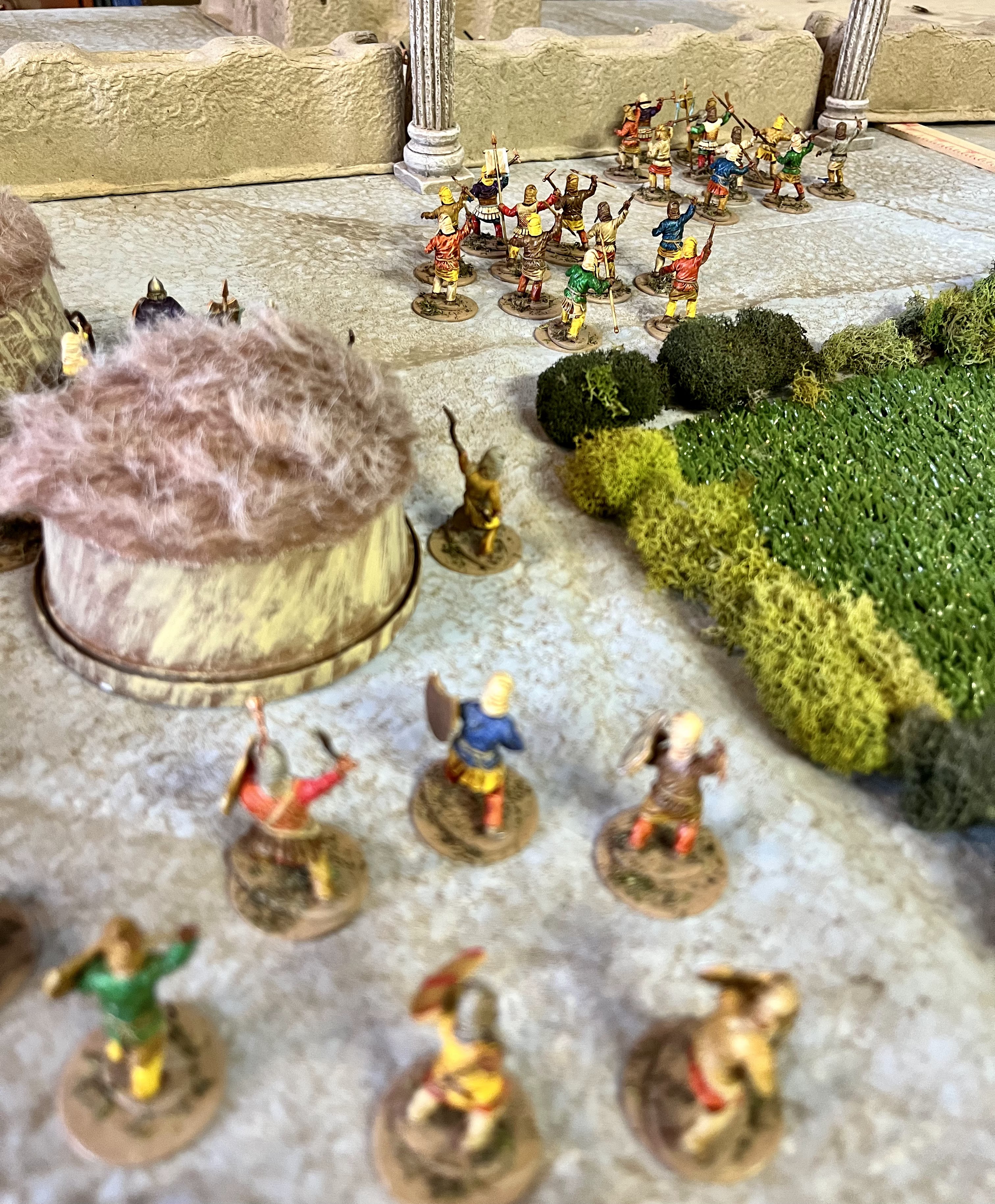
The Persian assault force is set-up 12 MU in from their board edge.  They deploy with their warband infantry leading the way towards the gate, followed up by Drilled Sparabara.  

The main Persian assault force

The rest of the force spreads out to attack along the wall and try to use their firepower to suppress the defenders.  The Psiloi are approaching in the cover of the fields.  The attack is well-supported by Persian archers across the battle line.  

The Persians look to have the defenders outnumbered!

The two forces are deployed and ready to fight.  The Persians have an advantage starting with 9 Arete Points to the Ionian Greeks 6 points.  We will have to see if this imbalance makes the difference. 


Mission: 
Persian troops will be allowed up to 3 gaps in the wall based on a pre-game mechanic.  Per the rules, we established that the Attackers have managed to get one opening in the wall.  In this case, we decide that traitorous pro-Tyrant and pro-Persian forces have managed to open one of the many gates into the city.  Persian troops and Ionian defenders have rushed to the gate for the decisive battle.  

The mission objective is to try and force the opposing forces to collapse. 

Maneuver Phase:   
The Ionians pay enough Arete points to go first, hoping to use their peltasts in a spoiling attack.  They break from the gates and are quickly peppered with Persian archer fire.  However, their shields protect them well-enough and they press the attack.  

The Persians simply outbid the Greeks for initiative and the Persian archers quickly send the Greek spoiling attack fleeing back to the "safety" of the city.  The Persians press forward.  As the Persian Psiloi move towards the Walls, the Greeks try and fail to interrupt. 

Greek missile troops try to force back the Persian Archers in the village by the gate, but a horrendous roll and no Arete points stops them from having any effect.  The rest of the Persian host is just outside of the killzone.  The Ionian Militia falls back a step, hoping to lure the Persians into the kill zone before the decisive combat happens at the gates.  However, the fleeing Peltasts cause the Militia to start wavering. 


Battle Phase: 
The Persians again just bid more than the Greeks can manage.  However, this time the Greeks hold back and save the Arete Points for re-rolls and other commands. The Persian counter-battery fire is also ineffective from their archers, as most of them are still moving into position.  

The Persian Vanguard of warband infantry see the Militia wavering and try to charge them.  The Greeks try to interrupt, but fail.  This leads to a melee, where the Persians lose 3 to the Greeks losing 2.  However, the Militia troops fail their discipline check while wavering and end up losing another Courage. Neither side can gain the upper hand at the gates.  


The Persian Psiloi also launch an attack at the Greeks defending the wall, but the Greeks strong position leaves the attack thwarted. 

The Greeks fight back with a barrage of their own.  The Persian Archers in the village are reduced to 1 Courage and start to Waiver.  The Psiloi at the wall lose 1 Courage.  The Persian Archers screening the Drilled Infantry also take a Courage loss from the Greek archers in the city.   


The Psiloi in reserve behind the gate charge in and easily help the Militia Hoplites clear the Persians out there.  The way is clear.... for now.  The Ionian Psiloi let the Hoplites push back the foe, and separate again as a reserve.  The Persian follow-up forces watch the vanguard stream past in disarray, but they are unmoved by the plight of their comrades. 


The Persian Archers and Psiloi again rain arrows and Javelins on the Greeks, who respond in kind.  The Ionian Archers are reduced to 1 Courage and are wavering, the Peltasts on the opposite side of the wall also lose a Courage.  However, the Persians moving to the gate are not close enough to charge and keep closing in. 

This gives the Greek commander enough time to harangue and re-group is Militia hoplites into a Phalanx.  He reminds them of what they are fighting for and the soldiers steal themselves for battle and redress their lines.  The Greek archers also Rally.  The Greek missile troops rain hell on the approaching Persians.  However, the Persians were prepared and only lose 1 Courage.       


The Persians Drilled Infantry charge for the gate and the Greeks meet them half-way, a counter-charge of their own.  The two sides clash with the roar of war shouts and the crash of metal on metal.  The fighting is fierce, but the Greeks hold and push the Persians back a step or two.  The Persians are down to 2 Courage, as are the Greek defenders.  


Despite the noble defense at the gates, the Greek defenders take hits all along the walls from the full press of the Persian attack!  The Ionian archers are forced from the walls from combined Persian Archer fire.  However, the Persian Archers in the village are forced back as well.  


Greek losses force a collapse test across the line.  It is not good for the Ionians as the Psiloi reserve and the slingers both flee the field.  

End Phase: 
The Persian Warband Infantry charged in to support their brothers at the gate.  It was a close run and fierce battle, but the Persian ability to dump in re-rolls proved the difference and the gallant Hoplite defenders at the gates broke and fled to save their families and try to escape the city. 
 

The Peltasts began to re-deploy to try and hold the gate a moment longer, to try and buy time for residents to flee.  However, they took more Courage loss for the Persian Psiloi trying to force the wall.  

The Ionian Peltasts avoid a barrage of Persian Javelins as they redeploy.  They get the gate just in time to see the Persian Drilled Infantry storming through.  They set their feet and throw, causing enough damage to reduce the Persians to 0 Courage.  They turn and flee.  This triggers Persian collapse tests.  


The Persian Warband Infantry and a battered Psiloi unit decide that the battle is won and fall back to camp.  It is a token victory that buys the city folks a bit more time to flee, but the outcome of the battle is clear.  

Conclusion: 
The Persians have won and the Fall of Miletus has begun.  The Ionian Revolt has been squashed by the Persian forces. 

In the Ionian Revolt Supplement, the final battle is a different scenario than the one we played today.  It is one that does not require specialized terrain like walls.  However, my opponent and I are satisfied that this siege scenario is an appropriate end to the campaign.  The optional siege scenario was a success!  That will be a great addition to a number of Men of Bronze campaigns!  

In the course of seven battles, the Ionians won 1, compared to the Persian 6.  A decisive defeat on land and sea for the Ionians.     


Become a Patron and get access to all the cool stuff, a peak behind the curtain of Blood and Spectacles, and early-access to playtest games!  


You can follow Blood and Spectacles Facebook page or Instagram for more fun! 

Check out the latest publications and contact me at our Blood and Spectacles website

Or purchase all out games at the Blood and Spectacles Publishing Wargames Vault Page!        

Monday, July 24, 2023

Battle Report- Men of Bronze: Battle of Pedasus


This is the continuing recreation of the Ionian Revolt.  The Ionian Revolt was a revolt against the Persian Empire by the Ionian Greeks and their allies prior to the Greco-Persian War.  It took place from 499 to 493 BCE.  It was a land and sea affair, so I am using a combination of Poseidon's Warriors and Men of Bronze to re-create the campaign.  Both are from the Osprey Wargaming Series.  In addition, Men of Bronze has a specific supplement for the conflict called The Ionian Revolt. 


Herodotus gives us details of three battles between the Persians and the Carians . The Persians won
the first two engagements, despite a strong challenge by the Carians . These twin defeats had the
Carians on the ropes and desperate. They resolved to fight the Persians one more time, but this time
launch an ambush on the road near Pedasus.

As the Persians approached near night, the Carians attacked. The ambush was a great success and
the Persian general Daurises and his commanders were killed. This forced the Persians to fall back
to regroup, and saved Caria from a siege.

For today's battle, we decided to skip over the 2 defeats of the Carians by the Persians.  We know very little about them but they seem to be relatively straight forward battles.  The first was the Persians forcing a river crossing.  The Carians were then reinforced by the Milisian army and fought again at a sacred grove.  The Persians won again.  

That was the lead up to the ambush at Pedasus.  A last roll of the dice by the Carians versus the Persian war machine.   

Forces:
Despite the various losses to the Carian army, we are going to assume they still had a relatively standard Greek army at this point.  That means, we will go with: 

Carian Army
Drilled Hoplite - General
2 Militia Hoplites
Peltasts
Psiloi

The Persians will be using a more standard campaign field army. 

Persian Field Army
Cavalry - General
2 Archers
2 Drilled Infantry

Set-up: 
This game has a unique set-up, but uses the normal 72MU by 48MU board.  However, this game will be played length-wise instead of long-edge to long-edge. You can find the details of the set-up in The Ionian Revolt supplement.  

The Persian column sees Carian Drilled Hoplites emerge from Pedasus

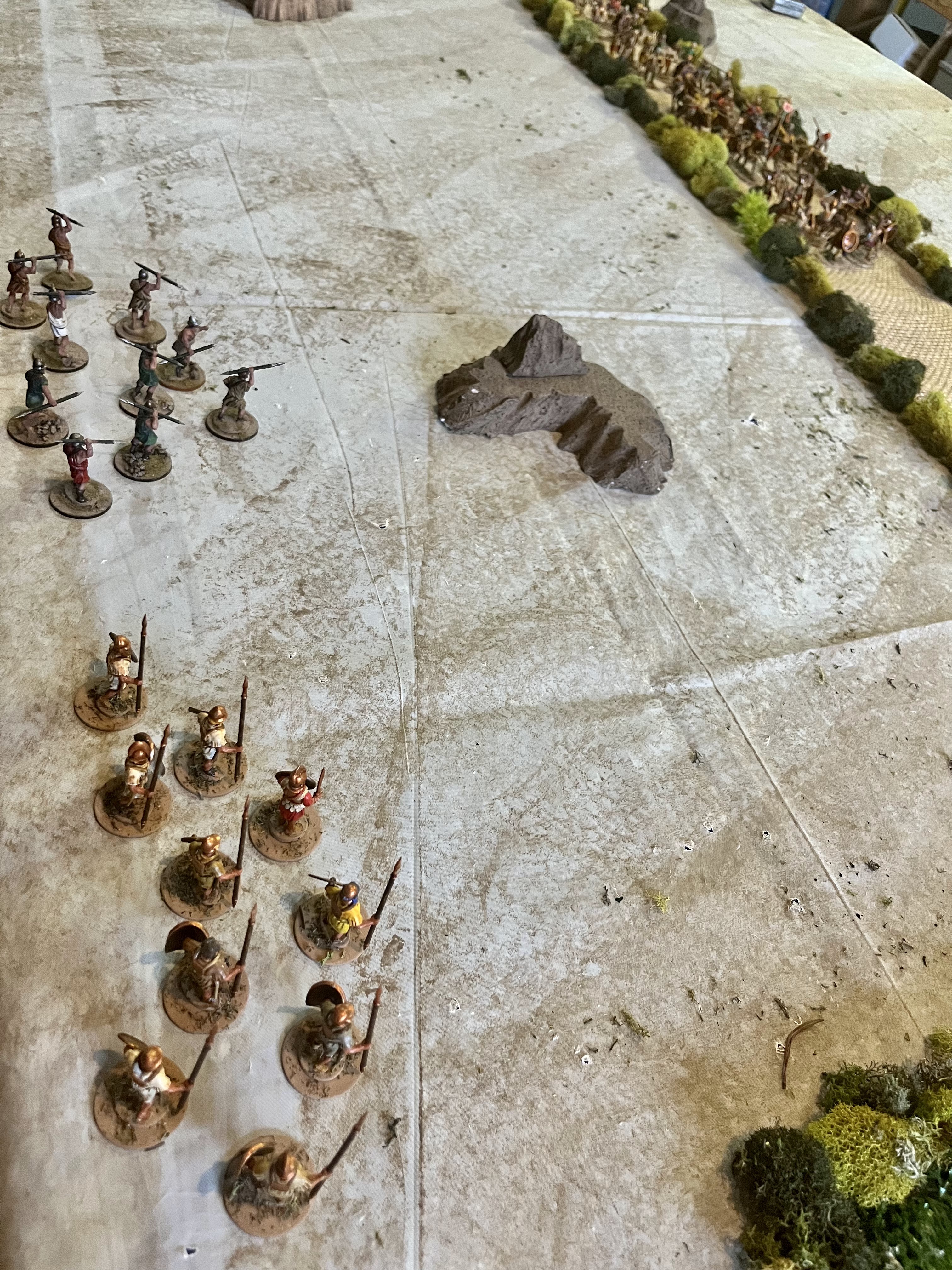
The Persians vanguard was the Drilled Infantry, followed by the cavalry, archers, and more drilled infantry as the rearguard.  The Carians are in a crescent to ensnare the head of the Persian column with peltasts and psiloi on the edges, then militia hoplites, being anchored by the drilled hoplites in Pedasus. 


Mission:
The game will use the rules for Men of Bronze based on the Ambush scenario.  This game will also have the Dusk Approaches complication.    

A bird's eye view of the deployment

For this battle, I will not be following every detail.  I have found this method really hampers and slows down the game play!  Instead, I will be covering the action in three main phases; the Maneuver phase, the Battle phase, and the End Game.  The Maneuver phase is where the armies are mostly closing the gap and set-up their attack plans and is typically turns 1-3.  The Battle Phase is typically where most of the fighting occurs and normally falls in turn 4-6, and the End Game is the final moves to determine the ultimate victor and often are turns 7-8.  

The Maneuver Phase: 
The Greeks begin to close the net on the Persian column.  Meanwhile, the Persians begin to shake out into a batteline.  The Greek light troops are leery of getting too close to the Persian archers, who can easily wreck the Greek light troops in a barrage of arrows.  The Persian cavalry goes out wide to threaten the peltasts on the Greek flank.  The Greek drilled infantry form phalanx and easily block the road. 

Battle Phase
The Battle begins with the Peltasts trying to move up and throw javelins at the Persian Archers, but they fall just short.  No pre-measuring can do that!  The Persians then interrupt with an Arete Point, and return fire.  The Peltasts are hit hard.  This barrage is followed up by a Cavalry charge that sends the Peltasts packing in short order.  First blood to the Persians!


The Persians re-shuffle their lines and let the Greeks take-over again.  The Drilled Hoplites on the road charge into the Persian Drilled Infantry opposite them, who counter-charge.  A bloody melee breaks out, but neither side has the upper hand.  


On the opposite flank, the Persian archers try to eliminate the Psiloi, but fail.  Their nearby Drilled Infantry then charge the Militia Hoplites, who counter-charge them back.  The injured Psiloi jump in to support their fellow Carians. The Militia Hoplites win and push the Persians back into their Archers.  


On the road, the Persians face stiff resistance from the drilled Greeks and are quickly pushed back.  The Persian back is broken when the other Militia Hoplite unit joins the fray! However, as the Greeks turn to butchery on the road, the Persian General slams into the rear of the melee with his Cavalry, reducing the Greeks to near breaking!  


On the Persian right, more catastrophe as the Militia Hoplites and Psiloi break the Drilled Infantry and Archers there.  This leads to the last Archer unit to also turn tail and flee.  They failed a collapse test.  The Persian army is in tough shape.


End Phase:
The entire Persian army has collapsed with the exception of the General and his Cavalry bodyguard.  The Greeks are injured but in no real danger of losing at this point.  They use heir Arete Point advantage to make sure they go first.  

The Greeks on the left reposition themselves to finish off any Persian survivors from the center melee.  They then decide to see what happens there.  The rear attack by the Persians cause the Greek General and his Drilled Hoplites and Militia allies to flee. However, they take heavy casualties in return and are also routed.  

Seeing their comrades flee, the other militia Hoplite units collapses! This leaves only the Psiloi left!  The Greeks barely hold the field of battle! 


Conclusion:
The first win for the Greeks during the Ionian Revolt and another historical outcome. I thought this was going to be a much more decisive loss than it turned out to be.  It actually went down to the last dice roll again.  If the Psiloi collapsed we would have had a draw. 

I think my plan to turn the flank and get my cavalry behind the Greeks worked well.  However, their line engaged my about a turn to early.  Then, the Greek Hoplites decisively beat their Persian opponents across the entire front.  Only my rear cavalry charge kept me in this game. 

The next battle will be a sea battle using Poseidon's Warriors.   See you next time in the Ionian Revolt.  


Become a Patron and get access to all the cool stuff, a peak behind the curtain of Blood and Spectacles, and early-access to playtest games!  


You can follow Blood and Spectacles Facebook page or Instagram for more fun! 

Check out the latest publications and contact me at our Blood and Spectacles website

Or purchase all out games at the Blood and Spectacles Publishing Wargames Vault Page!