Monday, February 16, 2026

RPG Review: Inspirisles - Hatchling Games


This was a game I picked up for my wife for Christmas.  She has been looking for a game she can GM for her first time GMing.  Therefore, she wanted something that was less complex than the My Little Pony: Friendship is Magic game.  This one appealed to her for two main reasons:

  • It is designed for younger players and is family-friendly
  • It features American Sign Language (ASL) in the mechanics
She learned ASL in college, was a big part of the deaf community in our area and even has a Facebook group dedicated to ASL in our area.  She was very close to being an interpreter before deciding to go a different route.  

Therefore, this game seemed like it would be a good fit for her needs.  We picked up the core rulebook, the Underisles expansion, and set of adventures she could start us off with.  

You can find this bundle here: Inspirisles

Today, I will be looking at the core rulebook.  Let's get ready to shape and sign! 


Things I Liked

A core idea that powers the game is a mechanic called Belief/Disbelief.  Since the setting is focused on Fae and magic, this was a clever idea to focus on.  The players are in an alternate, magical realm that is shaped and powered by Belief.  Disbelief is destructive energy that brings ruin and wrath to the magical lands of the game. Disbelief is negative emotions like Cruelty, Corruption, Greed, and Bloodlust.  Belief is a form of magical currency that powers the world and the PCs powers.   

The game is very clear that its intention is to do three things: 

  1. Story-telling
  2. Empathy and Collaboration
  3. Deaf Awareness
It is always nice for a game to be upfront about it's design goals. 

Sign Language is built mechanically into the game as an effect called Shaping.  They have resources for both American and British Sign Language as they are different.  They even have video tutorials on their site as well, so you can see the signs being made as well.  Using certain signs in certain ways will give you modifiers and re-rolls to various rolls.    

The section about Shaping is a very good introduction to the Deaf community.  For example, it is rude to assume a Deaf person would like a cure for deafness.  Many see it as their own culture and embrace it.  The sections about sentence structure are spot-on, as ASL uses a Yoda-like sentence structure of Time, Topic, and Comment.  The rulebook really mostly covers how to Finger-sign, numbers, basic question words, and a few RPG specific words too.  You could play the game without signing at all if you really wanted to, but that feels like missing the point. 

Character Generation is very easy and has no numbers.  It is all narrative, but asks questions that draw upon the world of the game to help you fit into a place.  In addition, you choose an element as that ties into what you can do with your "shaping".  You also build a sanctuary and narrate 5 items that align with your sanctuary and hobby.  Later you will use Belief to increase these items, your sanctuary, and even your PCs skill level. 

Mechanics and resolution only require 3 regular six-sided dice.    


The GM section does a good job of laying out how the game should be played.  It is broken down into a "Questing Day" that will have a variety of challenge archetypes.  The Questing Day is essentially the session for a night of play.  The archetypes are basically scenes with potential resolution styles.  All Questing Days end in safety and a chance to reflect and for the GM to gather feedback.  A whole chapter is an example Questing Day for a level 1 party using various archetypes.         


Things I Did Not Like

Some of the naming conventions for things I was not a huge fan of.  The background of the game is Celtic and British folklore so it draws heavily from these sources.  For example, the GM is called a Grail Guide.  Player-Characters are called Pendragons.  They use names and terms from Arthurian myth outside of that context and as a fan of Chaosium's Pendragon this caused me a bit of angst and confusion.  The lore in this game is unique to itself.   

There are two types of tests in this game, Belief Barriers and Disbelief Battles.  The first are challenge tests and the second are contested tests.  For any test, the Players choose who will lead based on element and they roll the dice.  Up to two other players can choose how they assist and give a bonus to the dice roller.  To encourage narrative, you only earn belief from shaping and using narrative actions, a simple dice roll may pass but will generate no Belief.  3-4 is a fail, and you gain Disbelief!  10+ is a pass, and 17-18 is Crit which generates additional belief.  Disbelief Battles only force opponents to flee or surrender since Bloodshed caused Disbelief.  These work as Belief Barriers except the total of any dice roll is compared.  The higher dice roll wins.    

These are very simple dice mechanics and lead to no real depths or even much decision making.  The biggest issue is determining the Leaders and how exactly the supporting PCs will do that.  Most of the decision making is how the elements will narratively work.  Therefore, there is little or no tactical depth or thinking to these tests beyond a bit of creativity.  To make them a bit more interesting, the GM can require multiple dice tests so the challenge lasts more than a single round.  

There is a small twist about which elements are dominant over other elements.  Offensive elements like Air and Fire force the opponent to re-roll dice in a Disbelief Battle.  Meanwhile, Earth and Water allow you to re-roll your own dice.  However, if you are facing an element that "Dominates" your own, then all re-rolls are cancelled.  For example, a Water element can cancel the re-rolls ability of a Fire element.  Therefore, picking the right leader does make a difference.   

You will notice that the ASL part is not integrated fully into the mechanics for overcoming challenges.  There is no place where the leader or the assisting players need to use ASL?  It is not clear what role ASL plays with shaping or the resolution mechanics in this game.  It is also not clear to me how ASL is needed to interact in this world either?  This is a BIG miss and almost betrays the Hook that got me to purchase these rules in the first place. 

These challenge types are more like simple narrative beats rather than complex puzzles or challenges of their own.  However, for a simple family-friendly RPG this can work just fine.  The impact of these challenges rests much more on the sill of the GM to make them exciting and how engaged he can make the players with them. This section does have several examples on how the process works and how to narrate them for both GMs and Players. 

This game has a self-contained focus of gathering the parts of Excalibur.  Some of the mechanics seem tied to this quest.  However, at no point does the game really tell you what steps this quest should take.  That is left up to the GM and the Players. 


Meh and Other Uncertainties

Since this game was designed to be played by young adults, learners, and be family-friendly they spilled a decent amount of ink on safety tools, consent tools, and how to play RPGs in a respectful manner.  The free-form nature of RPGs was not an excuse to live out your inner edgelord fantasy but to learn how to be part of something greater than yourself and a larger community.  I especially liked one of the blurbs that said, "Life is full of ups and downs, so use our game to experience disappointment in a safe space" 

The game provides a special tool called a "Grail Tool" that acts like a safety card.  Players can use it to show their discomfort in a scene or with a situation.  You can flip it from Red to Green, or lift it up depending on how series the situation is.  I have seen discussion of such tools in other rulebooks, but mostly as an aside.  Here since the audience is younger and the game is focused on education, the use of the safety tools is much more defined and explicit process.  I have only read about such tools so it was nice to see how the game implemented them.  

The Appendix has a consent document to help the GM know what is an is not triggering or wanted from the players.  This includes topics like blood, harm to children, animals, etc.  Creatures or scenarios that are off-limits like severe weather, illness, claustrophobia, etc.  Finally, it clears the air on romance within your games.  Again, since the game is for new RPG-players and younger folks this level of detail makes some sense to me.  However, I have never gone through such an explicit process in Session Zero, so this was something new to me.    

Since the game is focused on cooperation and empathy, NPCs are called "Friends".  These are fae and magical creatures in the Inspirisles often taken from Celtic and European folklore.  

It is important to note, that this game has no death.  Injury is also not a focus.  Instead the focus is on failure and the collection of Disbelief.  Disbelief builds up on a Calamity Meter.  This creates new threats that will distract the PCs from their goals and objectives.  The game provides gathering the 6-piees of Excalibur together as their main goal.  However, the Calamity Meter will give them distractiosn from this effort, and the only way to reduce the Calamity Meter is by finding pieces of the sword.  Of course, you can also use Belief to buy down the Calamity Meter as well.  

The last chapter breaks down the "Inspirisles", which races and people live where, key locations, etc.  This includes some adventure hooks, some foes, and a few other bits and pieces.  


Final Thoughts

Going into this game was an interesting experience because it had two main goals; be fun and educate.  That is a distinct difference from most of the other games I have reviewed on this site, as most of them are focused on just being fun.  Therefore, I had to look at this game from a slightly different lens and think about whether it accomplished both tasks.  I have an interest in using games as a tool to train and educate in the corporate world, so seeing how they tried to tackle this dual purpose was eye-opening to me.  

The rules are simple, but playable.  In some ways, it uses a lot of ideas as a game like Avatar: Legends using elements and shaping as a focus of gameplay.  It also focuses a lot on leaning into the Narrative too.  However, I think it is a lesser product overall.

Ultimately, the ASL portion of the game was interesting BUT I think it is overstated as a hook in this game.  It is not integrated seamlessly into the mechanics, in fact; the designers even say that they purposely made it playable without using Sign Language!  To me that is burying the lede.  What they tell you about Sign Language and Deaf-Culture is solid, but it is not well represented in the game itself.  It would require some work on the GMs part to make ASL integral to the game.  It almost felt like it was added after the fact and I was disappointed.  

So, do I think they hit their design goals of Story-telling, Empathy, and Deaf Culture?  Maybe, but I think they did not lean into their goals hard enough.  Still, I learned things from reading it.  I am interested to see if my wife decides to try to run it with my group.   

Until next time!       


You can follow Blood and Spectacles Facebook page for more fun: https://m.facebook.com/pg/BloodandSpectacles/posts/?ref=bookmarks&mt_nav=0

Or our website:

Or our Messageboard:

Or our Wargames Vault Page:

Monday, February 9, 2026

Heroquest: Rise of the Dread Moon- Hasbro/Avalon Hill


I have been slowly buying up Heroquest expansions, reviewing them, painting them up, and then moving onto the next.  In late 2025, I disrupted this approach and decided to just go ahead and get a whole bunch of the expansions all at once, mostly so I could round out my collection of heroes. That means, I have several expansions that are sitting and waiting for me to review and paint this year.  At the time of writing, the only one I do not have is the Wizards of Morcar.  That means there is a lot more Heroquest content coming up in 2026.  This may please or annoy you, but my backlog is my backlog!  

That brings us to today's entry.  Rise of the Dread Moon is one of the first expansions that is all new content.  It is no longer the only new content, but this one kicked it off.  Therefore, it is intentionally designed to build from the OG campaign in the core rulebook.  So, let's grab our Potions of Healing, hoist our shields, sharpen our weapons, and prepare our spells.  Time to go a Reviewing......


Things I Like

This is a big expansion with a lot of cards, miniatures, and cardboard.  Plus, it has a new set of quests and monsters too.  This is a chunky boy! 

I am very happy to add the Knight to our group of heroes.  He seems a natural fit into a fantasy game, and indeed Knights are referenced at the end of Kellar's Keep.  Therefore, it makes sense that they would become more involved as a hero after the O.G. Quests.  This guy's main thing is defense in the way that the Barbarian is offense.  He has the highest starting defense score of all the heroes. In addition, he has three cards of special rules that emphasize helping others and defense.  I got mine all painted up at the end of 2025.....


I like the addition of a few new enemies.  The first is an Elven Archer.  This adds some more ranged combat foes which is an interesting challenge for heroes compared to the usual melee foes.  The second is Ethereal monsters that can move through walls and can pop-up and attack.  Plus, they are hard to kill as they are not hit with a Skull, but a Black Shield!  Finally, Cultists have some interesting abilities to cast Dread Spells that work better the more of them there are.  Good new challenges that are not just harder stat blocks for the heroes to face off against.        

Not every quest in this booklet assumes that you leave to town in-between quests.  They are linked together.  This is not the first time they have used this idea, but in other expansions you could still go shopping and heal up.  Not so in Rise of the Dread Moon.  Instead, they provided something called a Hide-out that is an alchemy table, some gear, and a chance to randomly heal up.  This is a good mechanic to make resource attrition much more of an issue and increase the threat of the quests but still allow for updates in game.   


Things I Do Not Like

This expansion really hinders Mind Points as an alternate way to attack Heroes.  It is very clear that if Mind Points go to zero, the Hero does not die.  Instead, they become "shocked" which reduces them to 1 red die, 1 attack dice, and 2 defense dice.  Incidentally, unarmed Heroes also have 1 attack dice and 2 defense dice too.  This muddies the water from previous expansions and as a Zargon, you will want to be clear how you plan on dealing with Mind Points in any given session or campaign.  I could see different expansions using different rules in this area. 

The Alchemy Deck is a cool and great idea.  However, it seems to only apply to this expansion?  It is unclear how this will work in say.... Jungles of Delthrak or Against the Ogre Horde.  Are we supposed to assume that all special rules in an expansion only apply to that expansion or across the board, or only going forward in the "timeline"?  Again, Zargon will need to decide how he wants to approach this.    

This really needed a Sir Ragnar miniature.  He is a key NPC in this booklet, and they do not have a unique miniature for him.  This is something that Hasbro/Avalon Hill have been very inconsistent on.  In some expansions, they offer unique villain miniatures and in others they do not.  For example, in Return of the Witch Lord there is no Witch Lord.  However, in Mage in the Mirror they have an awesome evil Queen mini.  I honestly think they should make a "Named NPC" expansion with minis and cards for each of the big bads they have.  


Meh and Other Uncertainties

There are other new rules for smoke bombs, caltrops, and unknown mercenaries.  I am rather ambivalent about these.  I love the Mercs miniatures, BUT the concept of Mercs I am more torn on.  It is basically a indication that the Quest are much harder and they are having a tough time keeping difficulty up but still balancing the game.  

Also, connected specifically to the Quests are Disguises, Strangers, and Reputation.  Again, it does not seem like these apply to Heroquest games in general and only apply to this specific expansion and set of quests.  I think they are interesting concepts and new things you can add into your own Quests.    

This Quest clearly works best after you have played the OG Quests, Mage in the Mirror, and now this one.  That means your Heroes might be pretty buff at this point.  This is not an easy campaign and it ties in closely with the stories from those previous quests. However, in this one the Heroes are not welcome visitors and instead must infiltrate the city.  This concept is cool, but it is a bit odd as they did help the Queen in earlier adventures.  Therefore, the Elven guards you kill?  Best not to swell on it friend, but the blurb in the back assures us they were corrupted by Zargon's power.    

The first quest makes us of some water rules.  This is not the first supplement with water, but this one focuses on waterways moving to drains.  I think these waterway rules are more like wading through a sewer rather than swimming or underwater details.  I like them better than some of the rules in Spirit Queen's Torment.  

Final Thoughts

This is a lot.  This is an expansion for a successful party of Heroes.  It turns some of the dynamics of the game on its head with the disguises, strangers, reputation, and the whole concept of the Quests.  This leans into the idea that the Heroes are not truly agents of the state, and much more "black ops" than we have seen,  These guys are Mentor's hired guns and the campaign highlights it.

This expansion adds a lot of ideas and stuff.  It is not entirely clear how these updates should apply in other expansions, BUT they are great tools for Zargons to put in their tool box for their own homebrews.  There are also a lot of new cards and miniatures too.  Overall, there is a lot of value in this box even though it is one of the thicker and more expensive expansions.        

Until next.... oh.... wait..... you probably want to see all the miniatures in this set before we call an end to this review huh?  


Until next time! 


Become a Patron and get access to all the cool stuff, a peak behind the curtain of Blood and Spectacles, and early-access to playtest games!  


You can follow Blood and Spectacles Facebook page or Instagram for more fun! 

Check out the latest publications and contact me at our Blood and Spectacles website

Or purchase all out games at the Blood and Spectacles Publishing Wargames Vault Page!                

Monday, February 2, 2026

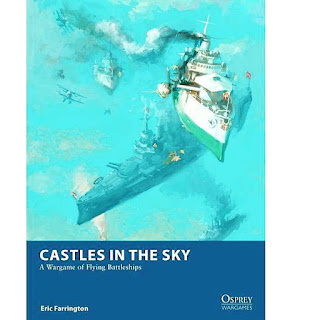
Battle Report: Castles in the Sky: Mirror Match


It is winter time here, and that is not a great time to be outside in my area.  However, it is a good time to be indoors playing miniature wargames!  Today I was teaching someone how to play Castles in the Sky.  Therefore, we used a simple Mirror Match between my Austro-Hungarian force and the Royal Navy.  This would give them a good feel for how the game was played.

Forces:

Dual Monarchy

Tegethoff Class- Com 3

Zenta Class- Com 3

Huszar- Com 2

Royal Navy

Queen Elizabeth Class- Com 3

Warrior Class - Com 3

Bullfunch class - Com 3

I didn't even bother giving the ships names or Captain names today, just went by the class to make it easier for them to find it in the book.  

Mission

A simple Patrol mission.  We would use Armor Loss to determine the winner.  The Fleet that lost more Armor would be the loser.   

Set-up:

We played on a 36MU by 36 MU board.  1MU was 1 inch.  For terrain we had three random cloud banks at altitudes 1, 2, and 5 respectively.  I used my ocean mat because it is easy to transport and looks good.  

The two fleets were on a crossing pattern both coming from the North side.  The Brits were up high and mid speed, with the A-H at Mid-speed and mid-altitude.    


Maneuver

As is normal for new players, they turned their Destroyer and came straight at me as fast as they could get it to go.  The British try to turn into Melee up close, while the Dual Monarchy try to lure them away with their cruiser, but it fails to draw them out.  Air torpedo attacks prove ineffective from long-range.


Battle

The British fleet closes the gap fast.  They tank heavy fire from the Tegethoff and the Queen Elizabeth bears down on her prey.  Her forward guns spew fire thanks to a good command roll that let's them go first, and a poor one from the Dual Monarchy deprives them of any Orders.  The Tegethoff is damaged in the exchange.  


The next round, the Tegethoff tries to duck under the guns, but it is not enough.  A full Fire for Effect Broadside plows into her stern, but the Austro-Hungarian captain used a Brace Order to avoid the worst of it.   However, the trailing Destroyer also manages to sink a hit into the Tegethoff.  

There is a very close range gun duel between the Warrior and the Zenta and Huszar.  The British cruiser takes the worst of it, taking a real hit.   

Both the Tegethoff and the Warrior explode!  They are packed in close to the enemy ships.  The Zenta and the Huszar manage to weather the explosions without damage, only Friction.  

End Phase

The Zenta moves to evade the British.  However, the Bullfinch is all over him.  The Huszar moves to protect their cruiser.  However, a torpedo still gets through and hits the Zenta for 1 damage and jamming her rudder.  

With that, we called it a game.

Conclusion:

British Victory!  10 AV to 8 AV

Well, the Queen Elizabeth came out the better Battleship this round.  That +5 at close range for Power.... yikes.  However, I made the mistake of trying to go toe-to-toe with it.  Once I was in the kill zone, realized the mistake; I could not get out of it in a timely way.  

Secondly, usually when someone sends their Destroyer way out ahead I easily focus fire on it and kill it.  I was not able to do that this time because it got behind me and I had to keep my guns focused elsewhere.  Normally, the Destroyer charge never works, but this time it did!  It was a thorn in my back all game.  

I only managed as well as I did because of a lucky strike from my Zenta.  That was a desperation move to bracket the Warrior with Cruiser and the Escort that could have easily backfired on me.  I know from experience that the Warrior can dish out a lot of pain on an enemy Cruiser.  

A relatively quick, fun game as I tried to get some new blood into the game.  With chit-chat, set-up, and take down this one lasted about two hours.  Enough time to drink a warm cup of tea, too.    

The biggest problem is the difficulty of getting models here in the states.  It can be a chore to track down a US distributor with stock.  I usually use Scale Creep Miniatures and have had good success.  There are not even a ton of 3D print options out there either.  The best bet is probably to use Dystopian Wars models or scratchbuilds.  This issue is also slowing down my development of the follow-on game; Mobile Fortress: Verdun.  

Until next time!                  


Become a Patron and get access to all the cool stuff, a peak behind the curtain of Blood and Spectacles, and early-access to playtest games!  


You can follow Blood and Spectacles Facebook page or Instagram for more fun! 

Check out the latest publications and contact me at our Blood and Spectacles website

Or purchase all out games at the Blood and Spectacles Publishing Wargames Vault Page!