Showing posts with label Sci-Fi. Show all posts

Monday, May 25, 2026

RPG Review: Scum and Villainy- Evil Hat Productions/Off Guard Games


It's no secret that I like to play narrative focused and cinematic games.  I have a preference for rules-lite.  Those are some of my biases that I want you to know about going into this RPG review.  Why would I tell you this?  Well, if you look at the cover you can see it is a Forged in the Dark role-playing game.  It is no accident that I am going to be interested in this game.  

Of course, I cut my teeth on the old West End Games Star Wars 2nd Edition.  I grew-up playing that as my sci-fi game of choice.  I should probably do a review on it some day even though it is not new.  I have also played Starfinder for straight Sci-fi games.  For a stretch, I have also played Palladium's Robotech system as well.  Finally, I have also played Green Ronin's The Expanse role-playing game.  I guess I am telling you all this to show my Bonafide's when it comes to sci-fi role-playing games.  I am not a rookie when it comes to this style of game. 

As an added bonus this a game that is about heists.  That makes sense, considering the source of this system is Blades in the Dark, which is a heist game.  I also have experience with heist games.  This is  mainly via Shadowrun.  However, I also have some experience with Noir games such as Hard City.  Therefore, I am familiar with this "less than savory characters" style games too.  In many ways, this one reminds me of the TV show Firefly.    

Therefore, you now know some of my bias going into this games.  You also know some of my history with RPGs of this type.  So, let's dig into this one shall we?  Time to fuel up, load the cargo, and get ready to blast through the blockade.  Does this game have what it takes to keep on flying?      


Things I Like

This game uses a Playbook system.  I tend to like those as it fills core "niche" with appropriate stuff.  However, they are typically choice one of these options which allows for a quick start.  The niche is often "fictionally appropriate" for the style of game being played.  This is a Star Wars/Firefly genre Space Opera.  Therefore, the core "playbooks" are: Mechanics, Muscles, Mystics, Pilots, Scoundrels, Speakers, and Stitches.  I think you can imagine which of your favorite characters fit in where.  

In addition to playbooks, there are a few "crew types" that help create an archetype for the stories you will be telling in a campaign.  These archetype ships set the tone of the table and adventures to come.  It is different being smugglers than bounty hunters than freedom fighters.  You might dabble in all of these, but ultimately the main draw is the archetype of the ship and crew.  

Dice mechanics are simple.  There is a small list of attributes from 0-4 dice.  These represent a dice pool that you roll for tests.  A highest dice as a 6 is a full success, 4-5 is a partial success, and 1-3 is a bad outcome.  No dice, then roll two and pick the lowest with no chance to crit.  Simple.  I like simple dice mechanics. 

The game discusses scene types with "On The Job", "Downtime", and "Free Play".  It gets into more details about types of Jobs and the Engagement roll to help speed up planning.  Therefore, players and GMs have an idea of what to expect from each part of the game.  

You can get extra dice for a roll, but there are always a complication.  They call it a Devil's Bargain!  These can be used to shake things up and raise the stakes.  I can see a certain type of player never taking these, and another always taking them when offered. 


Things I Do Not Like

I rarely talk about lay-out of games, but I am not a fan of how this game is laid-out in the book.  It is not easy to use.  When I was making my character, I had a hard time finding key details.  I was surprised since this is a Playbook driven game yet simple things like "attributes" are buried in the character section without a clear heading name.  Just, not great editing and design.  I know, a bit petty but it made making a character a bit of a frustration. 

There was 12 Attributes, which I think is probably 4 too many.  Again, a bit nit-picky but there you go.  Often times your Playbook will give you a bonus in an Attribute.  There are only 7 Playbooks, so that is probably how many Attributes the game should have as well.  The intention is to give you an idea about how the PCs will approach a given scene, where sneaking across a hangar is played out mechanically different from sprinting across the same hangar.  However, I think a layer of abstraction would work fine here to cover both situations.      

Then there are three resistance rolls that are used in different situations.  Again, I think it is one too many.  Resistance rolls always succeed, but you take stress.  Stress is bad. Instead of damage, you take Stress when called upon to resist.  If your Stress reaches max, you start taking Trauma conditions.  These are more like Role-play notes with names like Paranoid and Cold.  Trauma conditions are permanent, but when you have 4 Trauma you are out of the game.  It looks like you start with 12 trauma, and can choose to take 2 to Push Your Luck.  I think this is too much Stress to start and not enough impact from Trauma.  Instead, if you play Trauma well you get XP bonus.  Play it bad and..... nothing really.     


Meh and Other Uncertainties

Clocks. It wouldn't be a Forged in the Dark system without clocks.  Clocks are a pretty handy and cool idea.  The GM determines how many times you can essentially pass or fail before consequences start to spiral.  Bad Outcomes and Partial successes can cause opposing clocks to move, and success and Crits can have good clocks move.  Pretty neat way to raise the tension, especially since you will want to make these clocks public.  So, why do I put them here?  Ultimately, I think you will have too many clocks going at a time, even in fairly mundane circumstance.  

I.e. a simple smash and grab would have a clock for the PCs to "Get into the Hide-out" and then "Get the loot", and "Escape Clean".  Various actions would help them or hinder, but on the other side you might have the opponents with "Detect Intruders", "Clean-out the Loot", and "Turn-the-Tables"  However, at the same time each PC may also have their own clocks running for various personal reason.  They can stack up fast and a tool to help make tracking and abstraction easier suddenly is not easy.  Doing a clock is easy and cool, but running 12 clocks can be tricky.    

In addition to the dice any individual has, you can boost dice by taking stress, taking a Devil's Bargain, Assists from others, and there are also shared Crew resources.  There are a lot of ways to boost your dice pool, with varying forms of consequences.  It means you can easily manage risk, with only a few options to make interesting complications.      

Ultimately, I think the game just uses too much jargon for things that do not need it.  The lay-out is all ready strained, so the amount of game specific Jargon just takes me out of the rules.  I am sure a great GM can make this all disappear; but a great GM can make any game great!  What about a mediocre or average GM?  I am not sure it can be done here, and I think the jargon and terms will get in the way of the narrative your table is telling.  


Final Thoughts

I really wanted to love these rules.  I had heard a lot of great things about them.  However, I am not sure they are for everyone.  I actually like them less than a standard Powered by the Apocalypse game.  They are slightly more complicated with nothing new to show for it.  The big idea is the Clocks compared to PbtA and I am not sure they deliver an enhanced experience that can not be captured with less book-keeping.   

Plus, I think the lay-out and jargon make this game easier to play than to read.  As a new player to a campaign, I did not find it easy or intuitive to grasp.  I also had a hard time finding what I was looking for in the book.  It was too abstract and too detailed at the same time for my tastes and in the wrong areas.    

That said, I am glad I have read it and played it.  There are really good ideas here, I just am not satisfied with how it all goes together.  I can see others who would absolutely adore this game, and I won't turn down future games.  However, it is also not my favorite either.      


Become a Patron and get access to all the cool stuff, a peak behind the curtain of Blood and Spectacles, and early-access to playtest games!  


You can follow Blood and Spectacles Facebook page or Instagram for more fun! 

Check out the latest publications and contact me at our Blood and Spectacles Website

Or purchase all out games at the Blood and Spectacles Publishing Wargames Vault Page!   

Monday, October 13, 2025

Review: Voidfighter- Osprey Games


 Osprey Games latest is a starfighter game.  This should be right up my alley as I love a good dogfighting game of air or space combat.  I have some experience with playing and designing this type of game so I am really looking forward to this one.  

My pedigree in flying games goes way back to Aeronautica Imperialis (V1) from Forgeworld and Warwick Kinrade.  I was a bit late to the party but have many fun games since.  I spent a lot of time hand-making planes, making modifications to the rules, new aircraft, and new missions.  On the old Airspace Forums I even ran several annual narrative campaigns.  Since then, I tried several other aircraft and starfighter games with varying degrees of success/interest.  I still have those PDFs somewhere, I should make them available somewhere.  Maybe for Patreon Patrons?      

As an added bonus the writer of Voidfighter, Casey Garske; is a fellow Minnesotan.  For those who do not know, Minnesota is a frozen wasteland just south of Canada in the top middle of the United States.  If you have seen the movie or TV show Fargo it is that area.  The motel scene at the very end of the film was filmed right outside the town I grew up in.  White Bear Lake, "Go Bears" was just south of my hometown.  I wonder if he and I have ever crossed paths over a gaming table or in a FLGS?  If so, it would have been some time ago as I no longer live in the area. 

Final note, this game is 80 pages long.  Since Castles in the Sky I think Osprey has increased the length of their Blue Books from 62 to 80 pages.  I think this is a good idea as it allows the games to breath a bit more and add in some of the stuff that allows a designer to go beyond the 4Ms. I like to think my work helped pave the way for this change. 

Anyway, enough waffling about.  It is time to kick the tires and light the fires! 

Things I Liked

I always love a model and scale agnostic game, and this fits the bill.  I was also happy to see the game uses facings for various rules which helps add to the tactical game play.  Even though there is no real basing or scale, the rules do have three sizes of ships from Snub Fighters, to Gunships, to Corvettes.  There is no real need to base or even use minis, as flats would work just fine too.  If you have old X-wing, Aeronautica Imperialis, Battlestar Galactica, Micro Machine toys, or Armored Clash aircraft you should be just fine to play.  The typical game is between 4 to 16 per side. 

This game uses stander RPG polyhedrons with dice shifting.  I.e. instead of adding or subtracting modifiers, you move from one type of dice to roll to the higher or lower dice rolling. In addition, all dice rolls are 2dX.  You roll two dice and add them together.  This makes a nice curve of results that savvy players can use to their advantage and allows a bit of predictability in dice results that single dice do not have.   

The heart of the game is opposed rolls, but there are unopposed rolls for certain actions and pilot checks.  Opposed rolls are a nice feature as it keeps both players in the game and rolling simultaneously for speed of resolution.  In a dogfight game you want to keep things moving quickly to keep the speed of the game up to match the action. Unusually, in the Unopposed rolls your opponent also rolls to represent the "Uncaring Universe".  This allows players to avoid looking up target numbers for speed of game play, but means that the Player has more randomness in their calculation.    

I am very happy to see so many modern games using command points to perform special actions.  This game is no exception.  You get a set amount per round, with limitations if you lose your flight leader.  These allow you to perform special actions like the famous Cobra Maneuver, fire torpedoes, Re-group, etc.  It can also be used to modify rolls.  It you have seen it in a movie you will find it here.   

There are a decent amount of movement and gunnery actions that you can take, even before you go into using command points.  Unlike most Osprey books, the extra size allows a roster and Quick Reference sheet in the back.  However, it doesn't really cover these maneuvers.  Ships can do a Manuever or Medium move once per speed of the Voidfighter, so a Voidfighter with a speed of 3 can do any combination of Moves or Maneuvers up to 3.   


Things I Did Not Like

Measuring sticks.  Not a huge fan of these, but I know several game systems that make use of them.  To me they are just another barrier to entry, similar to templates.  They should be 2.5 inches, 5 inches, and 10 inches respectively.  Seeing these stick reminded me a bit the rules for Of Gods and Mortals also from the Osprey Wargaming Series.  These sizes are referred to as Short, Medium, and Long in the rules.        

In addition to dice shifting, there are the occasional actual modifiers.  I am not a fan of this as it goes against the Universal Mechanics established earlier for the game.  However, it does add a bit of granularity where it maybe needed that dice shifting does not allow. 

Interestingly, in a sci-fi game there is NO pre-measuring allowed.  This promotes mistakes in gameplay and also keeps the speed up as players have to commit to an action instead of hee-hawing around.  However, I am not 100% sure it fits a far future sci-fi setting where such technology would be easy to acquire.    

It looks like Initiative for this game is all or nothing.  The winner moves second and shoots first.  Activation is in groups, with a quarter moving at a time and then the opponent moving.  This is not an intuitive approach as there is a chart to help you figure our how many ships to activate.  I think it would have been better to use a Frostgrave style approach where the Flight Leader activates with 3 others, then the XO Activates with up to three others, and then everyone else.  That is if you wanted alternate group activation.  The easiest solution may have simply been a wingman/Squadron system where they have alternate activations for movement. 

There is a hit location table for each fighter, and I am not sure I like this level of detail for snubfighters.  I think I prefer a 1 or 2 hit removal rather than the attritional type of fighting we see here.  The level of detail maybe too much for the scale of the game?    

Loved the artwork in the book, but I was less thrilled with the miniature images.  It was not that the miniatures looked bad, but it was hard to see them on the space backdrops.  A hazard of space games.  In addition, the miniature photos had to be made smaller to fit all the text for the game into 80 pages.   

Meh and Other Uncertainties

Of note, this is designed to be a "kitchen table" game.  Therefore, it can play on a 3 x4 or even slightly smaller space.  These have become popular as the hobby of wargaming has grown.  Space and time seem to be in limited supply, so it makes sense that players would gravitate into games that can fit in smaller spaces and quicker matches.  There is nothing that would keep this game from being playable on a larger space either.     

There is a nice selection of space terrain for the game from asteroids, to turrets, to gravity anomalies, to space creatures.  Enough to keep any board interesting.  

There is also some pre-made factions and ships for the built-in setting of the game.  However, this game also has about 4 and a half pages on designing your own ships.  I am torn because there is no system of designing that someone can not break, but players love to have this feature to make their own corner of the universe or fit some existing sci-fi franchise.  Here you can have it both ways.  

There are rules for recruiting your squadrons and giving them Traits as well.  Again, this allows players to customize their experience with the game.  However, there are a lot of moving parts in this game with maneuvers, traits, command points, etc.  This may lead to some cognitive load, so it might be best to decide what you are going to use or not use with your opponent before play.  

There are 12 scenarios and rules for campaigns.  This helps with the replayability of the game.  


Final Thoughts

For those real old timers, this made me want to track down and get some Wing Commander themed 3D prints.  If you know where a guy can get some, please, please, please leave a comment. I would be very happy!  

If you have a ton of starship/future/alternate history aircraft sitting around, this would be a nice little pick-up.  Since it is miniature agnostic you could even make die cast or film licensed themed toys work if you really wanted to.  

This is a solid set of core rules with all the things you need for a good old fashioned space dogfighting game.  There are also enough bells and whistles to keep it engaging.  I am probably in the minority when I say I would love a 3D layer added to the rules to add to the tactical play.  Most games of this type do not get that ambitious and this is no exception.  Adding a 3rd dimension can make game play much more cumbersome, increase the cognitive load, and just add something else to track.  However, it adds such a great layer of tactical play to the game.  The game all ready probably has too many options and maneuvers as is, so a 3D element would be too much.   

This would make a fine club night game or even a campaign game.  I could see really inventive players tying this in with large land and space campaigns as well.  You can see the core inspirations on the tin, and that is just fine! Innovation is over-rated.  This game gets the right mix of new mechanics in with solid and familiar aircraft flying game rules.  Most of my complaints are simply quibbles and preferences.     

Hopefully I will have this out on the table soon.  Until next time!


Become a Patron and get access to all the cool stuff, a peak behind the curtain of Blood and Spectacles, and early-access to playtest games!  


You can follow Blood and Spectacles Facebook page or Instagram for more fun! 

Check out the latest publications and contact me at our Blood and Spectacles website

Or purchase all out games at the Blood and Spectacles Publishing Wargames Vault Page!                         


Monday, May 5, 2025

RPG Design: Glittering Void: A Role-Playing Game of Space Mecha Theatre


I first wrote this game at the same time I wrote Hostile Space.  In fact, as I was working on the wargame, I decided that it would be a fun setting to role-play in.  I originally wrote Hostile Space after watching tons of clips from various Mecha shows.  For some reason, they were just coming one after the other on my feed.  I enjoyed watching the Mecha buzz around and fight each other.  Therefore, it seemed like it could make a really fun dogfighting game. 

However, the heart of all good Mecha/Real-Robot stories was not about the dogfighting, it was about the characters and their stories.  Many of them had very spiritual plotlines and focused on romantic love triangles.  They were all about relationships.  The big robot battles were often just metaphors for the spiritual and emotional conflicts that characters were engaging in.  Hostile Space was not going to capture that aspect of Space Mecha.  Wargames were not a good venue for the melodrama and theatre, but it would be perfect fodder in a Role-playing game.

Hence, Glittering Void: A Role-Playing Game of Space Mecha Theatre was born.  


Space Mecha Theatre

What is Space Mecha Theatre?  Despite the trappings of Sci-fi, big robots, and warfare; the genre is not about the flying robots.  Those are just the genre tropes and setting.  The setting tropes should not be confused with what Space Mecha Theatre is about.  Space Mecha Theatre is ultimately about people and their stories.  Most of the drama, melodrama, and tragedy occurs outside of the Mecha.  

Space Mecha Theatre is about how individual people deal with the complexities around them like war, political scheming, and advanced technology while maintaining what quintessentially makes us human.  The common humanity of all the protagonists is the key focus of the story.  There is always "Big Things" going on around the characters like war, economics, and politics but it always comes down to how the individual deals with them and carries on.  The focus is on what makes us humans, and the commonality of emotions and experiences of the human condition.  That is the Theatre.   

Big Robots, spaceships, colonies, and political powers are all just setting conventions for the human theatre to take place in.  Space Mecha Theatre means that this is going to be set in a world where such machines are common.  The focus is human vs. human conflicts in a relatively "real" sci-fi universe within the Solar System.  Travel times are slow, communications are limited, and space is a hostile environment.        

This is not Space Opera.  This is not Hard Sci-Fi.  This is not Space Fantasy.  This is Space Mecha Theatre!               


Game Design Goals

This game took me about 5 years to complete.  It is the crunchiest Role-Playing Game that I have put together.  However, it had many of the same design goals as my other, simpler RPG-Lite games.  The key difference was how I wanted the game to be able to capture the varied and wonderful action that I had found in Space Mecha Theatre content.  

This game had the following design goals: 

  • Give players interesting and meaningful choices
  • Make character creation simple and easy
  • Simple, abstracted, attritional combat, NO HIT POINTS!
  • Hard to outright "fail"
  • Reward Role-play
The Core Unifying Mechanic
This game uses three basic concepts that layer together to create a relatively deep unifying mechanic to the rules.  
  1. The Rule of 4 
  2. Dice Shifting
  3. Level of Success
The Rule of 4 simply means that on any given dice, you want to score a 4 or more for a success.  

Dice-shifting means that all Modifiers are to the size of dice that you roll.  The dice used in this game are standard RPG dice so D4, D6, D8, D10, D12 and D20.    Difficulty changes the dice you roll, not the target number.  The target number is always 4+ per the Rule of 4. 

Level of Success simply means that the higher you roll above 4 on a test, the greater your potential level of success.  These levels of success are compared in opposed rolls to determine outcomes.  To determine a level of success, you simple roll a dice, and subtract 4.  You can then compare the level of success between opponents. 

That's it.  This simple unifying mechanic is the basis of all tests and rolls within Glittering VoidThese rules apply for characters negotiating a Peace Treaty between Great Powers, fights between Combat Suits, and Characters trying to bluff their way past guards.  


The New Age
Man has expanded into the Solar System with the help of the Fold Drives.  They have established themselves across the Solar System.  These colonies fragmented into new alignments and political blocs.  Now, there are four Great Powers that maintain a stable balance of power between themselves using an umbrella organization called the Concert of the Solar System.  Scattered between these Great Powers is a variety of Freeholds; independent colonies that shift their allegiances between Great Powers via proxy contracts and alliances.  The Great Game is the various Great Powers of the Solar System jockeying for spheres of influence with these independently minded Freeholds.  

Characters in Glittering Void can take on a wide variety of roles within the world of the New Age of Mankind.  The default setting is agents of the Concert of the Solar System as Peace Representatives, where their job is to act as roving troubleshooters to maintain the stability and integrity of the Solar System order and avoid an all-out war.  However, there is room for a variety of campaign styles and 1-off adventures such as Scouts, Couriers, Pirates, Businesspeople, and more.  The New Age is full of political intrigue, espionage, and off-book operations that are perfect for various types of games.   

The game has a brief and high-level background that is entirely optional for you to use.  It includes tools about common technologies such as Combat Suits, generators for quickly developing your own Freeholds and colonies, and even a starting adventure to give you a feel for the world of Glittering Void

What is in the Book?
The game book has what you need to get started to play right away including blank character sheets, index, table of contents, Quick Refence Guides, and Appendices with all the common technologies, skills, backgrounds, and gear for the game.  It has a core concepts section to get you started, followed by easy character creation.  There is also a section about how to run the game for the aspiring Comptroller (GM).  There is even a sample scenario to give you a good place to start off in the Glittering Void!  This rulebook is 165 pages long!    


Final Thoughts
I have played this game with people who have never played Role-Playing Games before, as well as veterans to RPGs.  It delivered a satisfying game experience for both groups of players.  The Character creation was easy enough for newbies to wrap their heads around and make strong characters.  The gameplay was crunchy enough for harden veterans to enjoy making tough tactical decisions.  The mechanics are simple but allow for a wide variety of in-game depth and complications.  This game was 5 years in the making!  

You can find it on my Blood and Spectacles website.  I am eager to hear what you think of it in comments, on my Messageboard, my Socials, or directly through the Contact Me page on the website.  

Art by _SpacePossum_


Become a Patron and get access to all the cool stuff, a peak behind the curtain of Blood and Spectacles, and early-access to playtest games!  


You can follow Blood and Spectacles Facebook page or Instagram for more fun! 

Check out the latest publications and contact me at our Blood and Spectacles website

Or purchase all out games at the Blood and Spectacles Publishing Wargames Vault Page!    

Monday, June 10, 2024

Review: Five Parsecs from Home: 3rd Edition - Modiphius

 For a site that is about Wargame Design, where the writer talks about having a wide and deep breadth of knowledge about existing games on the market; there sure haven't been a lot of reviews lately!  There are a couple reasons for this: 

  1. I try to get my new games via my FLGS and their distributor has been giving them a bit of a problem getting in the books I want.  Therefore, I am a bit behind.  
  2. I generally only try to grab games I either have minis for, really want to play anyway, or am working in the genre now-a-days.  Honestly, not a lot has been grabbing my attention even though a lot of cool stuff has been coming out.  I have been overwhelmed by the sheer quantity of it all lately!    
  3. I have been working my backlog of Kill Teams, Kadesh, and Heroquest.  Therefore, no time to add new projects right now. 
  4. I have been contemplating what my next Blood and Spectacles Project needs for post-production and been putting money towards that instead of new game rules. 
So, those are my excuses.  Therefore, I did manage to pick-up a set of rules that I have been meaning to get my hands on for a bit.  I know, I know I am very late to the party on this one.  The year 2020, during the Pandemic; the history we are all trying to forget and move on from; saw a huge boom in the solo-wargaming realm.  I think the reasons were pretty obvious.  


One of the "stand-outs' from this period was Ivan Sorenson's Five Parsecs from Home.  This is explicitly designed to be a solo-wargaming experience.  It is a sci-fi, skirmish game where you create a "crew" of folks and go have adventures!  This game (and others similar to it) from Mr. Sorenson pre-dates the Pandemic and definitely pre-dates Modiphius picking it up to publish.  Ivan Sorenson had been very active in the Indie Wargaming world as Nordic Weasel Games for a long time now, and helped blaze the way for Indie Wargame designers and self-publishing games.    

I will gladly admit that I have been slow to get on this bandwagon.  However, I figured it was about time for me to check it out for myself.  Grab your jump bag, gear up, and get ready to dust-off on my mark.  3....2......1....


Things I Liked

This is an Indie wargame and is therefore scale and model agnostic.  You can grab any mini you want form your collection and plug it into this game.  In addition, it is intended for small model-count games.  As a player you can control a 4-6 man crew to go out on adventures.  For adversaries, you probably want 6 aliens, 6 non-military baddies, and 6 military looking foes.  So, to play a campaign you might only need about 24 models?  The rules quickly touch on how to play in different scales as well.    

This is a campaign game by design, so there is a lot of material for the campaign.  However, there are two things that I want to point out.  First, you can select the victory conditions for your own campaign ranging from relatively short to utter slogs.  That means your solo-adventures can have a definitive "end" point to strive for.  That is good as many campaigns seem to be never ending!  

The game is not afraid to break the fourth wall for the player.  For example, there are guidelines for making them easier for a beginner and much harder for very experienced players.  Finally, there was something called "Elite Ranks" which are rewards that you give yourself for completing campaigns, rewards for YOU the solo-player.  In addition, if you own three of the creators games (or more), you also gain in-game benefits!  I liked this idea and it amused me to no end.  

Enemies have different play styles that are randomly generated.  This impacts the actions they are likely to take, the way they deploy, and how they operate on the table.  That allows for a lot of different combat encounters and various enemy actions.  


Things I Did Not Like

The game is based heavily on dice rolls.  Some players will not like this level of randomization and wish to control the flow of the story a bit more.  There are mechanics and mechanisms to off-set this to some degree,  However, some players will just prefer more "decision" making in their campaigns.  

Like a lot of individual, sci-fi skirmished based games there is not a lot of tactical game play.  The game wants to lean into the cinematics, and the focus is more on the adventure storyline, with the actual battle being a component in telling the larger story.  This is pretty common in campaign focused, skirmish games.  Again, the replayability comes from what happens off-the-table as much or more than what happens on-the-table.  That doesn't mean there are not decisions to be made, but there as just as much off-table Strategic Decisions, as there are Tactical Decisions.  This book is 175 pages long, and the combat rules are about 7-10 pages of it.    

There is a lot of work you have to put in prior to and after a battle.  That is half the fun of this game, but there is a lot of homework a player has to do to get table ready.  


Meh and Other Uncertainties

The basic mechanics, rules, and other details are nothing really new to the skirmish, warband , campaign genre.  You get injuries, deaths, recruiting, upgrades to your ship/hideout, etc.  If you have been following the skirmish game evolution in wargaming, none of this is particularly new or innovative; but it has been required.  Where this stands-out is the variety of randomized events that can happen to your crew along the way.  There is a ton of replayability thanks to all the charts and randomization of adventures, enemies, objectives, etc.  This reminds me a lot of Outremer and Rogue Stars both from Osprey Games.  The game is worth picking up just for those parts alone. 

There are several great Appendixes that give guidelines for ways to expand the game in a lot of different ways.  Things like scenario design, making story lines, rivals, etc.  This has a lot of great content for those who really want to dive into the world building of their games.  In many ways, this game really epitomizes the idea of RPG-lite in wargames.  


Final Thoughts

If you want a solo-campaign that fits in with the Firefly ethos of "Keep on Flying".  This game matches that better than any other game I have seen out there, with the caveat that it is ONLY for solo-play.  The closest comparison is Stargrave, but that was intended for Versus play.  The game leans pretty hard on the Strategic element and RPG-liteThere is a ton of opportunity for replayability and making the enemy actions unknown.  This is probably the gold standard of solo-play I have seen in a game BUT the player has to push-a-lot of buttons to make this game work.  That means, the player is operating the game more than they are actually "playing" the game.  However, in a solo-game that is somewhat expected and this one provides a lot of off-table decision making.         


Become a Patron and get access to all the cool stuff, a peak behind the curtain of Blood and Spectacles, and early-access to playtest games!  


You can follow Blood and Spectacles Facebook page or Instagram for more fun! 

Check out the latest publications and contact me at our Blood and Spectacles website

Or purchase all out games at the Blood and Spectacles Publishing Wargames Vault Page!   

Monday, April 15, 2024

Wargame Design- Hostile Space- Anime Inspired Space Mecha Combat


Well, this is a bit of an unexpected surprise.  I have been working on this title for a long time.  Those that have been following the blog for a while probably recall my efforts to build the Mecha, and play some test games over the years.  Looks like the first battle was from May, 2021, with the big follow-up later that month.  I finally got my first Mecha done in October.  Now, three years later I finally decided to complete the rules for distribution.  Of course, I made a name change from Glittering Void to Hostile Space along the way too. 

I was very close on giving up on these rules in post-production.  Why?  Instead of making a miniature game, I started work developing it into an RPG.  There is more to come in that space, but I figured I might as well get this out into the world too.  

Those of you who are my Patrons on Patreon have had access to these rules for a year or so.  With their help I have been able to make some adjustments to altitude, modify some cards, and clarify some wording.  There help focused on finish off these rules.  As thanks, they got access to the finished product months prior to everyone else.  In addition, the Patrons have also had access to the RPG rules of Space Mecha Theatre, In Strife and Conflict Beta rules, a G.I. Joe RPG module, as well as various other work in progress games.  They also get access to my first forays into Mecha combat; JUGS: A Game of Big Stompy Robots.    

Hostile Space game came about thanks to my pet bearded dragon.  Of course, my games come from a lot of different places.  They come to me in dreams, they come to me playing other games, and they come to me when I am working on business projects.  Even by those standards, this is a weird place to start.  My lizard likes to watch genre fiction, especially Kaiji movies.  As a result, auto-play eventually brought up various samurai flicks, yakuza movies, and then eventually Mecha shows and clips.  As I went about my business, these clips started to sink into my psyche.  I wondered how to translate the action I was seeing on screen to the tabletop?  

That led me to the following design goals: 

  1. Maneuver was going to be an important element to the game
  2. More military based and not Super Robot, Kaiju, or Over-the-Top Super Mecha
  3. Piloting was going to be a critical skill from the player
  4. Feels like space mecha combat with death coming from everywhere
  5. Campaign system to build ace pilots and differentiate them from the rest
  6. Generic and scale agnostic
So, let's talk about how I tried to do this in the game.  

A pair of New Olympian Ares Combat Suits

Zoom, Zoom, Zoom
One thing I love about aircraft games, is the idea that placement and maneuver are more important than shooting.  Position is critical, because without the correct position you can not get a clean shot, and leave yourself vulnerable to be targeted yourself.  If you watch a lot of Anime mecha, movement is a key component of any battle featured on screen.  Therefore, they are more aircraft games than any other wargame type.  It made sense that I would lean into the conventions of this genre more than any other.  

As you know, I am no stranger to airplane games.  I tried to re-invent them with White Star/Red Star.  However, for this game I wanted to be a bit more "traditional" in my approach.  There were a number of games to build-off of, and I was looking at games like Aeronautica Imperialis, X-wing, Bag the Hun, and Blue Max.  These have traditional mechanics such as altitude and secret maneuver choices.  However, I also was really interested in the Battlestar Galactica mechanics where ships could face one-way and move a different way.  

I wanted to incorporate these types of mechanics into the game.  In any given Mecha's turn it can change its direction of movement, do a maneuver, change height in the battlespace, speed-up, slow down, and even change its forward facing separately from the direction of movement.   This means that flying and positioning your mecha is more important than any other aspect of the game.  Plus, weapons have limited fire arcs and can only fire up or down one level.  Therefore, you can maneuver to avoid or engage and knowing when to do which is vital.    

These are skills that a player will need to bring to the game.  The actual piloting of the Mecha in your force are a thing for the player.  Is it the right scale for the conflict where each Mecha is being piloted by the player?  Probably not, but I do enjoy the "skill" aspect of these types of aircraft games.  Some of the most thought provoking and tactical games I have ever played are Airplane games.  Hopefully, I have captured that here too.  

Earth Alliance Suits close in on a New Olympian Ares

Model and Scale Agnostic
I made the game scale and model agnostic, so you can bring any sized mecha you want to the game.  I actually designed the game with Dream Pod 9's With The Lightnings range in mind.  However, I ended up using some cheap plastic robots that I modified for the game.  Therefore, when I wrote the game I wanted a model and scale agnostic system.  

That said, I did not include a "Build your own Mecha" system into the game.  Instead, I created a background and factions.  These are there so you can quickly get a fun, thematic game to the table quickly but the game works fine if you eject the background in the book.  Instead, there are some fairly straightforward unit designs from each faction that can fit into a variety of archetypes.  

Why did I avoid a "Build your own Mecha" system in the game?  The main reason is that they are too hard to build, too hard to articulate, scale arbitrarily, and are impossible to balance.  Once they leave my hands, they are way to easy to cheese, and there is no system I can design that a player could not simply break.  Of course, players are always free to design their own Mecha and homebrew what they wish!  The Mecha designs I have in the book should be easy to break up and use as a baseline for your own creations.         

An Earth Alliance Lander is escorted by a pair of Combat Suits

Replayability! 
The rules have a campaign system that can be used to link games together.  Your squadron can also gain experience and become Aces.  Their is skill progressions and special maneuvers that Aces have that other pilots do not.  Plus, the campaign has a definitive end point with a "Final Battle" scenario. 

There is a variety of units besides just Mecha in the game.  There are interceptors, long-range launchers, ground defenses, mines, defensive weaponry, and more.  These different units allow a squadron and player to deal with a variety of tactical challenges.  

There are 10 different missions that your squadron can fly, so you never have to play the same mission twice.  I also spent some time adding in a variety of "terrain" beyond simply asteroids!  This includes dust clouds, gravity convergences, radiation fields and more.  These features give the game a lot of tactical elements to be exploited and adds to replayability. 

A Mastiff tries to dismember a New Olympian Ares

Final Thoughts
It's amazing that this took me about 5 years to get this game to where it is today.  I am so happy that it is finally ready to join my stable of games on my Wargame Vault page.  Post-production really is a bear!   
My playtest games were very tactical with a lot of decision making every time I touched a model.  The rules were easy to grasp, understand, and put into practice.  However, put it all together on the table and to counter your opponent was a lot harder to do.  I played several times, and did not find that I had "solved" the game.  The hardest part was trying to "guess" what my opponents were going to do, and to be there to intercept them, or to try and avoid them.  There was a lot of thinking and considering as we moved.  This slowed the game down somewhat, but in a delightful way. 

I look forward to seeing how you all use the game, and what you think of it.  


Become a Patron and get access to all the cool stuff, a peak behind the curtain of Blood and Spectacles, and early-access to playtest games!  


You can follow Blood and Spectacles Facebook page or Instagram for more fun! 

Check out the latest publications and contact me at our Blood and Spectacles website

Or purchase all out games at the Blood and Spectacles Publishing Wargames Vault Page!   


Saturday, February 3, 2024

5-Day Challenge- Epilogue


Long time readers will know that I have been actively engaging in community building in my local area.  Thanks to other champions in the area, we were able to launch the True Crit Gaming Guild.  This is a gaming group in Northwest Wyoming dedicated to miniature wargaming, role-playing games, board games, and card games.  It is a non-denominational gaming guild!  

Those who have known me for a long time will know that I love campaigns!  I first started getting into wargame design after having such a great experience with the old Eye of Terror and Fall of Medusa 5 campaigns from Games Workshop.  The community stories and creativity unleashed was some of the best I had ever seen.  I wanted to recapture that and started running a variety of online campaigns with smaller, localized forums and online communities.  Almost all of these had little campaign specifics rules and scenarios.  

Well, thanks to the True Crit Gaming Guild, I am going back to the well and trying my hand at a fun Narrative Campaign.  This time, we are keeping it focused to games of Kill Team.  Kill Team is a Guild favorite for a variety of reasons.  


The campaign is a simple warzone control campaign set on a nominally Imperial world on the Eastern Fringe.  It is designed to be an Imperial vs Chaos themed campaign, with other factions being able to act as mercenaries or allies.  The focus is on giving us a setting to theme our games around and give us a good excuse to play games, paint models, and build terrain.  

Of course, you can follow along with the campaign on our True Crit Gaming Guild Facebook page as well.  In addition, I am also going to make the campaign booklet available to you for free as well.  Feel free to launch your own Siege Perilous campaign with your local community as well.  

To prepare for the campaign, I ordered a Blooded Kill Team to be part of the forces of Chaos.  However, it soon became clear it was not going to arrive on time.  I went to the FLGS and picked up a Sister of Battle box and resolved to create, assemble, prime, and paint a Kill Team in 5-business days.  Hence, the 5-day challenge was born!  

That challenge started 5-days ago and I managed to get the Order of St. Augustine Martyred was ready to take the field of battle!  

I packed up the Order as well as my Hand of the Archon along with my DIY terrain for the big day.  I managed to get the Terrain made on our groups Project Social day.  This day was intended for folks to build terrain, get their Kill Teams ready, work on various projects, and be ready for the big day!  I packed up my Hand of the Archon in case their were too many Imperials and I had to fight for the forces of Chaos! 


This was the big day that I had been doing all the work for!  Today would be my first wargaming in 2024.  So, as an epilogue for the 5-day challenge, here are a bunch of photos from the event. I was paired up against an Imperial player, so the Hand of the Archon took to the field instead of the Order of St. Augustine Martyred.  Maybe next time? 


This was my first time using the Hand since I painted them, so I was not 100% sure how they worked.  Thankfully, the Imperial player I was paired against was new to the Veteran Guardsman as well.  We worked together to help each other out, and had a good time playing the Looting scenario.  


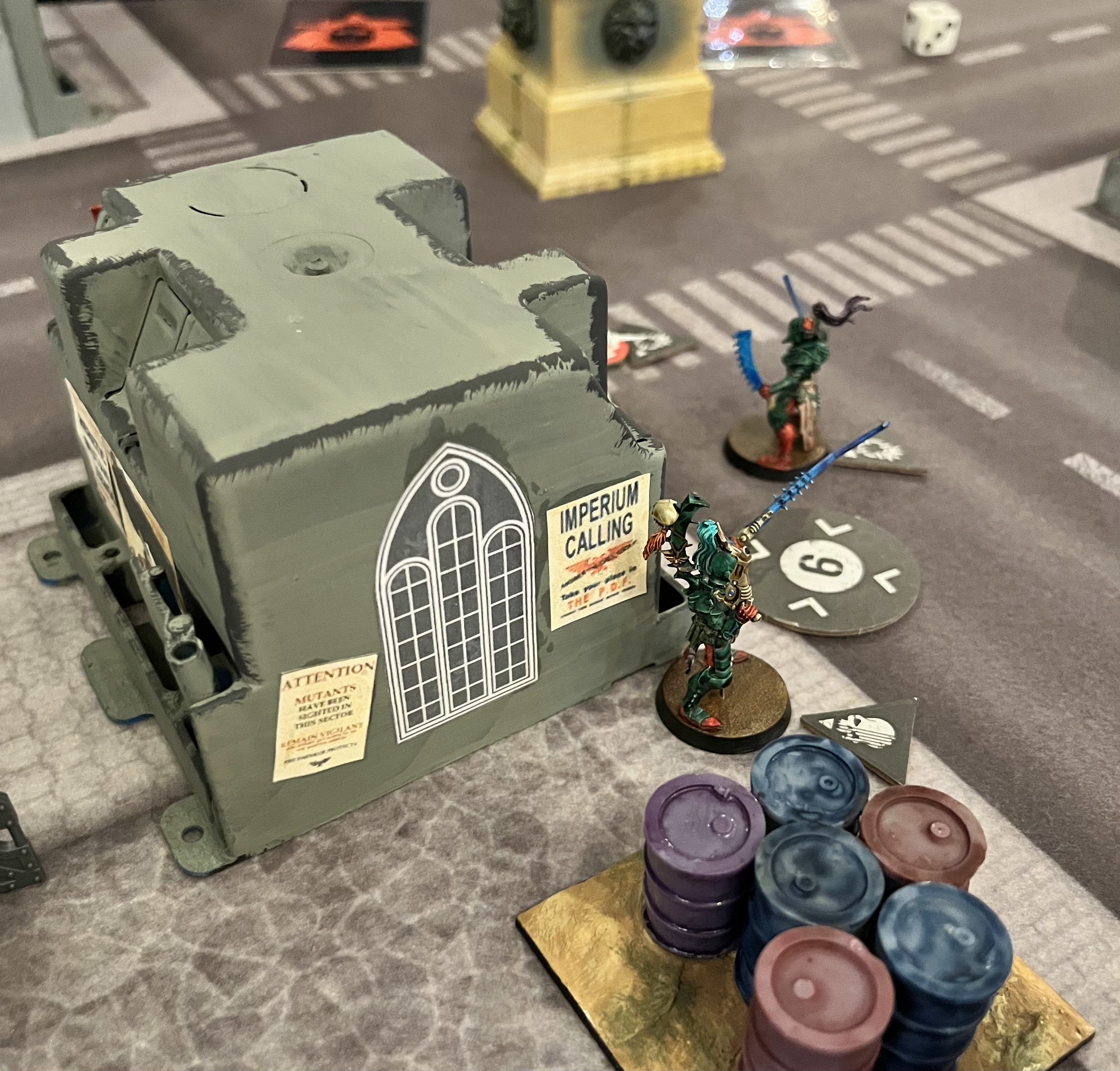
You can see we used my DIY terrain for the table I was on.  I was pretty happy with how it looked and played.  The Cigar Box Battles mat really helped to make it POP.  This was also our first time really taking advantage of the Tac Ops deck.  I had no idea what was on them, and randomly drew 3.  This was a close run game all the way down to the final turning point.  


However, my ability to get 3 Dark Eldar in a concealed position to activate Objectives allowed me to pull out a very close win.  In addition, I was able to take advantage of my random Tac Ops to net some final victory points to put me over the top!  A close run thing, but victory for the Hand of the Archon and the first Chaos victory in the campaign! 


Here is the Order of St. Augustine Martyred on the table with some Legionaries.  This was not an actual game, but I promised you guys some shots of the Order on the table.  Here it is!  Hopefully they will get to hit the table soon and bring victory for the Emperor!  

Thanks for all of your comments and well-wishes as I pursued the 5-Day Challenge to the finish.  Perhaps when my Blooded Chaos Guard arrive I will do something similar with them.  This was fun and I recommend doing something like this to help you finish a project too.   

Until next time!  


Become a Patron and get access to all the cool stuff, a peak behind the curtain of Blood and Spectacles, and early-access to playtest games!  


You can follow Blood and Spectacles Facebook page or Instagram for more fun! 

Check out the latest publications and contact me at our Blood and Spectacles website

Or purchase all out games at the Blood and Spectacles Publishing Wargames Vault Page!