Showing posts with label wargamesatlantic. Show all posts

Monday, September 30, 2024

On The Painting Desk: A Ludus of Gladiators


I have a large collection of Crusader Miniatures gladiators to play The Games: Blood and Spectacles with.  I can easily field just about any combination of gladiator types, and I probably have enough models for 3 different gladiator troupes.  However, when I ordered my Chaos Guard Kill Team from Only Games I also picked up a pack of the Wargames Atlantic 3D printed gladiators.  Did I need more gladiators?  Not at all.  Do I have more gladiators?  Oh yeah! 


About 9 bodies and an assortment of gladiator gear, weapons, and heads came in the mail.  The models needed a bit of work removing flash and connection points.  About the same as removing flash and sprue connections from just about any models.  The bodies came as one piece, with separate arms and heads.  It looked like I could make a wide variety of gladiator types.  I started by gluing the torsos to some washers to act as bases.  

Before I got too far in the project, I decided I needed to get out the rules again to make the appropriate gladiators I would need.  Glancing at the Ludus creation rules the core of the Laniste's troupe was 1 gladiator of each class.  That meant I needed a Heavy, Medium, and Light type as a base.  It would be a no-brainer to go with a Murmillo, Secutor, and Retarius as those were the "core" gladiator types.  However, I had some options to make a few more exotic designs like a Gaulus (Big axe) or Dimachaerus (Two swords).  Oh, time to make some decisions! 

One thing I noticed right away was that the proportions on these guys are much more accurate.  The Crusader models have a bit more exaggeration in order to make their type obvious.  Not so much with these 3D Prints.  That makes some of their helmets look a lot less interesting or intimidating, but much more realistic in scale.  The weapons too are more delicate and less blocky.  Not sure how I feel about it yet, and am a bit concerned with how they will mix in with my existing Troupes?   

Primed, but not fully undercoated yet

 Per the rules, you start with 500 Denarii to spend.  I want the core of my Troupe to be hardened fighters, so I spend the money on 3 Deserters to be my core gladiators.  I decide on a Hoplomachus for my Heavy, a Dimachaerus for my Medium, and a Retarius for my Light.  That takes up about half of my recruiting cash up front, and now it is time to fill in the rest with some back-ups!  I probably want at least 1 back-up per type as well.  I pick-up 3 slaves to train-up as well, and I chose a Murmillo (Heavy), Secutor (Medium) and Retarius (Light).  That is 6 Gladiators for 3 events per Games?  I do not think that is enough.  I decide to purchase a Barbarian Gaulus for the giggles.  That will leave me some money in the bank.  A Troupe of 7 gladiators out of the 10 I have to paint.  The others can be used as Damnati or Noxi opponents as needed.  The rest of my money gets split-up and goes into reserve.       

  1. Deserter- Hoplomachus  
  2. Deserter- Dimachaerus
  3. Deserter- Retarius
  4. Slave- Murmillo
  5. Slave- Secutor
  6. Slave- Retarius
  7. Barbarian - Gaulus
With that sorted, it is on to the painting!  I start by doing my standard Grey Seer spray, then dark grey wash, and then white highlight.  Nothing too special there, but it is a different approach then what I used on my Crusader gladiator models, so we will see how they look together.  

Primed and Ready! 

For these guys, I wanted a wide variety of skin tones, and my speed paints were not going to be up to the challenge.  When painting, I try to go from the lowest point, i.e. skin; and work my way up on a model.  I was going to have to use my Armypainter paints along with my Flesh Wash to get the desired outcomes.  I used Elven Flesh, Barbarian Skin, Tanned Flesh, Fur Brown, and Monster Brown as my base skin tones.  Hopefully, that would give me a wide-variety of skin tones to match the cosmopolitan look of the Roman Empire?  We will have to see how it all turns out in the end!  

Diversity and Inclusion in this Ludus

From that step, I decided to go back to my Speedpaints and Metallic Speedpaints to finish them all off.  I was not 100% sure how that would look with my existing Base+Wash gladiators from Crusader.  Plus, I have not really used the Speedpaints on Historical models.  This would be a big experiment for me.  It would probably help me decide how I was going to paint my Anglo-Saxons next. 

For the most part, I was batch painting this guys.  I started with their foot wear and slowly moved up the models.  I would take a look at what the details were and then gather a couple paint options for that detail.  Then, I would put them in little groups and paint them up.  They took about one evening to get all the block painting done, and then I let them dry.  

Block Painted with Speedpaints

After letting them dry, I gave them all an Armypainter Soft Tone wash.  That would cover any missed gaps, define the models a bit more, and just dirty them up a bit to look more like gladiators.  I find the soft tone works pretty well for fleshy models or natural colors as it is based on a brown, sepia like tone for the wash.  

Painting is done!

That left the final step, basing.  My gladiators I have based differently than my other figures. Instead of the usual Territorial Brown with scattered lichen, I will be using beach sand to base them.  I stuck with the Territorial Brown, lathed it onto the bases.  Then, I dipped it into the sand and tapped off any excess.  This only took a few minutes to get them all based up.  

Based up

Here they are next to some of the other gladiators from Crusader.  

Wargames Atlantic 3D Prints on the left, Crusader metal gladiators on the right

Well, that was a nice little palette cleanser and test before going onto the next project.  The Anglo-Saxon army.  That has about 50 models in it.  However, as a test for using Speedpaints on Historical models, I think these turned out well.  In addition, I was able to successfully combine using regular Armypainter and Speedpaints to get a good result.  Doing this also sped up the time it took me to finish these 10 guys tookabout 3 days of work time, or a weekend for a unit.  A good pace.  

Until next time!  


Become a Patron and get access to all the cool stuff, a peak behind the curtain of Blood and Spectacles, and early-access to playtest games!  


You can follow Blood and Spectacles Facebook page or Instagram for more fun! 

Check out the latest publications and contact me at our Blood and Spectacles website

Or purchase all out games at the Blood and Spectacles Publishing Wargames Vault Page!          
     

Monday, September 23, 2024

On The Painting Desk- Persian Chariots


I have a pretty large Achaemenid Persian army all ready.  I painted it up to play the Ionian Revolt for Men of BronzeIt has heavy and light cavalry forces, skirmishers, archers, Immortals, and Sparabara to make up the ranks.  However, one thing that I always wanted to add was some Persian Chariots.  Chariots had been a staple in Persian armies from the earliest periods all the way to the infamous scythed chariots used in the final battles against Alexander.  It felt odd not having more chariots in my force.  I had been bugging a few manufacturers to make a Persian chariot in plastic for a while now.  


Wargames Atlantic
heard my cries.  However, instead of just making a Persian chariot, they were much smarter than me.  They made a "generic" chariot kit that could be used with all manner of  chariot based armies!  They purposely left crew out of the kit, and gave you the space to put on any crew you wished from Persians, to Minoans, to Gauls, to Egyptians, etc.  Pretty clever really.  As soon as they were up for pre-order, I picked up a set, and I got a box of Persians to crew them. 

Most of my existing Persian force was from Victrix.  However, I had been happy with my Wargames Atlantic Dark Age Irish, so decided to give their Persians a shot too.  I could use extra soldiers to bulk out me large Persian force anyway.  I was contemplating putting on a Battle of Cunaxa from Xenophon's Anabasis.  As that was a civil war, the bulk of the troops would need to look like they came from the Persian army.       

I eagerly broke open the boxes to take a look at what I had gotten myself into.  First, I had been assembling a lot of Victrix and GW models in the last few years.  Therefore, I was a bit surprised when the boxes had no directions.  I gulped, hoping I would be able to figure it all out.  However, upon closer inspection, nothing looked to complicated.  

Chariot Sprues
 
Persian Infantry Sprues

Persian Chariots seemed to be a two-man variety, with two crew and four horses.  I based this take on the Gold Chariot model from the Oxus Treasure vault.  There is some speculation, that the Persians were the first to yoke four horses to a chariot.  Obviously, this set would only have two horses.  In addition, there were no parts for Scythes in this kit.  A few upgrades I think Wargame Atlantic could add to their 3D Printing Tribes options would be parts to make a four-horse and/or scythed chariot.   

I am going to go out on a big limb, and say that Scythed Chariots may not have actually been a thing.  What?  Impossible you say!  Xenophon talks about them, Alexander's biographers talk about them, and so do Romans!  How can you say they may not have been a thing?  Well, all of those sources are from a Western perspective.  There is not really any surviving details from an Eastern perspective.  It is possible, that Scythed Chariot is just a regurgitated trope about "exotic foreign armies" where the truth was something different.  

There is no doubt that Chariots played a role in warfare in the East.  We know that prior to selective breeding of horses to carry riders, they were the fastest way to get around.  In addition, not all areas were suitable for raising horses as strong, big, and skeletally sound enough to carry people.  Therefore, the Chariot as a weapon platform has a long history across the world.  However, Scythed Chariots?  Not so much data about them.  For example, the Oxus Treasure chariot model is NOT a scythed chariot.  In fact, I could not find any Persian references to them at all, but I am not an expert. 

However, whenever Western sources talked about facing off against Eastern and other "exotic foreign" armies the scythed chariot seemed to have been a trope.  The writers loved to talk about the vicious wounds that these weapons could inflict.  They also delighted in talking about how ineffective they were against the stars of western warfare "Heavy Infantry".  Therefore, I am not sure how much of the story of Scythed Chariots is propaganda, intended to entertain, or just a common trope of East meets West narratives.  Classic Historians were as interested in entertaining and story-tellers as much as they were interested in educating.  

Anyway, so that leaves the question how did the Persians actually use a chariot?  There are a few ways they could be used: 

  1. Shock platforms - Here is the "classic" example of the Scythed Chariot used in a charge to disrupt enemy formations through their speed, momentum, and power.  This is the de facto use in wargames for Scythed Chariots.   
  2. Missile Boats - Here is a more traditional Egyptian style of scooting around and firing arrows at the enemy.  In this model, they act more like a disruption and skirmish force, using speed to maneuver, get into firing position, and then get away before the enemy can retaliate.   
  3. Battle Taxi- In this style, the Chariots just move heavily armored soldiers around and drop them off in the thickest fighting.  This is the Homeric style.   
  4. Skirmishers - This is a similar approach as traditional cavalry, where they go out and attack stragglers, small groups, or chase down broken foes.    
Xenophon talks about them as both option 1 and option 4.  However, I find it very likely that Persian chariots probably made use of bow-armed troops.  After all, Persian armies focused on speed and firepower for their success.  Cavalry and lightly armored troops with missile weapons were the norm.  Therefore, I find option 2 to be a very compelling use case for a chariot in Persian armies.  


After putting together the models, I find it hard to believe that chariots could ever be used as a Shock platform, they are delicate little things.  I also have a hard time believing people fired arrows from the back with any accuracy.  You would feel every bump!  They must have raced to an area, stopped and fired, and then got going again.  

It is important to note that we never hear about Chariots being a decisive force in either Persian or Greco-Roman sources.  They are treated as just another form of cavalry.  In fact, Sources seem to indicate that they may not have been deployed in their own units, but were probably spread across the frontage of infantry units to act as Skirmishers themselves.  Again, these seems to lean towards Options 2 and 4 as compelling ways for the Persians to have used them.  It is unlikely they would have been operating in large swarms of Chariots!

Granted, the most common Persian enemy was Steppe peoples.  This was a mix of horse mounted troops and foot infantry but most likely lacking the heavy infantry we see in Western armies.  Against such light foot-based foes, the Scythed Chariot may have been very successful!  Sadly, we know very little about the Persia campaigns away from fighting Westerners.  The Persians themselves left us few records on the topic.    

All of this to decide a simple question, how many men in the chariot and how to equip them?  Looking at the model, I think I can only fit 2 in each car.  Therefore, I will try to have 1 soldier/driver and 1 archer.  This fits my conception of how the Persians would use chariots as another form of mounted skirmisher rather than a shock unit on its own.  I am sure others will feel strongly a different way, and I would love to hear your thoughts in the comments below.  


All crewed up.  I decided to give this guys all armored bodies.  An investment in a chariot must have been pretty steep.  You would probably try to make is survivable with some skilled soldiers in it.  I also kept the horses, cars, and riders all separate for ease of painting.  


With that done, it was time to go onto painting.  The first step was undercoating.  My original Persians I brush under coated with cheap white acrylic paint.  I did not want these guys to look noticeably different, so I figured I better do the same with them. 

This proved to be a big mistake.  I had trouble getting my Armypainter paints to adhere very well to the models.  In the future, before assembling Wargames Atlantic miniatures I think I will want to give them a bath in warm, soapy water to make sure any manufacturing chemicals are cleaned off.  These can make paint adherence and issue.  In addition, you may want to consider using a plastic spray primer instead of brush priming with a white acrylic.  I think the smoother application of a spray would help resolve this issue.  

I also went back to take a look at my Persian Cavalry, and tried to paint my Chariots in a way that will "fit in" with my existing units.  That meant lots of "natural" colors in yellow and brown, with some accents using orange, light blue, and purple.  I wanted my charioteers to be colorful.  


Once I had the basic colors blocked in, it was time for washing and touch-ups.  This is the technique I have traditionally used for my ancients and my other Persians.  These guys would need to fit in.  For wash, I used an Armypainter Soft Tone which is primarily a brown based wash.  


The wash always helps a model look finished!  The last step was to decide how I wanted to base these models.  I was unsure how to approach it.  For my gladiator chariots, I based them on 1 large base.  I dug around, and did not find anything similar I could use on these models.  I also had plenty of 60mm x 60mm bases I could use.  Ultimately, I decided to not base the models together.  Instead, I kept all three parts separate.  The charioteers can be removed from the chariot, the chariot can be disconnected from the horses.  That way I could swap out crew and steeds with other models if I wished.  

The horses and the Charioteers had puddle bases built onto the model.  Therefore, I decided to paint the Chariot crew bases Oak Brown.  That was the same color as the interior of the Chariot car.  The horses, I based using my traditional method of Territorial Beige cheap acrylic painted base with scatter sprinkled onto it.  

Here is the final result....


The last thing was to put them in with my existing Persian Cavalry and see how they looked.....


Overall, I am happy to add these chariots to my forces!  The Men of Bronze core rulebook has a Battle of Cunaxa scenario.  I think it it time to dig that out and see what I need to make that happen on the tabletop! 

It also got me thinking about the Carthaginians in Sicily again.  The first war against the Greeks on the island featured Carthaginian Chariot forces!  

Until next time.


Become a Patron and get access to all the cool stuff, a peak behind the curtain of Blood and Spectacles, and early-access to playtest games!  


You can follow Blood and Spectacles Facebook page or Instagram for more fun! 

Check out the latest publications and contact me at our Blood and Spectacles website

Or purchase all out games at the Blood and Spectacles Publishing Wargames Vault Page!                  


Monday, March 11, 2024

Battle Report: Fury of the Northman - Looting and Pillaging in Hibernia


Greetings faithful readers, and welcome to another Fury of the Northman battle report.  Erik Greybeard and his Victrix Vikings are once again facing off against King Ercc of the Wargames Atlantic Dark Age Irish.  

Mission:
The Vikings will be the attackers as they use the Loot and Pillage scenario against the Irish.  They will be attacking as Dusk Approaches as the complication. 

Forces: 
Since this will be a Loot and Pillage, the Vikings are allowed 10% more points then their Irish foes.  

Erik Greybeard's Vikings:
Nobles
- Shieldwall
- Boar's Head 

Warriors

Warriors
- Shieldwall

Militia
- Shieldwall

Skirmishers


King Ercc:
Warriors
- Heedless Charge
- Throwing Spears

Warband
- Heedless Charge
-Throwing Spears

Skirmishers
- Throwing Spears

Skirmishers
-Throwing Spears

Slingers
-Skirmishers

Slingers
- Skirmisher


Set-up:
Today we are using a 72MU by 48MU board.  1 MU is equal to 1 inch.  

Terrain is set-up per the rules found in the main Fury of the Northman rules and the objectives were set-up using the method outlined in the scenario. 

Square 1-3 is the Viking side, while side 4-6 is the Irish side of the board. 
  • Square 1 = Hill
  • Square 2 = Grove
  • Square 3 = 2- level hill
  • Square 4= Hill
  • Square 5 = Hill
  • Square 6 = Stone walls
Viking deployment

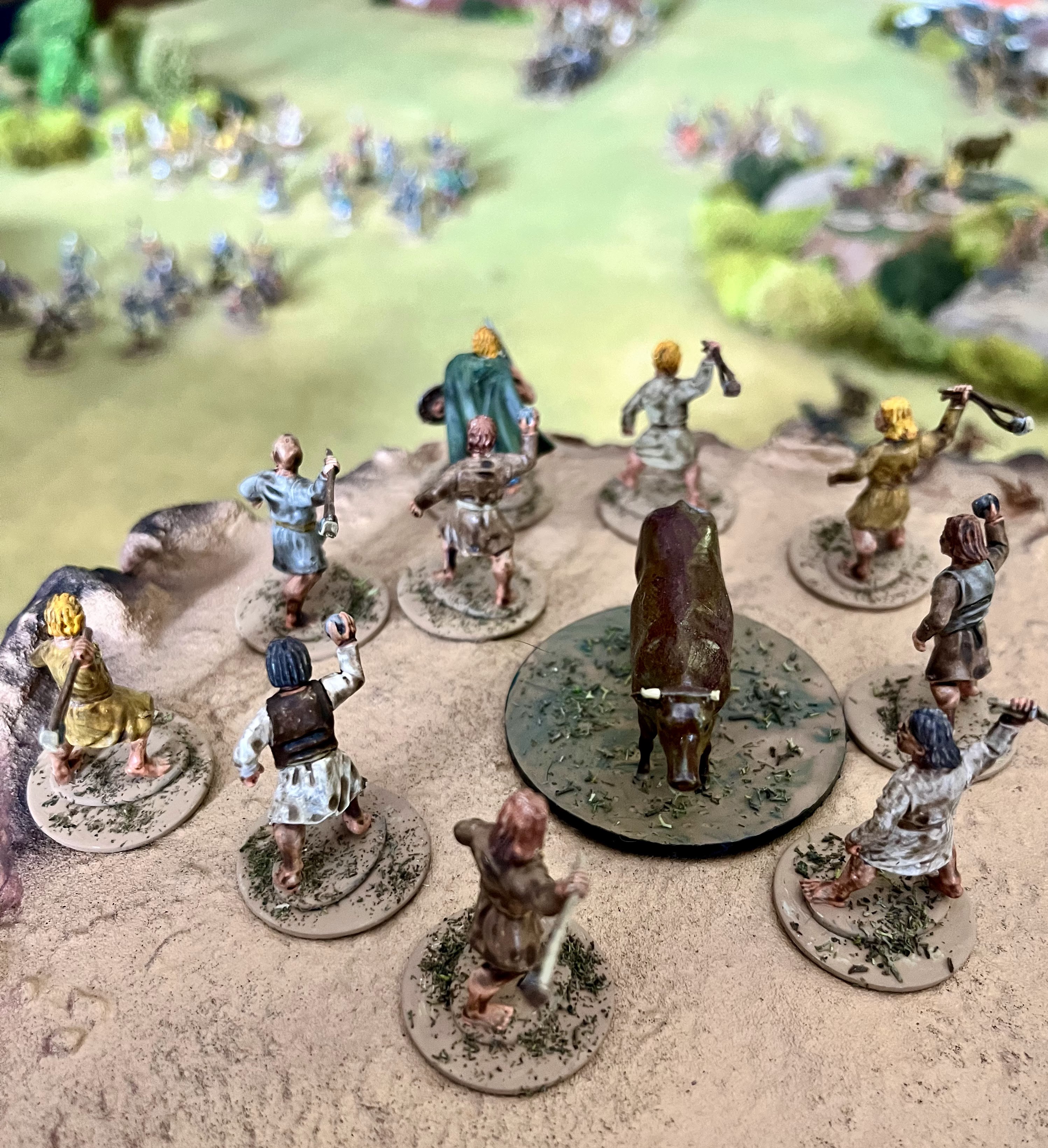
You can see the objectives, spread out in the form of piles of crates/chests or cattle.  They are just outside the Irish deployment zones. 

Irish deployment

I am going to break this report into three broad categories; Maneuver phase, Combat phase, and the End Phase.  I will not be detailing each move and action in detail, but try to cover key moments and decisive points of the battle in each phase.  

Maneuver Phase

Neither side was focused on subtlety or sneaking tricks.  The Irish moved up aggressively to grab their objectives, while Greybeard's Vikings pushed ahead as fast as they could.  


On the Viking side, Erik Greybeard led the attack with his nobles aiming for the center of the Irish lines and the cow on the hill.  It seemed to be only lightly protected by Skirmishers.  Once the Irish had their objectives, they took up defensive positions on hills and within their village.  They seemed content to let the Vikings come to them and were in strong positions, with good fields of fire with their slingers.  


Sensing a trap, the Viking Warriors with Shieldwall formed up.  They saw Irish Slingers lurking about the edges of a forested hill.  This slowed their advance on the Irish farming hamlet. 


Their caution was sensible, as the wily Irish popped out of cover and pelted Erik and his retinue recklessly charging across open ground.  First blood to the Irish as their slingers pelt the oncoming war chief with rocks and reduce them 1 courage.  

As we head into the 4th turn, the field looks like this: 


The Irish right has the Warriors and King Ercc ensconced in the hamlet, protecting two objectives.  The Viking militia and shieldwall oppose them.  The center has the Viking command leading the charge supported by their skirmishers, and their other warrior unit on the flank.  The Irish Slingers have stepped out to launch their attack, but they are exposed.  Behind them, the Skirmishers protect two objectives and the last Slinger unit protects an objective safely up on the top of a two-tiered hill.

Battle Phase
The Irish slingers in the center pepper Greybeard's Nobles with more sling stones.  Fed up, Greybeard and his Nobles charge forward!  However, the Irish fade back from them, leaving them disordered.  The Shieldwall followed their leaders lead, and also ends up tired and disorganized after failing to connect.  Meanwhile, the Irish try to fade away from the Viking assault.


King Ercc sees the spent Vikings ahead of him, and decides now is the time to send the invaders packing.  He charges forward heedlessly with his warriors, throwing their spears as they get stuck in!  The Irish king manages to push the Viking warriors back.  


However, the Vikings ferocity allows them to steal the initiative again, and they continue to push forward.  The Warriors on the Viking right manage to get to their objective, as the Irish skirmishers fade away from their assault.  In the center, Greybeard continues to pursue the Slingers but still can not catch them!  On the left, the Militia march into the Irish village in their shieldwall, daring the Irish to attack.      
Dusk begins to set-in, but the fighting continues to rage.   

The Irish slingers fire up-close and personal on the Viking nobles and continue to sap their courage.  However, the Nobles have gotten too close and crash into the Irish slingers this time.  They easily slaughter the Irish. Meanwhile, the Viking Warriors fight with King Ercc to a stalemate, but the Vikings are on the edge of collapse.  The other Viking warriors get to the loot the Irish were hiding, but fail to find anything of value.   

Irish skirmishers descend form the hills shouting war cries and throwing their spears.  It is too much for Erik Greybeard, and they turn to flee the battle field.  Those damned Irish seem to be everywhere, shooting and throwing spears at them!  


End Phase
The Sun was setting quickly now and it would soon be dark.  

King Ercc managed to drive off the Viking warriors he was fighting with.  However, behind him the Militia managed to loot some cattle.  


Viking skirmishers and warriors make a last ditch attack on the hill in the center, defended by Irish Skirmishers.  However, they are pushed back and the attack repelled, keeping the Irish loot safe.  


With that, the Viking straggle back into the night, their Raid complete. 

Conclusion
The Vikings managed to score and maintain 1 Loot marker for the battle!  They got to a second, but found nothing.  Routed units, the Vikings scored 4 from the Slingers, and the Irish scored 22 from the Viking units!  Wow, losing the Nobles and the Warriors was a big deal!      

Final Scores: 
Irish: 18
Vikings: -14!  

Looks like the Irish manage to win the follow-up encounter.  Their Fabian tactics worked much better in this scenario than the Cattle Raid.  If we reversed the Attacker/Defender I think the Irish would be hard pressed to prevail!   

Erik Greybeard tried to greet his warriors as they slunk back into camp that night.  They were tired, dirty, and hungry.  They grumbled muted responses to him as he hailed them.  They were discontented.  He had managed to feed them when they landed, but the lack of loot and more resistance than they expected left his men grumbling and ready to go home.  Greybeard needed to find a quick win to fill his men's bellies, pockets with gold, and some plunder to take home.  Otherwise, they might just try to settle down here with the Hibernians! 

Hope you enjoyed this battle. 

Bonus Content
I spent a bit of time clearing off some small 6mm pieces on my work desk.  I had a couple of vehicles for my Operation: Hemlock forces for a Horizon Wars-style battle in 6mm.  Plus, I can use a few of these for Aeronautica Imperialis as well.  These are all 3D printed.     

I couldn't precisely recall what colors I used for my initial forces, and therefore my Armored Bassies came-out a bit darker.  However, I recovered in time for the Hydra and Lightnings.  


The bases are just painted, nothing fancy.  I actually kept the Bassies and Hydra removable from the base so they could be lone targets or AA platforms in Aeronautica Imperialis.  I feel pretty good about the Imperial forces, but before the big battle I will need to pivot and make some Ork forces too.    

Until next time!


Become a Patron and get access to all the cool stuff, a peak behind the curtain of Blood and Spectacles, and early-access to playtest games!  


You can follow Blood and Spectacles Facebook page or Instagram for more fun! 

Check out the latest publications and contact me at our Blood and Spectacles website

Or purchase all out games at the Blood and Spectacles Publishing Wargames Vault Page!