
Full Disclosure: I do not own this game. However, I did get to play it on my journeys with a group of fellow players. We played it enough times for me to get an understanding of the game, its world, and what it is trying to do. Therefore, I feel like I can talk about the game with some confidence even though I have not played it all the way through and I do not own it.
This is a 1-4 plays cooperative board game. It has two parts to each game, the first part is a story-driven section where you make decisions and follow branching story lines based on those decisions and results of the checks and tests. Here you collect clues, items, and allies that will come into play during phase 2 of the game. Phase 2 of the game has your group switch into a tactile wargame on a hex grid against the big bad of the mission. The things you collected in the early phase of the game can help you in this battle. The various missions are linked together in an on running storyline and series of adventures that make up a campaign.
There are a lot of elements here that will be familiar to readers of this blog. There is the decision-making and branching story lines of RPGs. There is the grid-based tactical combat of some tabletop wargames. The technical term I have heard for this game is a story-based boss battler. I tend to think of these types of "hybrid" games that use miniatures as a "Dudes on a Board" game.
So, now that you know what this game is let's dive into the Deep Woods. Grab you compass, collect your iron, and hold onto the wirebridge! Here we go!

First off, this game has really top tier production values. The story lines, the miniatures, the artwork, etc. It is all very well-made and well-presented. The storylines fit together nicely, the branching works well, and the world that this game inhabits feels real and lived in. Great work on making a fantasy, horror style Hybrid game. This game is very replayable and as a co-op game works well. The voice acting in the app is also top tier and sets the tone well. This is a AAA board game product and it shows how much bigger of a market board games are compared to Indie wargames and RPGs.
The game is cooperative. I.e. players are working together to beat the game. This set-up works well int he story-driven segment as well as the tactical segment. There is a wide variety of heroes to choose from and I like that they each have a difficulty rating so you know what you are getting into as you choose your avatar. Most of what you need to play is right on the play board and then you supplement it with action and equipment cards.
They use a blind box approach to the baddies. Therefore, there is an element of surprise as you play the game and encounter the enemies. Each box has a number that corresponds to the mission, so you do not know what you are going to fight until it is revealed. It felt a bit like when you would get a cut-scene in a video game with a fun reveal moment.
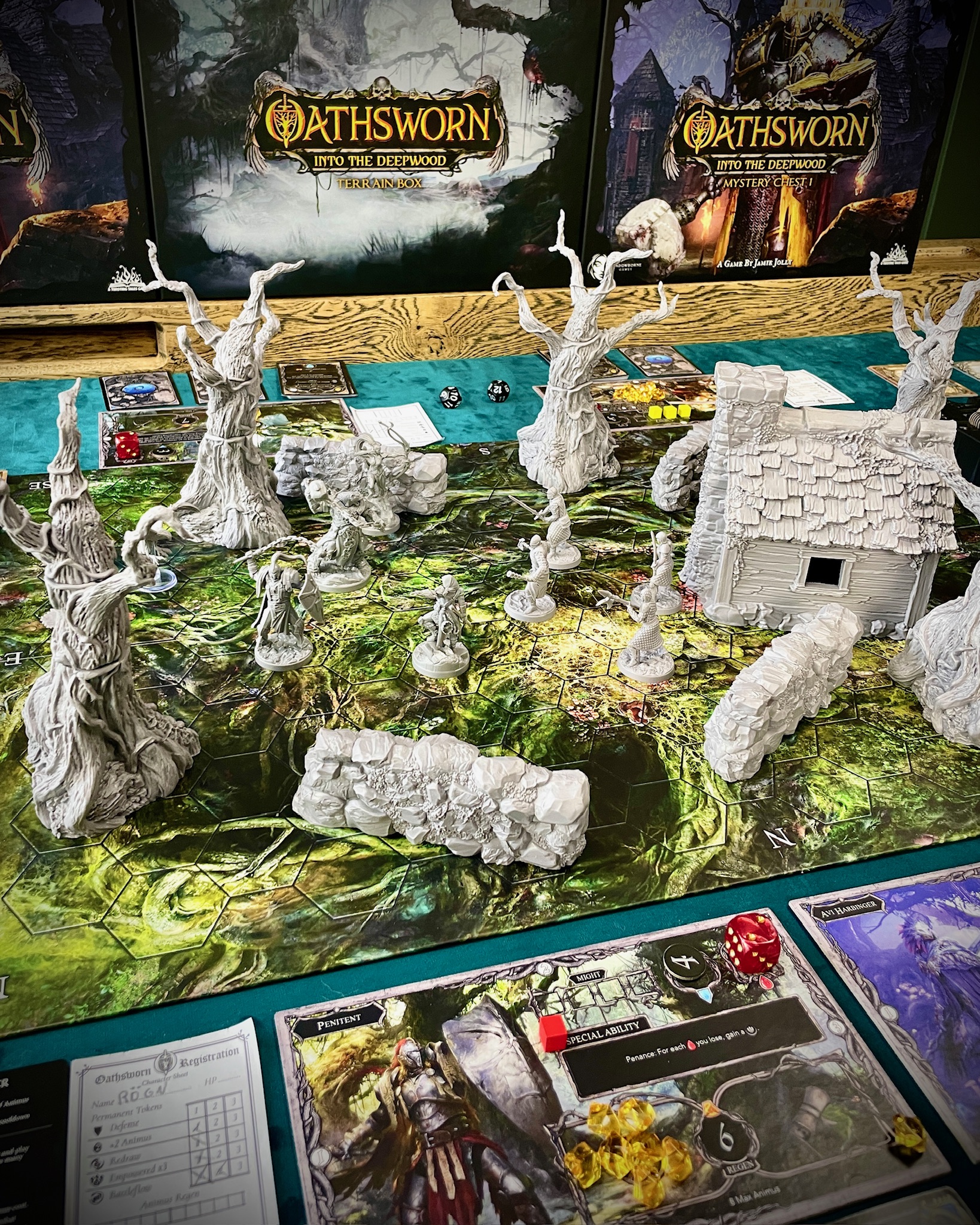
The minis for the PCs are 54mm and big with good detail and options to swap weapons and such as you gain power. They are all pretty nice sculpts. I think my host had splurged on the top tier content though.
They manage to capture the feel of a horror game. I.e. you do not really improve as you play. Instead you are avoiding degradation more than anything else. That also makes it interesting in that you have to make "less bad" choices as you play.

Things I Did Not Like
Like all modern board games, this thing is way more complicated than it really needed to be. There is a lot of different actions and cards that essentially boil down to hitting it with a stick. The main tactics are focused on system mastery, managing your "battle flow", and knowing how the enemy AI works. In that sense, it really almost feels more like a computer game except I am pressing all the buttons for the game to keep working. I spent just as much time operating the game as playing it and making decisions.
The most complicated decisions were trying to decide which RNG I wanted to use, cards or dice. The cards allowed you to manipulate the deck while the dice allowed you to bypass some of the worse outcomes. More important than choosing the right "card" to play from you hand was deciding which combination of RNGs you wanted to use and when. It essentially boiled down to a game of probability manipulation and card-counting. Again, this whole process made it feel super gamey to me.
You would get an idea of what the enemy was going to do next, so you could then build your turn strategy cooperatively to minimize the impact of the creature's actions. It was played off as our experience as Oathsworn fighting monsters, but ultimately it felt like another gamey element. It the monster abilities were not revealed until they happened, then it would be much more horrific and less gamey.
Finally, we all had a deck of cards that could be used to attack or defend. As you used them, they dropped into a refresh pattern called a battle flow. More powerful defense and attack took longer to refresh. In theory, manipulating this battle flow was a big part of the tactics of the game, along with managing your pool of action points. The tactics of the game felt more about manipulating these elements on your character card more than what was happening on the game board, such as terrain, model placement, tactical maneuver, etc. Yeah, I was able to use LOS blocking, some kiting, etc. but ultimately it was the artificial tactics of the "battleflow" and action points that mattered more than position and maneuver.
:strip_icc()/pic9248329.jpg)
Meh and Other Uncertainties
The game had a nice city map that you moved around in Phase 1 and triggered story points. There was also some time elements, as the faster you gathered clues and figured out the patterns the more cool gear you got for Phase 2. There was also a nice double sided hex map for outside or indoor encounters. However, all used the same. Terrain mattered at the beginning, but most of the monsters just wrecked it instantly if they moved over it and by the end the board was mostly empty then.
Each mission took about 2 hours to play. 1 hour for the story and 1 hour for the boss battle. However, the game seemed to have some replayability in the story segment if you decided to follow different threads or paths. The boss battler part would be modified but what you gathered along the way. For example, in mission two we failed a check during the story section, which allowed the boss to ambush us in the final battle and attack us first. If we had gone a different route, we may have avoided that peril.
The world building in the story-section is pretty solid. I liked the idea of the Deep Woood, the wire bridges connecting the towns, the desperation to survive in a dangerous environment, and the idea of the Oathsworn. There was a lot of world-building woven into the Fighting Fantasy section of the game, and some foreshadowing for those paying close attention.
Final Thoughts
These types of Hybrid games are not for me personally, but I won't turn down a game of them either. I find that with the right players, any game can be really fun. I was a Polar Warbear in this one, and that led to some fun banter and jokes around the table. I mean, I got to drop a Golden Compass joke! Plus, any cooperative game always leads to a good time.
However, I find these "hybrid" games lean to far towards "Game" rather than Simulation or Narrative on the Designer's Triangle. I feel like the focus of these types of games becomes system mastery more than actual tactical maneuver. It feels more like mastering the combos in an arcade beat'em up or CRPG. The story is good, but lacks the true choice of an RPG and the combat lacks the actual tactical depth of a true wargame. Instead, the focus is on mastering the mechanics and probabilities of the game itself and that is what leads to success.
I can see the appeal of a game like this to a lot of players, especially those who lean towards system mastery. That seems to be a trait in board game players in general. Me, I do not care too much about system mastery and instead lean towards spectacle. Oathsworn has great models, but the lack of painting to manage the surprise and the "samey" battle conditions do not keep me engaged on that level even if the models are very good.
I am glad I got to play it and will play it again, but I am in no rush to go buy it. I would get Shadows of Brimstone before Oathsworn.Until next time!

Or purchase all out games at the Blood and Spectacles Publishing Wargames Vault Page!
No comments:
Post a Comment